Review: Death Match (1994)

Go ahead, if you and your friends want to look like Swiss cheese”
image

SOURCE

My opinion regarding kickboxer/actor/activist Ian Jacklin is a little more complicated than with most karate stars, but in a nutshell, I thought the guy was pretty cool until I realized that he spends his life promoting quackery to cancer patients. Nevertheless, I enjoy his acting career and see it as a microcosm of a successful B-movie trajectory, with Death Match being the climax. Created outside of the major video studios, it has an unambitious story but a good production with a huge amount of martial talent. It’s required watching for fans of the subgenre and easily the best of Jacklin’s film career.

The story: An ex-fighter (Jacklin) goes undercover in a deadly fighting circuit to rescue his kidnapped best friend (Nicholas Hill).

I need to emphasize the state of the production, even though it may seem odd to praise a film for looking average. Keep in mind how easy it is for indie movies to turn out like crud. By all rights, Death Match should’ve been interchangeable with a typical Cine Excel production (underpopulated vistas, dubbed dialogue, etc.) but it’s actually indistinguishable from most Pepin-Merhi or Shapiro-Glickenhaus actioneers. As a matter of fact, it would be pretty aspirant for a PM or SG production, given the impressive list of names in the cast. To be fair, we sometimes only get a little taste of them – cult stars Richard Lynch and Jorge Rivero have only one scene apiece as Mafia bosses – but the list of talent goes on. Martin Kove and Matthias Hues are good as the lead villains, with Kove supplying the drama and Hues most of the fighting. Steven Leigh, Eric Lee, and Benny Urquidez don’t have any fights but do well in their dramatic scenes. Michele Krasnoo, Butch Togisala, Randall Ideishi, Ed Neal and Peter Cunningham partake in some of the highlighted brawls, and many more show up elsewhere. If these names aren’t clicking, you haven’t been watching movies like this long enough. The sheer accumulation of performers with reputations in the genre is amazing, especially since your average PM production sometimes wouldn’t even spring for half.

Of course, presence isn’t as important as utilization. The real question is how good the 16 fight scenes are, and the answer is that they’re a mixed bag. On the bright side, there are no downright bad matches and the choreography is nicely varied – some street-fighting, some shoot boxing, and even a lone stick fight. There are some some surprisingly long shots highlighting lengthy exchanges, and a few performers have standout moments of action. (I really enjoyed the Matthias Hues-Dino Homsey bout.) However, for the most part, nobody performs the best work of their career. Michele Krasnoo is made the least of, being introduced as a fighter but then only engaging in half a match. I have the impression that the choreographers were simply stretched too thin by crafting this many fights on a limited schedule. If so, then I wish the number of brawls had been cut in half and the remaining ones given more flair.

Socially, the movie has good points and bad points. Where the latter is concerned, the fact that two women are cast in fighting roles is undermined by the female lead (Renee Allman) abandoning the sparks of characterization to play a formulaic love interest. Additionally, a sexual harasser (played by Bob Wyatt) is inexplicably made a
supporting character. However, I like that the movie seems to be championing an anti-capitalist message, using organized crime and fighting as metaphors. The villains trap fighters in a system that depends on their toil while devaluing their lives, and the same villains consider theft against them to be the single greatest crime. Threatening their income by refusing to fight by their rules is likewise punishable. The protagonist sets himself apart from this system by having abandoned organized fighting and claiming to compete solely “for the competition” – not exactly a fair outlook in light of all the pro fighters in real life who earn their income via competition, but it’s nevertheless a repudiation of the metaphorical wage slavery in the feature. Death Match isn’t The Godfather when it comes to allegory, but it’s effective in delivering its message.

There’s a moment in the film when Jacklin’s character is weirded out by Martin Kove’s belief in the supernatural powers of crystals. Retrospectively, it’s funny to see Jacklin in the role of the skeptic (even though crystal power seems to be one of the few areas of nonsense that Ian hasn’t stated a belief in), but I have to admit that he does well enough as the lead. He doesn’t have quite the charisma of, say, Don Wilson, but that’s not to say he wouldn’t have made a good star in the long run. Indeed, I wish he would’ve been handed another top role before the end of the martial arts genre’s video golden age. Nevertheless, his undisputed high point here is worth hunting down if you’re a collector. Death Match encapsulates many of the essentials seen in movies like this and adds just enough of an inspired touch earn a recommendation from me. Check it out wherever you can.
image

SOURCE

Death Match (1994)
Directed by Joe Coppoletta (The New Adventures of Robin Hood)
Written by Curtis Gleaves (story & screenplay), Bob Wyatt, Steve Tymon (Ring of Fire II: Blood and Steel)
Starring Ian Jacklin (Kickboxer 3), Martin Kove (The Karate Kid), Matthias Hues (Bounty Tracker), Renee Allman (The Stoned Age)
Cool costars: Martial arts regulars Steven Vincent Leigh (Sword of Honor) and Eric Lee (Ring of Fire) appear in acting roles but don’t fight. Similarly, kickboxing hall of famer Benny Urquidez (Wheels on Meals) is limited to a training montage but offers his Jet Center studio as a filming location. Sexy pro wrestler Stevie “Puppet” Lee appears as the arena gong beater. Richard Lynch (Puppet Master III) and Jorge Rivero (Centennial) have one scene apiece as non-fighting Mafiosos. Onscreen fighters include Nicholas Hill (Bloodsport II), Michele Krasnoo (Kickboxer 4), Ed Neal (Breathing Fire), Butch Togisala (Firepower), Dino Homsey (Deadly Bet), Randall Shiro Ideishi (Black Scorpion), Debra “Madusa” Miceli (Shootfighter II), Jamie Krasnoo (Full Contact), and Nick Koga (Red Sun Rising). A performer called Hector Pena appears in a stick fight, but I’m not sure whether he’s the actual Hector “Aztec Warrior” Peña, world champion fighter. Also, kickboxing legend Peter Cunningham is inexplicably credited as “Peter ‘Sugarfoot’ London” – leading to a snafu on IMDb where the film credit goes to porn actor Peter London.
Cool crew: Composer Marco Beltrani – who’d go on to earn two Oscar nominations for his work on The Hurt Locker (2008) and 3:10 to Yuma (2007) – makes his feature composition debut with this one. He is directly heard on the soundtrack playing guitar and keyboards.
Content warning: Group violence, violence against women, violence against children, sexual harassment, sexual assault, ableist dialogue, graphic description of an execution
Title refers to: Either the main attraction of the underground fight ring or the fights-to-the-death taking place at the end of the film. A “death match” also refers to a hardcore pro wrestling contest – a fact which may be relevant in light of stunt coordinator Brandon Pender’s history as a World Championship Wrestling producer.
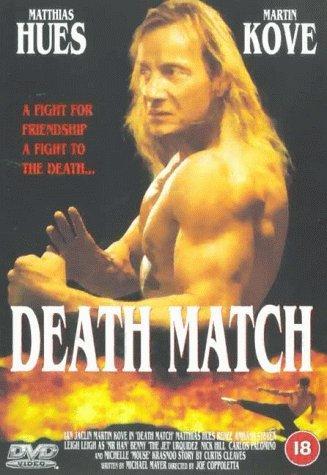
Cover accuracy: Different covers exist, but the most widely-distributed one is dominated by an image of Matthias Hues. Hues is one of the two lead villains, but relegating leading man Ian Jacklin to a teeny-tiny graphic is misleading. Heck, Jacklin can’t even get top billing, with Hues and Martin Kove claiming the large print.
Number of full-length fight scenes: 16
Crazy credit: “No music by Giancomo Puccini was used in connection with this picture” – even though Richard Lynch’s character specifically mentions the composer’s works.
Copyright Horseplay Productions, Inc.

Review: Drifter TKD (2008)

“Taekwondo is not a corporation! It’s an art!”

SOURCE

*SPOILERS AHEAD*

Does anyone else remember Ron Pohnel? He had that awesome ring match against Jean-Claude Van Damme in No Retreat, No Surrender (1986) – the one right before the finale. After that, he practically ceased to exist until IMDb informed us last decade that he was finally working on another movie. And not just any movie, but a full-blown vehicle for himself! I didn’t care that it was going to be a very low-budget effort – I just wanted to see the guy again. However, after waiting almost ten years for a release and then only accessing the film through Pohnel’s Youtube channel, my expectations steadied a little. Little did I know that even then I was in for disappointment. Drifter TKD is a micro action flick burdened by a terrible screenplay and the filmmakers’ failure to take advantage of what resources they have. It’s a poor directorial debut for Pohnel and really just a passion project gone awry.

The story: After giving up his taekwondo school to a greedy corporation, Master Harrison Luke (Pohnel) takes on the life of a destitute drifter. Settling in a homeless community, the master takes a stand for the disenfranchised against a golf club owner trying to intimidate them.

Tempting as it is, I’m not going to compare this to the other movie Pohnel did. However, even judging it on its own merits yields little praise. To be fair, there’s no sense bemoaning its lack of budget and shot-on-video presentation: given his limitations, director/producer/cameraman Ron does well enough. And while the fight scenes are definitely in trouble for being too short most of the time and questionably shot/edited, they reveal that Pohnel is still packing some moves. Nevertheless, the movie does everything else wrong. With the exception of ex-Power Ranger Blake Foster as Harrison’s student, none of the supporting martial stars engage in any of the action – not Mel Novak as the evil CEO, nor Ron Hall as his henchman, nor Leo Fong as Harris’ fellow master. The lighting is off in several scenes and the dialogue isn’t always audible over the soundtrack. The dialogue is weak, frequently sounding contrived and unnatural (“To be a CEO, your heart has to be cold and hard”) and with characters repeat their backstories multiple times. Some prominent characters are just outright unlikable, with David Fultz as Harrison’s bumpkin sidekick generating some particular vitriol in my notes.

Worst of all, the story ends up going absolutely nowhere. After almost 90 minutes of testing my patience with poor pacing, the movie resolves none of the problems it’s set up. Harrison remains a drifter, his loyal student returns to his heartless father, the corporation maintains a monopoly on local taekwondo schools, the homeless people remain homeless, and even though the leader of the local gang gets beaten up, both they and the evil club owner are left with no curb on their homeless-harassing and human-trafficking shenanigans. The film kind of addresses this with a last-second philosophy about going with the flow and making the best of a bad situation, but it just feels like a badly-planned story. The characters end up in almost exactly the same place they started, making me feel like I’ve wasted my time.

While I’m criticizing, I might as well also point out the film’s social failings as well, beginning with almost every non-white actor with a speaking role being cast as a villain. Also, at least two female characters are martial artists (Sohara Key and Charl Pohnel) but are also depicted as no match for their male aggressors, making their previous training scenes amount to nothing. One of them gets seriously creeped on by David Fultz’s character with no consequence. Seriously, he’s more harshly reprimanded for incorrectly throwing a kick during martial arts practice, which suggests that even in a movie where sex trafficking is a thing, disappointing your male teacher is a bigger faux pas than threatening women.

As eager as I am to promote indie cinema, it’s hard to recommend this one. It doesn’t take itself very seriously, but the grinding pace and lack of engaging content makes it a chore to sit through. Check it out if you really want to see what’s become of Ron Pohnel, but otherwise just skip to the end of No Retreat, No Surrender again.

THE COPYRIGHT HOLDER HAS MADE THIS TITLE AVAILABLE FOR FREE.  YOU CAN FIND IT HERE.

SOURCE

Drifter TKD (2008)
Directed by Ron Pohnel
Written by Ron Pohnel, Charl Pohnel
Starring Ron Pohnel, Blake Foster, Solara Key (Thunderkick), Ron Encarnacion (Parts of the Same Circle)
Cool costars: Martial arts stars Mel Novak (Game of Death), Ron Hall (Bloodsport II), and Leo Fong (Low Blow) are here but don’t fight. Jacob Stiver, Charl Pohnel, and Omar Lizarranga do fight. Longtime TV actor Richard Pines plays the greedy golf club owner.
Content warning: Kidnapping, human trafficking, sexual harassment, homophobic dialogue
Title refers to: “Drifter” refers to the protagonist’s occupation. “TKD” – short for taekwondo – refers to the martial art featured most prominently in the film.
Cover accuracy: A close-up of Ron Pohnel with a wide shot of him (or possibly Blake Foster) walking in the background is appropriate. The billing refers to Charl Pohnel by her full name, Charlene Oka-Pohnel, in contrast to how it appears in the onscreen credits.
Number of full-length fight scenes: 5
Copyright Webgeeks Productions

Review: Circle of Pain (2010)

Oh my god! What did I do?”

Source

For the longest time I actively avoided MMA-themed action movies, especially the direct-to-video features that began coming out in the 2000s. Overall, I wasn’t wrong to do so, and Circle of Pain is an example why. While rising above the sheer unpleasantness of Never Surrender (2009) – the crown jewel of terrible cage fighting movies – this particular flick is heavily flawed from surface to core and ticks off a lot of personal peeves. Poor writing and bad fight scenes ahead.

The story: An ex-fighter (Tony Schiena) is strong-armed into a high stakes match with a cold-hearted champion (Heath Herring) by a greedy promoter (Bai Ling).

I watched the movie twice in one day, the second time with the commentary track, and this definitely made me appreciate it more. The film was shot in 12 days and the studio meddled with the script, so I’m more forgiving of its more obvious limitations – the small scale and rushed feel. Director Daniel Zirilli shows that he can do a lot with a little, so I’m interested to see what he’d do with more resources and less interference.

…Kinda. Even with regard to its disadvantages, the production doesn’t carry a lot of promise. Foremost, it doesn’t do much with its cast. Aside from the fact that it oversells three of the four stars on its cover (Kimbo Slice, Frank Mir, and Roger Huerta have a combined total of six scenes), the only performer coming out of it relatively well is Heath Herring, who knows how to play an asshole villain. Tony Schiena has some moves and charisma, but he comes across as a blockhead and isn’t particularly likable. Bai Ling will get her own paragraph in a moment. TV’s Louis Herthum is sort of a poor man’s Geoffrey Lewis as the lead’s tough old trainer. And then there’s Dean Cain, playing Schiena’s wheelchair-riding sidekick and no doubt handling the role even better than a genuine disabled actor could… Yeah, right! (It’s not a great role, though: he spends the film living vicariously through the protagonist, and the writers never realize that this isn’t a particularly positive trait.)

The film’s most exploitative feature isn’t violence but sex and nudity. There’s the expected breast shots, and they’re followed up by two or three scenes that are straight up softcore porn. This is strikingly at odds with the rest of the movie’s tone, and for good reason. Zirilli candidly admits that these parts were demanded by producers and that he doesn’t like them, saying that he’d probably prefer the TV version of the film. My biggest gripe on the matter is how it affects Bai Ling, who plays the only substantive female role in the picture. Ling’s part was rewritten from a male role, and the imposed changes seem to mainly be sexing her up ridiculously. (I just can’t see her male counterpart screwing Heath Herring in the gym.) The character’s overt sexuality symbolizes her power, but it’s also meant to demean her, especially when she’s rebuffed. It’s a messy, ungainly dynamic that’s only here because a woman is playing the role. For an infinitely less sexual take on a woman playing a villainous promoter, check out the English language Hong Kong flick Extreme Challenge (2001).

The fight scenes could be better. For some reason, MMA-themed action always looks better in theatrical features than on video, and the same is true here. The fights are kept down-to-earth and realistic out of necessity, but even though they improve throughout the picture, they’re just not very fun. Tony Schiena is a legitimate karate champion, and when he shows off some powerful-looking forms, I couldn’t help but wish he were in a Bloodsport sequel instead of this muddy schlock. The pro fighters do well enough, but having seen Roger Huerta fight in Tekken (2010), I was disappointed that he didn’t get a proper brawl. (He’s Herring’s trainer.)

Again, you can do worse than Circle of Pain in the MMA video genre, but why even go there? It’s bearable if you go in with low expectations and enjoy seat-of-the-pants filmmaking, but c’mon – that’s not what you’re here for. You’re here to watch your favorite pro fighters headline a killer action movie, and that’s just not what happens. Leave it be.

Source

Circle of Pain (2010)

Directed by Daniel Zirilli (Crossing Point)

Written by Bobby Mort (Scorched Earth), Daniel Zirilli (story), Sean Patrick O’Reilly (story)

Starring Tony Schiena (Locked Down), Bai Ling (Game of Assassins), Dean Cain (Lois & Clark: The New Adventures of Superman), Heath Herring (Chavez: Cage of Glory)

Cool costars: Louis Herthum (Westworld) as the trainer. The list of supporting fighters include Kimbo Slice (Blood and Bone), Frank Mir (Hell’s Chain), Roger Huerta (Tekken), Yves Edwards (Beatdown), Miguel Torres, Conner Brantley, and Carlo Prater.

Content warning: Sexual harassment, sexist & ableist dialogue, violence against the disabled

Title refers to: Literally, the caged ring which the fighters compete it…even though it’s not actually circular. Figuratively, it may refer to the destructive cycle of doubt and guilt that the protagonist deals with after paralyzing his best friend.

Cover accuracy: Slice, Mir, Huerta, and Herring certainly do appear in the movie, but their billing and promotion come at the expense of the actual leads. Also putting Slice ahead of Herring – both in billing and in placement – is a hard faux pas. The Tapout logo is better-placed, though, as it’s featured very prominently throughout.

Copyright Grindstone Entertainment Group / Lionsgate Home Entertainment