MATTHIAS HUES Kickboxer 2: The Road Back (1991), Mission of Justice (1992), Fists of Iron (1995)
Huge German Viking-looking person from Germany whose soft little accent is enough to put a guy into the ground by itself. Occasionally crazy and liable to have his head turned by mild psychosis or dysfunctional programming (he’s an android, by the way), he’ll nevertheless see you through to the near-end of your nefarious scheme and will probably go down spectacularly just in time for your evil plans to blow up in your evil face. A tried & true choice.
Grade: 8.5/10
JAMES LEW Red Sun Rising (1995), Balance of Power (1996), Outside the Law (2002)
Okay, if you’re going to spring for the grandmaster in the first place, drop the extra dime and make him your top henchman. Better yet, make him your partner! Anything less is like putting gold leaf on a Whopper. Make no mistake, he’s gonna fucking die, but he’s going to make the person who kills him look like so much more than a skinny dork pretending to fight. Give him a cape or a trench coat and he’ll throw in some lite supernatural feats. You’re really getting all the bang for your buck, here.
Grade: 9.5/10
RON YUAN Ring of Fire (1993), Deadly Target (1994), White Tiger (1996)
No. Just stop it, you bastards. Stop being such fucking jerks. You know that choosing him’s going to spell humiliation for the poor guy. Like, whoever you put him up against is going to grab him by the wrists and make him start slapping himself. Stop it. I know you’re thinking of matching him against Gary Daniels again, and you guys are just mean. Listen: Ron Yuan puts his all into his henchman work and it’s not right that you laugh at him. He deserves some fucking respect.
Grade: A for effort, Ronny my baby
RON SMOORENBURG Ninja: Shadow of a Tear (2013), Tekken: Kazuya’s Revenge (2014), Never Back Down: No Surrender (2016)
What’s the deal, Ron S.? Twenty years later and you’re still getting gigs based on how you beat up Jackie Chan that one time? Listen, dude: if you’re not going to even approach being that cool ever again, just let us know. People keep hiring you, and serviceable as you are, you know damn well we haven’t paid for plain serviceable. We’ve paid for Phantom of the Opera tickets and you’re putting on a damn puppet show. Not happy. You better shape up, mister, or I’m leaving you a bad review on Yelp.
Grade: Pending stern review
TORU TANAKA (aka CHARLES KALANI, JR.) The Running Man (1987), Martial Law (1990), The Perfect Weapon (1991)
O-Oh! Oh my-! He’s…um…he’s rather big, isn’t he? Like, wide as car bumper. Chest you could fall asleep on… Arms that could calm a bear… I-I think if I asked, he’d pick me up and set me down someplace high. If he’s my bodyguard, he could physically shield me from morning to night, as close as possible. Just never let me out of his grasp… Good god, is it getting hot in here or what? Someone bring me some water before I pass out…!
This
review is based on the unrated version of the film.
SPOILERS
AHEAD
The
Man with the Iron Fists had its
moments, but I don’t think it did nearly enough with its resources.
I wasn’t a fan, so my hopes weren’t high when its lower-budgeted
sequel was released.
As
a matter of fact, I didn’t bother checking it out at all. However,
having finally
seen it now, I realize it
wasn’t necessary for me to avoid
it. The Man with
the Iron Fists 2 is bereft
of most features
that defined its predecessor – a supergroup cast, the
wuxia influence, and a
general over-the-top style
– but this is actually what
makes it for me. More sober-minded and focused
on its characters,
this is a surprisingly worthwhile
adventure and
definitely the best action feature I’ve yet seen from director Roel
Reine.
The
story: En route to Wu Chi Temple to cleanse his soul, the blacksmith
Thaddeus (RZA) is embroiled in a
treacherous conflict
between a small mining village and the oppressive Beetle Clan.
The
most obvious way the film deviates from the original is the lack of
major names. With the
exception of the lead star, no one here’s been anywhere near top
billing for a major release in years. Nevertheless,
this one’s cast isn’t without cult charm, and they’re
all clearly acting their
butts off. Dustin Nguyen is the real star as the de facto leader of
the village, and Carl
Ng makes a surprisingly strong impression as the despicable villain.
Cary Tagawa is solid as the
wheelchair-driving mayor, while Eugenia Na does good work as an
archer and Nguyen’s onscreen wife. Action hero-in-the-making
Charlie Ruedpokanon enjoys the best role of his young career as
Nguyen’s brother, while action regulars Kazu Tang and Ocean Hou are
memorable enforcers.
Grace Huang and Andrew Lin reprise their roles as the Gemini Twins
for a flashback scene. RZA easily
slips back into his character
but reduces
his impact by not having much
to do with the first half of the movie.
While this
cast ultimately appeals
less to people used to
theatrical fare, I
love how the lack of name
emphasis requires the actors to focus on their characters all the
more. No award-winning
performances, but there are
some good exchanges that
elevate the otherwise humdrum plot.
Aesthetically,
I declare the film a complete triumph. Director/DP
Reine and production designer Lek
Chaiyan (Anna and the King)
create
an absolutely beautiful flick composed of exotic
on-location shots and
intricate costumes. At the
risk of comparing the film to its predecessor too often,
this one eschews the
original’s lavish style
and focuses on a more
realistic and detailed look, smoothly incorporates the local
countryside
for a sense of scope.
This organic style carries
over to the action content, which is considerably scaled back from
the predecessor’s wirework bonanza. The fighting is almost entirely
grounded and less reliant on special effects, and
this works well for the performers and the Thai stunt crew. Of
course, the results aren’t
perfect: over-editing works its way into more and more of the brawls,
and the mass battle scenes are one thing that the original film did
better. I was excited when Cary Tagawa unexpectedly became
a combatant in the 11th
hour, but he’s stunt doubled to within an inch of his life.
Nevertheless, we get some
good matches in the Charlie Ruedpokanon/Ocean Hou and Dustin
Nguyen/Carl Ng encounters, so
the adrenaline department
gets an overall passing grade.
I’m
disappointed that the animal motifs are downplayed this time: RZA
mentions in the DVD’s special features that he sought to explore
insect themes, and while we get the Beetle Clan, everything else is
downplayed to the point that appears
incidental. (E.g. the miners as ants.) The overabundance
of gore ensures that executive producer Eli Roth got to eat for
another day, but the over-the-top violence isn’t very creative.
Again, die-hards of the
original won’t be happy about
these things, but
I find the faults forgivable.
With fewer resources at its
disposal, the sequel finds a harmonious balance much easier than its
richer
predecessor. It’s still a take-it-or-leave-it feature for casual
viewers, but it’s hard to
deny the effort and skill
that went into this. The Man with the Iron Fists 2
is utterly watchable on its
own merits, and if you’re like me and enjoy seeing small
productions succeed against all expectations, you’ll definitely
have fun. Rent it.
The
Man with the Iron Fists 2
(2015) Directed
by
Roel Reine (Hard
Target 2) Written
by
RZA, John Jarrell (Romeo
Must Die) Starring
RZA, Dustin Nguyen (Once
Upon a Time in Vietnam),
Carl
Ng (Point
of Entry),
Cary-Hiroyuki Tagawa Cool
costars:
Grace Huang, Andrew Lin, Charlie Ruedpokanon (Ninja:
Shadow of a Tear),
Ocean Hou (The
Blood Bond),
Kazu Patrick Tang (Dragonwolf),
Eugenia Yuan (Jasmine).
Seigi Ozeki, who seems to have dropped from the leading man spectrum
following Muay
Thai Warriors, plays a vengeful member of the Lion Clan. Sahajak
Boonthanakit (Zero
Tolerance)
is one of Thailand’s rising dramatic stars and plays one of the
featured minors. Simon Yin (Birth
of the Dragon)
is likewise memorable. Content
warning:
Extreme
violence, group violence, lynching, childbirth, racist
dialogue Copyright Universal
Pictures Home Entertainment
Fighter, teacher,
superstar – these are some of the labels befitting the memory of
Grandmaster Frank Trejo. Beginning his journey in the fighting arts
by learning boxing at age 8, Frank was introduced to eastern styles
via shotokan karate but found his niche in American kenpo under
founder Ed Parker. Not content to only master theory, the young black
belt initiated a competitive career in the early 70s, winning over
400 championships on the karate circuit and entering the fledgling
kickboxing scene to secure a state title. Additionally, Trejo was the
coach and captain of the Budweiser National Karate Team – America’s
first martial arts troop to receive corporate sponsorship – and
toured internationally for two years. Eventually becoming an
instructor, Frank combined his diverse experience into the “kenpo
fusion” style he taught as part of his international seminars and
work with disabled students. As if all this wasn’t enough, Trejo
also enjoyed a film career for which he acted in and choreographed
action features – mainly vehicles for fellow martial artist Mimi
Lesseos.
Tragically, health
problems plagued the grandmaster late in life, with diabetes and
complications from treatment necessitating several amputations. On
April 11, Frank Trejo died – leaving behind a major contribution to
the martial arts and an endearing legacy. He will be greatly
missed.
Styles &
Accomplishments Kenpo (10th
Dan, 19-time IKC Champion, Budweiser National Karate Team captain;
Kenpo Karate Hall of Fame entrant) Kickboxing
(California State Champion, record: 21-1) Shotokan Karate Judo
Films to See
Pushed to the Limit (1992) –
co-starring role / fight choreographer Beyond Fear (1993) –
co-starring role Personal Vendetta (1995) –
co-starring role / fight choreographer
Trivia:
As
of this writing, Trejo is the only competitor in IKC history to win
international titles in both
forms
and fighting on the same day.
It’s a shame that
the phenomenon of supergroup casting has grown old long before all of
its possibilities have been exhausted. The sad reality of filmmakers
regularly not making the most of all the names they can get under one
title is evident in Mark Dacascos’ freshman effort as a director,
which further depresses me by not making a strong case for
yesterday’s action heroes becoming filmmakers. Possibly the
greatest coming together of stars since the original Expendables films, Showdown in Manila nevertheless
feels like a forgettable
action-thriller featuring a bunch of nobodies.
The
story: Private investigators Nick Peyton (Alexander Nevsky) and
Charlie Benz (Casper Van Dien) track an assassination to an
international terrorist group. Eventually, they call in some comrades
to help capture its deadly leader (Cary-Hiroyuki Tagawa).
How
good the
movie is depends largely on
how well its big-name stars are utilized. Here’s my take on ‘em:
Alexander
Nevsky – This
huge bodybuilder seems to be more of a star in Russia than North
America,
and thus I question having
him lead
a movie filled
with more recognizable action guys.
Judged on his merits, he’s not terrible
–
he makes more of his physical
size
than Dolph Lundgren and does well enough in
action scenes –
but
he’s in
desperate
need of charisma. For all his good looks, Nevsky remains a virtual
stranger to me even after the credits
rolled.
I
wouldn’t mind seeing him improve, but I don’t predict many U.S.
producers will line
up to put him in another starring role.
Casper
Van Dien –
As probably the cheapest ex-
A-lister on the market right now, it doesn’t
surprise me
that
ol’ Casper’s present,
but it
sure irritates
me.
He’s
playing yet another womanizing jerk, albeit with more chagrin and
humility
than expected.
It
breaks my heart to admit it,
but
he’s
actually one of the best things about th4
film. He’s not the only cast member with genuine charisma and
acting ability, but he is
the one with the most scenes. For
better or worse, he keeps the film from sinking until the other big
names show up.
Cary-Hiroyuki
Tagawa – One
of the genre’s quintessential villain actors is well-placed
as the
bad guy, but he’s the first cast
member whose
presence is over-hyped. The number of scenes he’s in can be counted
on one hand, and while you can count on his considerable screen
presence whenever he’s on camera, he barely gets in on any of the
action. Also, for what could’ve
been a monumental B-movie, his character’s pretty weak and
comes to kind of a disappointing end.
Tia
Carrere – As
Carrere hasn’t
had much to do as an action hero since Relic
Hunter,
I
wasn’t expecting much of her and thus was delighted when she
briefly partakes in a quick fight scene! Honestly, though, there’s
no reason to get excited. Despite
being an important character, she
largely drops out of the film after the early scenes and is wasted as
a draw.
Mark
Dacascos –
Already
taking on the role of
director, it may have been wiser
for Mark to remain behind the camera entirely
and
not tease us with an early appearance. He has a single scene, and
while he manages to fit a brawl
in there, I
can’t help but miss him throughout the remaining runtime. His
character is the linchpin of the story but I would’ve preferred a
lesser-known actor in the role, as I wouldn’t have spent the rest
of the movie thinking about how much better it would
be if he were
still in it.
Matthias
Hues –
Hues
plays pretty much the same blonde enforcer he
always
has
but with a lot less screen time. Ironically, he has more lines in his
handful of scenes than he’s had in entire
vehicles.
He’s also in
the
only
dream match-up this film offers,
as he engages Casper Van Dien in a short and one-sided fistfight.
Afterwards,
Nevsky
takes him out with one punch.
Don
Wilson, Cythnia Rothrock, and Olivier Gruner –
I list these three as a unit because they arrive and leave the film
at the same time and share the same scenes. They comprise the group
that Nevsky calls in to storm Tagawa’s base (along with Dmitriy
Dyuzhev, an
acclaimed Russian actor who’s nevertheless unknown in the west) and
bring with them the majority of the action content. It’s what I’ve
come for, but the characters
feel tacked-on, as
though
they’re
indulging
a last-minute favor from Dacascos to appear in his movie. While
their segments remain the best in the picture, they
aren’t in
top form:
Gruner’s acting is somehow worse than usual, and weapons
specialist
Cynthia Rothrock inexplicably
looks like a complete amateur when handling a pair of batons.
With the utilization of this ultimate gathering of B-movie dragons
falling way short of hopes, do any other parts of the movie stack up?
Well, I’ve seen worse first-time directors than Dacascos, who
proves he can at least craft a professional-looking feature. The
problem is that his run-of-the-mill style works against a picture
whose adrenaline spikes never reach higher than “meh.” I would’ve
been more entertained by a big disasterpiece with an unpredictable
storyline and actors imploding under crazy direction. As is, Showdown
in Manila and its paint-by-the-numbers plot have nothing wrong
with them other than the disappointment they generate. I’d rather
have seen director Dacascos drop all his plates in spectacular
fashion than realize that, even with all he had going for him, the
best he could do was something I’ll have forgotten about in a week.
With literally nothing going for it other than the opportunity of
seeing some of its stars in the same action scene, I can’t
recommend this film with any kind of enthusiasm. As always, fans of
the stars might want to pick it up to complete their libraries, but
everyone else can treat it mildly.
Showdown in
Manila
(2016) Directed
by
Mark Dacascos Written
by
Craig Hamann (Boogie
Boy),
Alexander Nevsky (story), Mark Dacascos (story) Starring
Alexander Nevsky (Moscow
Heat),
Casper Van Dien (Starship
Troopers),
Cary-Hiroyuki Tagawa (Mortal
Kombat),
Tia Carrere Cool
costars:
Mark Dacascos, Matthias Hues (No
Retreat, No Surrender 2: Raging Thunder),
Don Wilson (Bloodfist
series), Cynthia Rothrock (China
O’Brien series),
Olivier Gruner (Angel
Town),
Dmitriy Dyuzhev (The
Island).
World champion martial artist Emanuel Bettencourt (Kebab
Connection)
plays one of the lead villain’s bodyguards, as does Filipino action
star and Olympic taekwondoka Monsour Del Rosario (Bloodfist
II).
There’s
also a surprising amount of critically-acclaimed
Filipino stars in various supporting roles, including Iza Calzado
(Bliss),
Mon Confiado (Heneral
Luna),
and Jake Macapagal (Metro
Manila). Content
warning:
Human trafficking, violence towards women Copyright
Hollywood Storm / ITN Distribution
Industry insiders
know Michael and Martin McNamara as the guys who sued Miramax for
copyright infringement over the release of Jackie Chan’s Twin
Dragons. Followers of the
Canadian
martial art scene know them for their ongoing struggle to legalize
kickboxing competition in
Ontario. Before now,
I knew them as the assassins who fight Billy Blanks in Back
in Action, and as of recently, I
also recognize
them as the stars of the first Canadian martial arts film here.
Thanks to that title, Twin Dragon Encounter
will always have something to brag about, but truly, the
movie’s nothing to go on
about. I love indie action flicks, but this poorly-planned,
micro-budgeted
adventure just isn’t worth the effort it takes to track down a VHS
copy.
The
story: Martial arts instructors Michael and Martin (McNamara) take
their girlfriends on a rural getaway, only to be accosted by a
violent group of mercenaries.
The
movie is a pretty hardcore vanity project, with the brothers being
presented as practically
heirs to Chuck Norris’ title of badassery. I’ve seen worse
self-aggrandizement, but it’s rare to see so much mustachioed
machismo stuffed into a 79-minute runtime, my favorite moment of
which being
when the McNamaras put off swimming with their girlfriends to saw
logs while shirtless.
It doesn’t help that everyone else falls over themselves to make
them
look good. The villains compose the biggest collection of boobs I’ve
ever seen, with not a single one able to stand against the brothers’
mighty kicks. Girlfriend Nancy McKenna (Death in Hollywood)
acquires some fighting skills after being
rescued early on, but it’s ultimately meaningless ‘cause the bros
repeatedly save her anyway.
The
movie’s also just poorly written. It ends on a cliffhanger, teasing
its Dragon Hunt sequel,
but does so after wasting a lot of time on throwaway scenes like the
lovers
getting chased into a tree house by a bear. The
plot is needlessly prolonged, to the point that our heroes can avoid
almost all of their
peril by practicing some common sense. Worst of all, the action
scenes leave
a lot to be desired. The film’s got more than its share of onscreen
karate, but I can’t
remember a single time I remarked
how cool a brawl is. The McNamaras – who also produced the movie –
have a bad habit of highlighting regular moves with slow motion, with
the effect that they actually become worse because you can now see
the
imperfections in the choreography.
I
will give the film credit for some unexpectedly decent visuals, no
doubt thanks to director Paul Dunlop’s background in
cinematography. Of course, this isn’t nearly enough to save the
show. Neither cool
enough as a regular action picture
nor exotic enough as a foreign curiosity, I can’t recommend Twin
Dragon Encounter.
Twin Dragon
Encounter
(1986) Directed
by
Paul Dunlop (cinematographer for Blind
Eye) Written
by
Gary Hart, Michael McNamara Starring
Michael & Martin McNamara, B. Bob, Nancy McKenna Cool
costars:
Kickboxing champ Karl Adhihetty appears as an enforcer. Content
warning:
Violence against women, sexist dialogue, kidnapping, sexual assault Copyright
Manesco Films / Vidmark Entertainment
When Boyka:
Undisputed4 was released last
year, I decided not to see it
at once. Part of this decision is
attributable
to the hipster in me and the fact that it
would be a popular movie, but also because I just
wasn’t thrilled that it’d been made. I maintain that Undisputed
III: Redemption ended the Yuri
Boyka story as well as it could, giving the character an open-ended
conclusion and
raising
the bar for martial arts action in
the process. I thought that
further installments could
only be weak cash-ins,
ignoring
the standard that Scott Adkins and Isaac Florentine had set. And you
know what? I was right.
On its own, B:U4
is an okay adventure with above-average action, but as the successor
to one of the most defining martial arts features of our era, it’s
a major disappointment.
The
story: After unintentionally killing an
opponent in
the ring,
Yuri Boyka (Adkins) travels back to Russia to offer his condolences
to the fighter’s wife (Teodora Duhovnikova). Upon finding her under
the thumb of a local kingpin (Alon Aboutboul), he demands to fight in
an underground tournament in exchange for her freedom.
To
be fair, the movie is better than I expected in at least one
department.
Upon finding out that it
wouldn’t actually be directed by Florentine but Todor Chapkonov –
maker
of really horrible TV features – I expected a big
step down in style and technical quality, but I’m happy to say that
this isn’t the case. Chapkonov mimics Florentine’s spaghetti
western style to the point that I wouldn’t have guessed it was
anyone else behind the camera. Thematically,
however, the movie is trouble,
beginning with the premise of having Boyka out of prison. It’s
initially as odd as seeing Dr.
Lecter outside of the asylum in Hannibal,
but the movie
makes nothing of this.
There’s nothing to allude to Boyka’s incarceration, no
fish-out-of-water moments, and
no
acknowledgment that he’s irrevocably set apart from society.
Returning writers David White and Boaz Davidson had an
opportunity to expand the
character in unique ways, but instead
treat
the
movie
as they would any other story about a lone wolf tough-guy. What’s
the point?
Such
uninspired writing is the film’s biggest weakness. It really is but
another bland action yarn that just happens to be
part of
a revered franchise. Boyka does nothing
I didn’t expect of him
(beyond
uncharacteristically giving a darn about someone he’s killed),
and Alon Aboutboul’s villain is almost entirely predictable and
bland. Teodroa Duhovnikova’s
grieving widow is a sexy lamp. Without
spoiling, the movie has Boyka’s story not come
full circle so
much as regressing – essentially keeping him in a place where it’ll
be convenient to add on future installments.
The
film’s strongest aspect is its action content, which – as always
– is
primarily
hand-to-hand fighting. The fact that B:U4
might fail to
live
up to its predecessor isn’t that important, as I’m happy with the
general standard that Adkins & Co. have created.
I enjoyed the juicy role given to genre staple Brahim
Achabbakhe and
appreciate seeing him make an impression both dramatically and
physically. Emilien De Falco is
great as Boyka’s doomed opponent. Andreas Nguyen and fight
choreographer Tim Man steal the show with their two-on-one match.
Disappointingly, these
and almost all other
fighters come across as interchangeable, rarely fighting with
distinguishable styles and even looking very
similar.
Martyn Ford has
a decent couple of matches and is easily the most intimidating Big
Bad of the series, and yet he’s also the most boring for the
complete lack of substance given to his two-scene character. Again,
I like the action content as a whole, but it pales to Adkins’ past
effort in both style and substance.
The
strengths of the fight scenes make it impossible for me to not
recommend the movie at all, but know that they’re the
only thing
it has going for it. I
say the Undisputed
franchise should’ve ended
gracefully
eight years ago, but I also think this unwanted addition had
the potential to
be a lot better. Thus, unless you’re a Scott Adkins completionist
or a major fan of Yuri Boyka, treat this as a rental.
Starring
Scott Adkins, Teodora
Duhovnikova (Corpse
Collector),
Alon Aboutboul (The
Dark Knight Rises),
Brahim
Achabbakhe (Dragonwolf)
Cool
costars:
Martyn
Ford (Accident
Man),
Emlien De Falco (Dragonquest),
Andreas Nguyen (Luc
Van Tien),
Tim
Man (Ninja: Shadow
of a Tear),
Trayan Milenov-Troy (Undisputed
2: Last Man Standing),
and
Velizar
Peev (Derailed)
all
play combatants. Bashar Rahal (Direct
Contact)
also appears but doesn’t get in on the action.
Content
warning:
Violence towards women, sexual assault
Copyright
Millennium Films / Universal Pictures Home Entertainment
Wesley Snipes
vehicles have become a rarity, but I hadn’t realized that we’ve
reached the point where even movies advertised as such aren’t
actually so. This is the case with Armed Response,
which is more of an
ensemble effort that
doesn’t even feature Wesley as its top guy. The movie’s
advertising is all about subverting expectations like
that, as
it presents the picture as an action flick despite
being a horror movie.
Its
poor reception
makes me think that I wasn’t the only one unpleasantly surprised by
this, and while I had some
fun with it,
I need to add my general disapproval to the cacophony. Though better
produced than expected and bearing
a decent premise, it’s ultimately toothless and doesn’t take its
ideas nearly far enough.
The
story: A team of military operatives is sent to investigate radio
silence at a high-tech, AI-supported interrogation facility called
the Temple. When the Temple inexplicably traps them inside, they’re
subjected to mind-bending phenomena and mortal danger by a mysterious
entity.
The
studios involved in the production include Saban Films, WWE Films and
Erebus Pictures – Gene Simmons’ new company. I expected something
over-the-top and bombastic from this alliance, and in a way, I got
it. The story is determined to break the rules we expect for such a
horror film, with the result that a lot of its details come as a
surprise. (Even if the plot itself is predictable.) Director John
Stockwell somehow manages to keep me from falling asleep despite
filling his movie with endless scenes of characters stalking down
corridors. I was never bored while watching this…but I did get
irritated. At some point, for its own convenience, the film just
stops trying to make sense. The facility is pretty miraculous to
begin with but stretches things to head-shaking levels by physically
conjuring a ghostly figure to knock off the cast. Eventually it just
grows hands out of the walls to rip a character’s limbs off. The
movie’s selling itself as a combination of The Cube and any
number of rogue A.I. stories but then pulls Nightmare on Elm
Street-style tricks without precedent.
The
cast is okay, even though they’re not made the most of. Again,
Wesley Snipes shouldn’t have top billing – at least not ahead of
Dave Annable, who plays the real protagonist. Snipes’ presence
isn’t even essential: with only a single fight scene to justify his
casting, anybody could’ve played his role. WWE wrestler Colby Lopez
(AKA Seth Rollins) is used to greater effect, but neither of his two
fights are against Snipes. Anne Heche spends most of the movie being
a plain supporting character before suddenly ascending to main player
status. Gene Simmons is practically unrecognizable in his cameo and
doesn’t leave any impression.
My
biggest complaint is the lack of thought behind the movie’s premise
and themes. There’s no real discussion or acknowledgment of the
dark reputation that interrogation facilities have earned since the
Bush years, which is disappointing given where the plot goes. While
the story’s “twist” is that the sentient Temple is choosing to
punish the operatives for war crimes, its morality is disappointingly
mainstream. It kills the most direct perpetrators but inexplicably
gives a pass to the Heche character – choosing to ignore (1) her
complicity in the atrocities and (2) her willing participation in an
immoral war. Additionally, there’s at least one character on the
team who’s legitimately innocent (Morgan Roberts), but the Temple
does nothing to protect him from murder. I can’t help but imagine
what the movie would be like if its sense of right and wrong was more
nuanced…
Armed Response
will make for a tolerable evening
when it finds its way onto the SyFy channel, but there’s no need to
spend money on it unless you’re an absolute Wesley Snipes
completionist.
Starring
Dave Annable (Brothers
& Sisters),
Wesley Snipes (Blade
trilogy), Anne Heche (Six
Days Seven Nights),
Colby Lopez [AKA Seth Rollins]
Cool
costars:
Most of the supporting cast
has credits
in major action flicks, but I haven’t seen enough of those to know
whether the actors are sufficiently cool; they definitely aren’t in
here. Gene Simmons would be included if he weren’t such an asshole.
Content
warning:
Extreme violence,
military brutality, violence
against women, child murder, drowning
Acts of Vengeance
is a ham-fisted but satisfying revenge thriller about a lawyer
(Antonio Banderas) searching for his family’s killer. With
this, director Isaac
Florentine continues to revert to his old style
of producing simple vehicles for any action hero he can get his hands
on. The simplicity
might just
be a matter of the movie
failing to
live
up to its artistic
aspirations, but the result is an enjoyable little brawler with a
touch
of class.
One
of the story’s
selling points is Banderas taking
a vow of silence for the
duration of his quest, but
this is undercut by (1) not happening until after the first 30
minutes and (2) him continuing to narrate the story throughout.
Nevertheless, our star
is well-utilized here, conveying intensity and performing amazingly
well in the fight scenes, particularly in
his showdown with Karl Urban.
Tim Man is quickly becoming
one of the best fight
choreographers in history, showing that he can make anybody look
their absolute best.
Socially,
the movie is very critical of cops. I don’t think this was the
makers’ intent, but the police are roundly portrayed as either
incompetent, apathetic, or murderously vindictive – justifying the
hero’s vigilante status. There’s also an attempt to paint
Banderas’ character as an immoral, get-anyone-off-at-any-cost
sort of attorney, but because this is only stated but not seen, the
balance the filmmakers sought just isn’t there. Personally, I don’t
mind.
Acts of Vengeance
is a worthy purchase
purchase for fans of early Florentine, before Scott Adkins became
his golden boy, and
also a strong initiation for Antonio Banderas into the martial arts
genre
Starring
Antonio Banderas (El
Mariachi
series),
Paz Vega (Sex
and Lucia),
Karl Urban (Star
Trek
trilogy),
Johnathan Schaech (Legends
of Tomorrow)
Cool
costars:
Raicho Vasilev (Spartacus
series) plays a Russian
combatant,
while director Isaac Florentine and choreographer Tim Man play
martial art instructors.
Content
warning:
Police brutality, violence towards women, implied child murder,
implied
child sexual abuse
For reasons I can’t
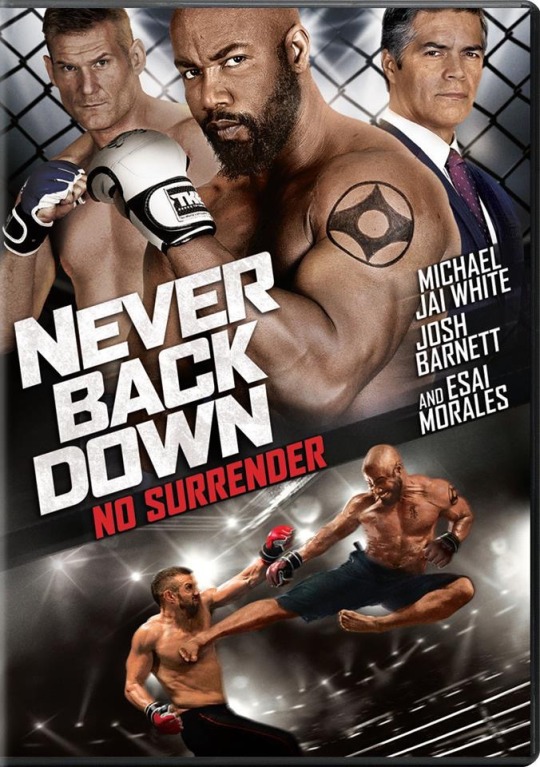
explain, I hadn’t thought to look into the Never Back Down
series before now
and thereby completely
overlooked
that Michael Jai White had
expanded from martial arts star to
filmmaker. This
movie
actually gives me some hope for the future, as it’s virtually the
only one I’ve seen
show an interest in actually
carrying on the legacy of
martial arts videos’ glory days. Don’t give me another boring
Dolph Lundgren production if White’s making films. Of course, Never
Back Down: No Surrender’s
not perfect – it’s
actually one of the few
movies of this sort where the problematic screenplay bothers me more
than any technical shortcomings. As
is, this one works best as a blueprint to improve on, but in
the meantime, it’s a very
watchable blueprint.
The story: Legendary
fighter Case Walker (Michael Jai White) travels to Thailand to train
his comrade Brody James (Josh Barnett) for a high-stakes title match,
but soon realizes that the promoter (Esai Morales) has shady
intentions.
NBD3
has so many real-life
influences that it’s practically
meta. There are numerous
connections
between Josh Barnett’s character and the actor’s
real-life competitive career,
many of them unflattering. Additionally,
the movie tackles the
ever-relevant issue of steroids in sports with
surprising zeal. Ironically,
this approach makes the
film’s frequent idealistic stances feel haphazard and naive, as
it presents
simplistic solutions to complex problems. Also, I didn’t like that
the story is full of unresolved issues: aside from the loose
thread of Casey taking on a couple of young proteges, it’s
uncomfortable that
the feature
allows
things like Brody’s blatant infidelity and the racism of some
supporting characters to
fade into the background. I also
didn’t like how a side-story regarding sexism towards a character
played by Jeeja Yanin is “resolved” via sexism. Despite
all of this, the screenplay isn’t
weak: Case
Walker is likable enough,
and the story eschews
typical life-and-death setups in
favor of a political approach
that feels more suitable to
modern sports promotion. Not
every idea it has
pans out, but I can
appreciate a film for showing
me that it at least had thought behind
it.
How
much you enjoy the action content depends
on your tolerance of
unnecessary slow motion. Fight
choreographer Larnel Stovall delivers good stuff, but the fact that
only a couple of the eight fights
aren’t mucked about with
this editing technique
is disappointing.
Nevertheless, Michael Jai White remains one of the best performers in
modern martial arts films,
and this is apparent throughout the feature. Though he achieves
Hector Echavarria levels of self-glorification by including a scene
that puts him over a genuine MMA star
like Josh Barnett, he looks fantastic in whatever he does and
whoever he fights. He’s got
a great cast of supporting
kickers,
including Nathan Jones as the rival champion and genre
staples Brahim Achabbakhe,
Eoin
O’Brien, and Ron Smoorenburg as
various brawlers.
More impressive on paper but less so onscreen are the Thai stars: the
aforementioned Jeeja Yanin has a
single
fight and is barely a character, while Tony Jaa only shows up to make
a fool of himself in a comedy cameo. Seriously,
if
the poor quality and
infrequency of
Jaa’s most recent output
hasn’t
caused you to lose esteem for him, his buffoonish
scenes
here will do the trick.
Despite these disappointments, NBD3
is an enjoyable watch. Again, I’m pleased that MJW
chose
to be
a filmmaker: it’s good
knowing that the legacy of U.S. martial arts videos has a competent
torchbearer, and it’s important that the subgenre contains
perspectives other than those of white men.
The main problem remains
the movie’s screenplay, but
I’m hopeful that White will improve in that regard in
time. Even so, this one is
worth a look.
Written
by
Chris Hauty (Never
Back Down 1
& 2), Michael Jai White
Starring
Michael Jai White, Josh Barnett (Absolution),
Gillian White (Bamboozled),
Esai Morales (NYPD
Blue)
Cool
costars:
Stephen Quadros (Sworn
to Justice),
Nathan Jones (Tom
Yum Goong),
Jeeja Yanin (Raging
Phoenix),
Brahim Achabbakhe (Dragonwolf),
Ron Smoorenburg (Who
Am I),
Damian Mavis (Kung
Fu Yoga),
Amarin Cholvibul (Hard
Target 2),
Eoin O’Brien (Kill
‘Em All),
and Creighton Mark Johnson (Risk
for Honor)
all appear in martial roles. Pro fighter Quinton Jackson cameos in a
little scene. Tony Jaa also cameos, but…I just can’t.
Content
warning:
Sexist
and racist dialogue, racially-motivated violence,
police brutality. There’s
also a scene where a transsexual prostitute is “humorously” outed
against her will.
Game
Over is a well-made independent
flick in that none of its flaws are the result of its budget. I’ll
always recognize
director Peter Sullivan for
having helmed more Christmas movies than anyone else, but it’s fairer
to distinguish him as someone who brings class and competence to any
genre of film, including martial arts action. While
far from the best adrenaline production
of its time,
this is
a solid
example of what can be accomplished at a
lower economic level and
the go-to vehicle for star Andre “Chyna” McCoy.
The
story: An out-of-work and persecuted parolee (McCoy) enters a
mysterious fighting circuit in hopes that the $100,000 prize will be
enough to rebuild his life.
Chyna
McCoy’s been near the top of the top of a cast list before, but
this is his first starring role. I
see room for improvement where his acting and charisma is concerned,
but his look and martial moves are
memorable. At
any rate, his costars and the screenplay help
keep the film
interesting enough to forgive any related
slip-ups. I’ve seen this
template of movie
done better, but the perspective of McCoy’s character gives it an
urgent freshness that I wasn’t expecting. Paul Green plays a
properly deplorable parole
officer who keeps the pressure on the protagonist, and
while this ongoing angle of racism and police corruption definitely
makes for some uncomfortable scenes, the story would’ve been
generic without it.
The
action content’s almost entirely made up of fight scenes, and while
their quality fluctuates, I give ‘em an overall passing mark. The
film was made with the involvement of the Zero Gravity Stunt Team –
the same group that gave us Lateef Crowder – and scenes featuring
them and other high-flying tricksters tend to be the best. Edwin
Villa plays a tailor who attacks our hero with pins and uses his tie
as a whip. McCoy is a
capoeira practitioner and capable of some
flashy stuff, but he
mostly keeps things simple
with down-to-earth
brawling and the occasional
submission technique. His showdown with Blade II’s
(2002) Daz Crawford is built up throughout the film and ends
up being a major
disappointment…but the movie saves itself with a completely
unexpected second finale with co-lead La Trice Harper.
Other
shortcomings include some questionable editing, a couple weird
dream/flashback sequences, the use
of women as trophies, and
a twist ending that could alienate as many viewers as it surprises.
While these aspects
definitely strain
the film for
likability, I think it weathers them nonetheless. Between its
worthy action content and steady direction, this is
a good watch for anyone
seeking a no-frills karate thriller. I hope that Chyna McCoy gets at
least one more
starring vehicle – one with a bigger budget.
THE
COPYRIGHT HOLDER HAS MADE THIS TITLE AVAILABLE FOR FREE. YOU CAN FIND
IT HERE.
Game
Over (2005)
Directed
by
Peter Sullivan (The
Sandman)
Written
by
Max Miller (screenplay), Kasim Saul (story)
Starring
Andre “Chyna” McCoy (T.K.O.),
La Trice Harper (Matthew
26:17),
Daz Crawford, Paul Green
(Blackout)
Cool
costars:
Edwin Villa (Shira:
The Vampire Samurai),
Larnell Stovall (The
Circuit 2),
and
Kerry Wong – co-founder of the Zero Gravity Stunt Team – all play
various opponents. So does the late Orlando Ortega, who
deserves a brief highlight. Ortega was a Nicaraguan-born
taekwondo
practitioner who,
shortly before his death, had taken up the reins of film production
by writing, producing, and starring in his own comedy short. He was
shot to death in May 2007,
at
age 31, in West Hollywood. The
identity and motive of his killer remain a mystery.
Content
warning:
Violence
against women, sexist dialogue, racist dialogue, police corruption
& brutality,
group
violence
Copyright Blackgoldsun
Entertainment, Maverick
Entertainment




 B-Movie Dragons