A Timeline of Low-Budget & Direct-to-Video Filmmaking [Martial Arts Subgenre]

Since
no such thing seems to exist yet,
I decided to lay a foundation. This chronology is undoubtedly
incomplete, but I’ve tried to mention all events that stand out to
me and ones that would probably stand out to others. To the best of
my knowledge, all information is accurate.

March
23, 1987 – The film production &
distribution
company Imperial Entertainment Corp. is founded. One of the first
studios to focus primarily
on
low-budget action features, its releases include Cynthia
Rothrock’s Lady
Dragon
,
Jerry
Trimble’s Breathing
Fire
,
and Don
Wilson’s Red
Sun Rising
.

August
18, 1988 – The
taekwondo-themed action feature
Miami
Connection

receives a limited theatrical release and subsequently bombs, almost
bankrupting star/producer Y.K. Kim. Over 24 years later, mounting
cult
fame inspires
a re-release
for the film on DVD.

1989
– Joseph
Merhi and Richard Pepin found PM Entertainment Group, Inc. – the most
prolific producer of direct-to-video action and martial arts fare of
the 1990s.

February
24, 1989
American
Ninja 3: Blood Hunt

receives a limited theatrical release before being sent to video.
It’s the first time an installment to
a major martial arts franchise receives anything less than a wide
debut.

February
1990 – Martial
arts legend Cynthia
Rothrock makes her solo debut in the U.S. with China
O’Brien
.
Rothrock would subsequently become one of the most prolific
low-budget action heroes and the single
most
successful female martial arts star of the American film market.

February
23, 1990 – Kickboxer
Olivier
Gruner debuts in Angel
Town
,
a movie about warring gangs. Ironically, a gang brawl breaks out at a
California drive-in during a screening.

April
12, 1990
– Film
production company Cine Excel Entertainment is founded by director
David Huey. Its first U.S. release, American
Streetfighter
,
premieres about two years later on video and is one of the first
starring vehicles of kickboxer
Gary
Daniels.

March
4, 1991
– The
Hong
Kong-based Seasonal
Film Corporation’s No
Retreat, No Surrender

series goes DTV with
its third installment, Blood
Brothers
.
Keith W. Strandberg returns as writer, but director Corey Yuen is
replaced by Lucas Lowe. Karate star Keith Vitali makes his debut as a
leading man.

December
18, 1991 – Pro kickboxer Don “The Dragon” Wilson,
America’s most prolific DTV action hero, makes his video debut with
Ring
of Fire
.

1992
– The film production
company
Nu Image, Inc. is founded by Avi and Danny Lerner, Trevor Short, and
Danny Dimport. Four years later, a subsidiary called Millennium Films
is launched. Producing both theatrical and DTV fare, their output
over the years has included the Undisputed
and
Ninja
series.

February
7, 1992 – Michael Worth makes his action film debut in Final
Impact
,
becoming the first martial arts action hero created by PM
Entertainment. Worth is also the first martial arts star to debut on
the video circuit, without any prior work in theatrical or
international markets.

July
16, 1992
– The release of Tiger
Claws
,
one of the first films of the subgenre to feature Chinese martial
arts over karate and kickboxing. Star Jalal Merhi had attempted the
same with his previous vehicle, Fearless
Tiger
,
but this wouldn’t receive a U.S. release until 1994.

August
20, 1992
– U.S.
video premiere of Martial
Law II: Undercover
,
the first martial arts vehicle of star Jeff Wincott.

October
14, 1992
– Director
Isaac Florentine releases his first U.S. production, Desert
Kickboxer
.

November
6, 1992 – Billy Blanks makes his starring debut in Talons
of the Eagle
,
which enjoys
a limited release before going to video.

March
3, 1993
American
Samurai

premieres in
the U.S. on video.
Mark Dacascos co-stars in his first substantial martial
arts-themed role.

May
5, 1993
Shootfighter:
Fight to the Death
is
released, becoming
the
first U.S.
starring
vehicle of Hong
Kong
action
staple
Bolo Yeung.

July,
1993 – At age 13, Ted Jan Roberts makes his video debut in Magic
Kid
.
To date, he is the youngest martial arts action hero of
the western hemisphere to
have a substantial solo career.

March
1, 1996 – Almost eight years after the release of the cult hit
Bloodsport,
its sequel The
Last Kumite

premieres via a limited theatrical release. With the exception of one
supporting cast member, no one who worked on the original had a hand
in the sequel.

December
8, 1998
– The
release of Champions,
the first U.S. action
film
based on mixed martial arts competition.

February
9, 1999
– Jean-Claude
Van Damme’s Legionnaire
unexpectedly becomes the star’s first DTV release. With a $35 million
budget (adjusted: $52.5 million), it’s officially one of the most
expensive releases of the subgenre.

2002
– PM
Entertainment folds. Its catalog of over 150 features and two TV
shows is acquired for
distribution by
Echo Bridge Home Entertainment.

November
23, 2004 – Unstoppable
becomes the first Wesley Snipes action vehicle to go DTV, following a
limited theatrical release.

2005
– Nicholas Chartier and Dean Devlin found Voltage Pictures, whose
output includes the
DTV rleases
Puncture
Wounds
,
Lady
Bloodfight
,
and Eliminators.
In a Variety
interview
four years later, Chartier describes
his business strategy of marketing DTV action flicks as a means to
pay for higher-budgeted theatrical productions.

May
31, 2005 – The
DTV action-thriller Submerged is released, and the Uruguayan
national government subsequently threatens legal action against the producers for
its embarrassing
portrayal of the
country.

December
27, 2005 – Multinational conglomerate Sony first becomes a major
player in the DTV action
scene when its subsidiary, Sony Pictures Home Entertainment, releases
Black
Dawn
.

2008
– The low-budgeted Money
Fight

(aka The
Red Canvas
,
aka Art
of Submission
)
becomes the first film to receive an “off-planet” premiere
aboard the International Space Station.

April
28, 2009
– Hector
Echavarria releases his MMA-themed
passion
project, Never
Surrender.

For
the next several years, Echavarria
is
the primary producer of movies capitalizing on the MMA craze by
heavily incorporating cage fighting into his plots
and featuring pro fighters in supporting roles.

February
2, 2010 – The Michael Jai White vehicle Black
Dynamite

is released on DVD, following a limited theatrical release. An
instant cult hit, it
wins widespread acclaim and the “Best Film” award at the
Seattle International Film Festival.

February
2, 2010
Universal
Soldier: Regeneration

is released on DVD in the U.S. Widely regarded as superior to its
predecessor, its
star

Jean-Claude
Van Damme –
reportedly
turned down the opportunity to appear in Sylvester Stallone’s
blockbuster The
Expendables

in favor of focusing on the
smaller production.

June
1, 2010
Undisputed
III
is
released to cult acclaim. The vehicle catapults star Scott Adkins to
martial arts superstardom, and the movie is quickly
regarded as a benchmark of martial arts filmmaking.

August
2011 – DTV movie veteran and pro fighter Joe Son is convicted of
torture and sentenced to life in prison. Two
months later,
he receives
another 27 years for the voluntary manslaughter of a
cellmate.

May
6, 2015
– The
Dolph Lundgren/Tony Jaa collaboration Skin
Trade

is released in the U.S. via the internet. In addition to being Jaa’s
first American production to not be released theatrically, it’s the
first U.S. martial arts film to have an online premiere.

April
14, 2016 – The
Martial Arts Kid

becomes the first full-length martial arts movie produced via crowd
funding.

Though
I’ve already distanced myself from Steven Seagal, he just gave me a
reason to go further and condemn him outright. His statement
regarding the NFL players who take a knee during the national anthem
is deplorable.

I believe in free speech, I
believe that everyone’s entitled to their own opinion, but I don’t
agree that they should hold the United States of America or the world
hostage by taking a venue where people are tuning in to watch a
football game and imposing their political views.
I think it’s
outrageous, I think it’s a joke, it’s disgusting. I respect the
American flag. I myself have risked my life countless times for the
American flag and I don’t understand or agree with this kind of
behavior. I think it’s an outrage.
” [SOURCE]

Seagal’s
blatant misdirection of the issue, ridiculous hyperbole, and shameless
lying in this circumstance (we’ve been waiting your entire career
for proof of how you ever risked your life, Steve) shows that he has nothing
constructive to add and is merely standing in the way of decency and
justice. Additionally, Seagal’s position reeks of hypocrisy: not
only does he have no problem imposing his own political views when it
suits him, but he’s spent a good portion of his career attempting
to integrate himself into black culture and portray himself as a
friend of the black community. His denunciation of peaceful protests
against police brutality indicate that he’s done with that act. (As
if championing Joe Arpaio and fellow racist
sheriff Harry Lee on his Lawman TV
show wasn’t enough.) Similarly, I’m done with him.

Seagal
is the main reason I found my particular film niche, as I followed
him from his theatrical features into the direct-to-video realm. The book Seagalogy: A Study of the Ass-Kicking Films of Steven
Seagal
helped nudged me towards
film analysis.
However, I’m done talking
about the guy
and his movies, entirely. Steven Seagal has become complicit in the deadly epidemic of racism, and it’s dashed any desire
I have to even remotely further his career. Fuck you, Steven.

Reviewnalysis: China O’Brien II (1990)

*SPOILERS
AHEAD*

Sequels
aren’t as common in martial arts cinema as other genres (at least not
for U.S. fare), and ones within the direct-to-video realm are
similarly rare. While China
O’Brien II
was
shot simultaneously with its predecessor and therefore a
guaranteed
release,
the original’s success assured that a sequel would indeed be in
demand. Sadly, this is an
instance
where embarrassing stereotypes about sequels indeed
apply.
While
the original China
O’Brien

was a simple but endearing adventure that established
Cynthia Rothrock in America’s martial arts movie scene, China
O’Brien II

rings hollwer.
The circumstances behind
its creation
ensure that its production values and action content are as strong as
its predecessor’s, but an
uneven story and an unambitious
screenplay go a long way in making this the inferior flick.

The
film opens at night with a low-key soundtrack and
a
convoy of cars making its
way through a forested area. Things pick up soon, as the
convoy
divulges
a slew of police officers who’re
hunting
the story’s villain. Escaped convict C.Z. Baskin (Harlow Marks) –
ex-Special Forces operative and drug smuggler – shoots several
officers before turning up at a hideout with his sizeable
gang
of Vietnam veterans.
He lays out his goals in
a straightforward way:
he wants
to kill the judge, prosector, and detective responsible for sending
him to prison, along with a former teammate who betrayed and stole $5
million from him. Barely five minutes into the movie and we already
have enough information to determine that the hero-villain dynamics
have flipped: whereas
the first film featured our heroes attempting to topple a villain
who’d
entrenched himself in the system, this one casts the heroes as the
establishment and the villains as outsiders. We’ll
see soon
enough that
such a reversal actually renders our protagonists more vulnerable
than before.

Baskin
succeeds in having
his personnel eliminate
their
first three targets in short order,
treating
us to
a convoluted scene
where the
judge is murdered while participating in a magic act. The final
victim, Frank Atkins (Frank Magner), is living
under
the Witness Protection Program in the same town where Lori “China”
O’Brien (Rothrock) is receiving a commendation for ridding the place
of organized crime. Also present
are her returning cohorts Matt Conroy (Richard Norton) and Dakota
(Keith Cooke), and we see that their collective
problems
have become significantly less drastic
in
recent times:
while Dakota beats up a couple of men harassing a woman (one of
them’s future Mortal
Kombat

star Chris Casamassa), China and Matt drive off to arrest a bumbling
mountain man called Chester (J.R. Glover) who made a mess of a local
bar. The
trio seems to have everything under control.

This
impression continues even as the plot begins to move along and
several of Baskin’s men arrive
to kidnap Frank and his wife Annie (Tricia Quai) during
the July 4th
celebration.
Despite
an ominous soundtrack, our
heroes
thoroughly kick the crud out of these guys. The would-be kidnappers
flee, and China gets the cagey Frank to tell her about the
situation…though
he leaves out the bit about the stolen money.
An unproductive call from
his
FBI keeper
gets
Frank into an uproar, but China shuts him down and forbids him from
leaving town. Frank
doesn’t like this. Unlike
its predecessor, this
film has almost nothing to say on gender roles or feminism, but
there’s a glorious moment where the impotent
Frank whines
“I bet you like beatin’ up on men, don’t you?!” It’s a
not-so-subtle reminder that China is a subverter
of norms and
that men of questionable character can’t come to terms with
this.

Dakota
is dating Frank’s stepdaughter Jill (Tiffany Soter), which is a
little uncomfortable when you remember that Dakota is old enough to
be in college but
Jill
appears to go to school with students in
their
mid-teens. He
picks her up from the
campus
on
his bike and
brings her home, where Baskin and his men are lying in wait. Dakota
puts up a fight, but he’s kidnapped along with Jill and Annie.
Ironically,
Baskin’s
attempt to thus
press
Frank to surrender himself and the money almost goes wrong: Frank is
in the process of skipping town when China happens upon him and finds
out what’s going on.
(Frank’s
shame at being shown up by a woman is complete when he threatens her
with a gun and she takes him down from
the other side of a door.)
She
calls in Matt and her deputy Russell (Michael Anthony), and they
hatch a plan to retrieve the hostages with Frank’s (forced?)
cooperation.
The next day, it’s put into effect: Frank meets with Baskin at a
rock-crushing plant while
China & Co. Sneak up
, and following a massive fight scene that parallels the first film’s
sawmill brawl, all the good guys escape. Baskin, who gets quickly
taken out by China early in the fight, vows revenge.

This
fight scene, in
which Dakota doesn’t actively participate,
is a demonstration of how he’s
become estranged from
the other lead protagonists. While
neither
his screen time nor his contribution to the action content has been
reduced,
he shares very
few
scenes with China or Matt and has no one-on-one
time
with
them at all.
What’s more, he’s become almost facetious to the story.
While
the original movie featured his quest for revenge as a major plot
point
and gave him moments wherein
he
at least helped
China out of a jam, here he’s little more than a flashy side
character.
The importance of his kidnapping is diminished by China already
being prepared
to put herself on the line for Jill and Annie, and probably the most
significant thing he does throughout
the picture is
rescue Jill from molestation
by one of Baskin’s men (Douglas Caputo). I’ve heard that Keith
Cooke was very discerning
about
only accepting
roles that highlighted
his onscreen presence; if this is true, then
Dakota
being
indepdent of China and Matt probably appealed to Cooke,
but the result is that the film could’ve largely been made without
his character. The things he does and the things that happen to him
don’t affect the plot much, and that’s disappointing.

Baskin
effectively isolates
the town by cutting phone lines, scrambling radio airwaves, and
setting up roadblocks.
The next day, his crew rolls in to flush out China and her allies,
and the rest of the movie consists mainly of China, Matt, and Dakota
taking out opponents throughout
town.
It’s a cool collection of fight scenes, including ones with a trio
of specialty fighters (Billy Blanks, a whip-wielding Indiana Jones
wannabe, and Toshihiro Obata wearing a pair of Freddy Krueger claws),
but the
whole affair is one-sided with our
heroes
rarely losing the upper hand.
Things are a little more perilous for the characters who aren’t
martial artists: Russell is shot to death trying to get help, China’s
dispatcher Lucille (Cindy Clark) is killed when the police station is
shot up, ol’ Chester is killed just shortly after being sprung from
jail,
and even Frank is gunned down by Baskin as his family and he try
to escape with the money. Baskin grabs the suitcase of
dough,
ignoring the women, and is subsequently killed by Annie after
she grabs Frank’s rifle.
It’s surprising,
a little disappointing, but also apt that the antagonist is taken
down by a character who even the audience is meant
to consider beneath notice. C.Z.
Baskin is a more threatening and able villain than Edwin
Sommers was, but in the end, they’re both eliminated by a former
victim of their greed.

TRIVIA:
Filming had already
wrapped
when director Robert Clouse was told that the runtime had to be
increased. Some additional action scenes were shot, including the one
featuring Billy Blanks, who was cast at short notice.

The
film ends on a downer, with China and Matt leaving Frank’s funeral
and mourning the loss of Lucille and Russell. Dakota’s there, but
he doesn’t leave with his friends.
Looking
back at the whole picture, I get the impression that the filmmakers
were intending for this to be a grittier
and more perilous movie than the original – you get hints at a
darker tone throughout via the soundtrack – but they
failed
to achieve the effect by reserving
all of the more
depressing stuff
for
the final
15
minutes. Sure, the
movie collectively
lacks the original’s upbeat tone, but it’d
be
comparable to shooting The
Empire Strikes Back

without the heroes facing
any setbacks prior to Luke Skywalker losing
his hand.
It just feels uneven.

China
O’Brien II

is a typically
inferior sequel in many ways, but its production circumstances make
the situation a little weirder. The films were shot at the same time
with much of the same crew and supporting cast, so their look and
design are
identical. That’s what makes it so disorienting that China
O’Brien

should be such an engaging romp while its follow-up is a distant
exhibition. I don’t know nearly enough about the production to say
more, but it goes to show just how delicate of a process it is to
create
a cult classic. It’s difficult to capture lightning twice, even
when the bottles are standing right next to each
other.

Nevertheless,
as
technically
the more mature film of the two, the sequel manages to make at least
one
narrative point about
change and adaptation. The most obvious example
of this
is China’s relationship
with
firearms, which was laid down in the original film and even
reinforced,
here. China never uses a gun, even
opting
to use a hunting bow when in need of a long-range weapon, but she
reluctantly
approves of
her allies using them. Russell uses a machine gun during the brawl at
the plant and there’s a meaningful shot of China entrusting a gun
to Frank, and
even Matt takes control of a rifle at
one point.
(There’s
also
a
recycled shot of Dakota riding his motorcycle with an M-16 strapped
to his back.)
The good guys kill people with these weapons – a signifier
for
lack
of control and a major no-no in the past, but now an apparent
necessity. There’s much to be said about taking a realistic look at
self-defense and firearms, but in the context of the film, this
underscores the effectiveness of the villains: they’re apparently
so dangerous that they drive our heroes to desperation and put a dent
in China’s ideals. In the aftermath, Sheriff O’Brien probably
reflects
on her worldview and how she intends
to protect
her town. It’s impossible to imagine her deputizing schoolchildren
anymore.

The
relationship Matt and China share with Dakota also
comes under the header of change.
The former two are
now
a
couple, but Dakota is noticeably estranged. They
still share
friendly gestures and
show concern for each other,
but there are hints that the trio may be in the process of breaking
up. Dakota’s status as a deputy is strictly voluntary, and after
seeing him spend more time with Jill than his cohorts and not joining
them after the funeral, I’m left with the impression that their
dynamic is coming apart. Dakota doesn’t hint at his plans and I
don’t want to make unfounded predictions, but as China admits that
she’ll miss her fallen friends, perhaps the
unspoken message is that she’ll also
miss
Dakota, now that he’s beyond
her inner circle.

One aspect that I
wish had been taken greater advantage of is the rest of the town’s
involvement in defending itself. The movie starts off with the place
feeling as organic as before, but as the film progresses, we see less
and less of the citizens. By the time the big finale occurs, the
streets are empty. The film’s trailer promises us that “This
time, [China] will need to have the whole town cooking,” but the
most we see of this is an out-of-the-blue scene where a couple of
Baskin’s thugs are thwarted by two chefs armed with cleavers.
Perhaps that bit was inserted to pad out the runtime, but seriously –
where have all of the extras gone? I can see China advising the
townspeople to stay in their homes off-screen, but the impression
this makes is that, despite their successful rallying of the
community in the past, China and her friends are eventually on their
own when it comes to facing danger.

Despite
its drawbacks, I still recommend China
O’Brien II

– not to just anybody, but probably to general martial arts fans
and definitely to Cynthia Rothrock devotees. The fight scenes are
top-notch, and there are enough entertaining moments to make it worth
your while. The
movie has plenty of problems, but it avoids the most common sin of
sequels by not merely rehashing the last flick. This
one’s yet to be released digitally or on DVD, and while it may not
be worth buying a VCR for, it’s definitely worth digging an old
model out of the basement.

China
O’Brien II

(1990)
Directed
by

Robert Clouse
Written
by

Robert Clouse, Craig Clyde (The
Wild Stallion
),
James Hennessy (Wind
Dancer
).
Sandra Weintraub receives a “based on a story by” credit, but
it’s unclear whether this just refers
to
her work on the previous film.
Starring
Cynthia Rothrock, Richard Norton, Keith Cooke, and Frank Magner –
all of
who
appeared in the original China
O’Brien
.
Cool
costars:

Chris Casamassa, Billy Blanks (The
King of the Kickboxers
),
Toshihiro Obata (Rage
and Honor
).
Donre Sampson plays one of the more
noticeable
henchmen, and while not particularly distinguished, he did appear in
the super cool Revenge
of the Ninja

and therefore merits a mention.
Title
refers to:

Cynthia Rothrock’s character.
Content
warning:

Violence against women, group violence, kidnapping
Copyright
Pan-Pacific
Productions, Inc. / Imperial
Entertainment Corp.

5 Killer Fight Scenes You Might’ve Missed

If you enjoy any of these, consider supporting the studios by buying or renting the respective movie.

College Kickboxers (1991) – Ken McLeod vs. Jeff Langton

Mission of Justice (1992) – Jeff Wincott vs. The Gauntlet

U.S. Seals II (2001) – Karen Kim vs. Sophia Crawford

In Hell (2003) – Jean-Claude Van Damme vs. Michael Bailey Smith

Contour (2006) – Dennis Ruel & Ray Carbonel vs. Everybody

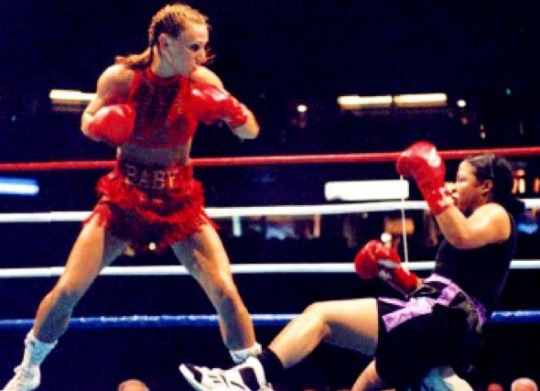
Dragon Profiles: BRIDGETT RILEY

image

Source

A
career in the fighting arts wasn’t what people expected of Bridgett
Riley, a former cheerleader who was working as a flight attendant
when she made the transition to professional kickboxing. Her
nickname, “Baby Doll,” was bestowed on her in her teens by a
karate instructor who was amazed by the small-statured young woman’s
fighting ability. Nowadays, people are less surprised, given
Bridgett’s thorough domination of the pro kickboxing scene and five
world championship reigns. What’s more, Riley bridged
the gap between martial arts and boxing – becoming a top rated
pugilist and securing a 15-3 record with one IFBA World Championship
reign. All the while, Riley successfully balanced her fighting
careers with one in show business: though still mainly known for her
stuntwork in major blockbusters, she’s also notable for a handful
of fighting parts in DTV films and television.

Styles
& Accomplishments

Kickboxing
– ISKA, WKBA, WKA,
UKF & IKBF World
Champion; record: 26-2
Karate
– 1st
Dan
Muay
Thai

Films
to See

Triple Impact
(1992)
– lead role
Bare Knuckles
(2013) – supporting role
WMAC Masters
(1995-1996) – recurring role

Trivia:
In her first professional kickboxing match, Riley defeated
U.S.
national champion Denise Taylor in a major upset. Taylor grabbed a microphone and demanded a rematch, calling
her loss a fluke.
A month later, Riley defeated Taylor again
via
technical knockout – breaking her nose in the process.

Videos
Vs.
Olivia Gerula

Highlights
(Boxing, Kickboxing, Film, Etc.)

Long Review: Death Fighter (2017)

“What’s
the matter, never humped a rock before?”

image

While
every other martial arts fan was watching the long-awaited Boyka:
Undisputed
IV a
couple weeks ago, I was
getting my hands on a
more low-profile release called
Death Fighter. I
regret that decision, now.
While looking
up
lower-profile movies
has served me well in the past, it led
to a disappointment
this time. After having its
release pushed back repeatedly for
several
years, this film finally reveals that it has little more
going for it than
a
supergroup of karate stars and a few surprises. While
there are some things that I like and admire about this one,
I have
to admit that it’s just too plain to hang with its more substantial
competition.

The
story: A renegade FBI agent (Matt Mullins) teams up with an
ex-military mercenary (Don Wilson) to take down a dangerous kingpin
(Gigi Velicitat) in the Thai jungle.

Ensemble
casting is so common now that it’d almost be a bigger surprise to
feature less than four
prominent names in an action movie, but Death Fighter
certainly secured an iconic
draw. In addition to XMA
champ Mullins and kickboxing
hall-of-famer Wilson, the
cast packs two more legends
in Cynthia Rothrock as one of the evil lieutenants and the late Joe
Lewis as Mullins’ doomed partner. Throw in rising genre staple
Jawed El Berni and you can
see why I had such high hopes
for this. However, the utilization of its stars is the main
reason I’m unhappy with the film. Only the acrobatic El Berni
delivers approximate to his reputation; everyone else is in trouble.

  • Matt
    Mullins
    : I’ve been waiting for this
    guy to step up and become the
    next Scott Adkins ever
    since I first saw
    him in Adventures
    of Johnny Tao
    . With
    Death Fighter being
    technically his first vehicle in 12 years, I thought it’d
    be the stepping stone he
    needed to get people at large
    to notice him…but now, I
    have doubts about his
    potential. Matt shows off his
    martial
    skills just fine, but jeez, are
    both he and his character
    ever bland! Mullins comes off
    as a Ken doll, and
    is absolutely unremarkable beyond
    his fight scenes.
    Adkins is no master thespian
    but at least he can create a memorable character, whereas Mullins
    barely creates an impression. Were
    it not for Matt’s
    physicality, anybody could’ve
    played this role.
  • Don
    Wilson
    : The opposite of his younger costar, Wilson is charismatic but
    totally unprepared for the movie’s style of action. Choreographer
    Patrick Tang favors a flashy, acrobatic style of fight scene, but
    Wilson isn’t about to change up his usual grounded game for
    anybody. Though Don’s brawls feature significantly less slow motion
    than his regular fare, they’re noticeably slower and less creative
    than anybody else’s – giving the impression that everyone had to
    go at half-speed with the old man.
  • Joe
    Lewis
    : Speaking of old men, the late
    karate god is in decisively poor shape. I know
    Joe was in failing
    health at this time in his life and thus excuse
    much
    about his utilization,
    but he still seems
    poorly-placed in an
    action-packed film like
    this. He briefly beats up a henchman
    and engages in a shootout before being killed off only
    a few minutes into the movie. Whereas
    his previous role in Kill ‘Em All
    seemed like an
    appropriate sendoff to the
    grandmaster’s film career,
    this almost seems like an unwanted obligation.
  • Cynthia
    Rothrock
    : Having previously
    stated
    that she’d like to do at
    least one more Hong Kong film in her life, I’d hoped that the
    similar
    style of this picture might
    be the opening Cynthia needed to remind the world that she’s an
    action legend. Not so. Rothrock seems awkwardly cast in her
    supporting role, playing second fiddle to a performer less
    charismatic than she (Velicitat),
    and like Wilson, her two fights leave a lot to be desired. Her
    dream match against Don is
    particularly disappointing, featuring some
    cruddy
    camerawork.

Nevertheless,
the picture has some noteworthy redeeming traits. Despite
my complaints about some of the fighters’ individual performances,
I’m still generally pleased by
the action
content. Though he doesn’t
properly
distinguish himself from other performers who utilize the tricking
style, Matt Mullins is well-matched against Jawed El Berni and the
various Thai stuntmen, making
for occasionally nice
showdowns. However, the film’s trump cards aren’t any of its
advertised performers, but rather two hitherto-unknown costars who
just about blow their cohorts out of the water. Chiranan
Manochaem is introduced as a dramatic performer and potential love
interest to Matt Mullins, but explodes onto
the adrenaline scenes
with
some impressive
fights,
making her arguably the best-utilized performer of the bunch. Less of
a character but definitely the best onscreen fighter is Prasit
Suanphaka, playing
Don Wilson’s near-stoic sidekick. I’ll
be really
disappointed
if
this guy gets lost among the masses of stunt
guys
in Thailand, because he’s one of the most versatile and unhinged
performers
I’ve lately seen leading
a fight scene. With
a brawling style that’s a fair mix of Tony Jaa and Jackie Chan,
he’s
one guy who should definitely been in more movies.

Other
positive things I noticed include the
refreshingly
layered participation
of women in
the action scenes.
I recently wrote an essay on the depiction
of women in martial arts films, and it
seems as though the filmmakers were thinking along similar lines
regarding exceptionalism.
Chiranan Manochaem soundly dismantles any demure expectations you
develop about her character
leading up to her first fight (demonstrating
that
women can be action participants and
supporting stars at the same time),
and Cynthia Rothrock’s otherwise disappointing casting as an
enforcer helps level the field between the sexes and makes the sight
of women fighting men less extraordinary than filmmakers often
perpetuate. A
subplot involving human trafficking isn’t handled with as much
gravitas as I’d hoped (it takes a backseat to the personal revenge
angle), but it isn’t played for titillation. Not
only that, but
– for the first time I’ve ever
seen
in a U.S. production – the kidnapped women are rescued by another
woman. These
are small
touches, but the effect they have on the presentation is
noteworthy.

If
there
were
only such
aspects
to
consider and
the handful of weird B-grade
moments (e.g. a kid thinks it’s funny when a murder victim’s
blood pours onto
his head), the film might
yet manage to shine a little.
Disappointingly, the
technical presentation keeps
viewers
from properly engaging with
the story.
While the movie can get its plot
from A to B, choppy editing frequently
gives a strained feel to conversations, fight scenes, and
montages.
The presence of some naturally pretty scenery merely
draws
attention to the lack of standout cinematography. Also, the movie’s
tone can shift so drastically at times that it can
be like watching
two different films: it
favors a refreshingly optimistic outlook wherein characters develop
genuine bonds and manage
overcome personal problems, but it can quickly turn around and become
quite grim, like the rather gratuitous throat-slitting scene.
This film wasn’t rated by the MPAA, but
I
can
see
it getting one of those ironic R ratings based
on
just a
couple
of
scenes.
(For
the record, it’s gotten
a 14^ rating in Canada.)

Outright lack of quality isn’t
Death Fighter’s failing point so much as mediocrity. While a
movie like this would be a decent watch in most circumstances, the
amount of talent involved makes it all the more disappointing when
you see how little the filmmakers did with their resources. It makes
me fear for the career of Matt Mullins: Rothrock and Wilson
subsequently showed themselves prepared to shape up in The Martial
Arts Kid
(produced after this one but released earlier), and the
sheer amount of movies coming out of Thailand assures me that I’ll
probably see Manochaem and Suanphaka again, but Mullins probably had
a lot riding on this for his prospective solo career. He’ll always
be able to find stuntwork and supporting roles, but if this is all he
can do when the spotlight’s on him, I have a feeling that it won’t
grace him many times more. However, responsibility for the picture’s
quality ultimately falls on the filmmakers: to the extent that
director Toby Russell wasn’t hampered by producers, he’s
demonstrated that he needs more practice in producing a standout
karate film and, for the time being, should stick to documentaries.

image

Death
Fighter
(AKA
White Tiger)
(2017)
Directed
by
Toby
Russell (Cinema of
Vengeance
)
Written
by

Lawrence Riggins (Replicant)
Starring

Matt Mullins, Don Wilson, Chiranan
Manochaem,
Gigi Velicitat (The
Mark
)
Cool
costars:
Prasit
Suanphaka,
Cynthia Rothrock, Jawed El Berni (Ninja
II: Shadow of a Tear
),
Joe Lewis
Title
refers to:
The
official
title could refer to virtually any of the above-mentioned performers,
whereas the working title refers
to Matt Mullins.
(Don
Wilson: “Sometimes,
it takes a stubborn tiger like you to get a reluctant lion like me
to fight. And you’re white.”)
Content warning:

Kidnapping, implied torture, violence against women, extreme
violence
Copyright

Vision Films, Inc.

From
the
Death Fighter DVD summary: “…
Their quest for vengeance brings them face-to-face with a band of
notorious criminals (Cynthia Rothrock … )”

Me:
Wow. This makes it sound like Cynthia Rothrock plays every single
villain in the movie.

Him:
…I want that. That would be so awesome. Just a bunch of Cynthia
Rothrocks going around, interacting with each other. Put that in the
review. I’m going to be disappointed if this movie doesn’t
feature Cynthia Rothrock Village.

“Guess what happened on set today!” Behind-the-Scenes Trivia of DTV Martial Arts Videos

Hollywood isn’t
the only place which spawns crazy anecdotes from the film-making
world. Here are some little-known tidbits about little-known kick
flicks.

image

No Retreat, No
Surrender 3: Blood Brothers

(1990) – A Standoff Between Stars

Working
on this movie was no picnic, and tensions nearly
reached a
breaking point while
filming
the story’s
emotional high point.
In a scene where the film’s protagonists
discover the dead body of their father, star Loren Avedon repeatedly
played the scene against direction – making it impossible for his
onscreen sibling,
Keith Vitali, to complete his blocking. Eventually, the filmmakers
collectively appealed to Avedon, who grew frustrated and screamed
at his
assembled coworkers.
This sort
of disrespect
didn’t set well with Vitali, who
happens to be
one of the most
decorated
karate competitors in history. According to writer Keith Strandberg,
Vitali was “ready to tear into” Avedon, who eventually diffused
the situation by apologizing to his costar. That was probably for the
best: Loren Avedon is cool, but I don’t favor his chances against a
former pro fighter. [SOURCE]

image

Martial Law (1990)
– Cynthia Rothrock: Ball-Buster

Stuntwork
is a potentially risky business, and no one other than trained
professionals have any business being stunt personnel.
This sentiment wasn’t shared by an ill-fated layman whose
friend invited him onto this film’s
set
to participate in a fight scene with one of America’s top martial
arts stars. I can see the appeal of wanting to work directly with
Cynthia Rothrock, but the perils of not knowing what you’re doing
were
made apparent when this individual forgot the
choreography. In scene where a gang of thugs descend upon a
bat-wielding Rothrock, the heroine was to strike at a downed opponent
with her weapon; he was to evade by rolling away, but this man rolled
in the wrong direction. Rothrock brought the bat down so hard on this
fellow’s groin that he required a visit to the hospital. Ouch!
[SOURCE]

image

Karate
Cop

(1991) – Real Life is More Dangerous than a Post-Apocalyptic
Wasteland

Following
a day of shooting, Ron
Marchini and
his wife went for a walk in Stockton, California’s Grupe Park.
Marchini had probably spent the day dodging bullets in the context of
the film’s plot, but found himself doing
it for a real when a car
pulled up within feet of the couple and an
occupant opened
fire with a rifle. Despite the close proximity between shooter and
would-be victims, neither Marchini nor his wife were injured. As
deplorable as this act was, you can’t blame the shooter for their
spinelessness: if you had a murderous beef with a
legendary
karate competitor, would you be willing to settle it face-to-face?
The person’s lucky they were never apprehended. [SOURCE]

image

Martial
Outlaw
(1993)
– Jeff
Wincott’s Body
Motivation

I
think writer Thomas Ritz crafted a pretty good vehicle for star Jeff
Wincott, but apparently
Jeff
wasn’t entirely satisfied. As was the case for this
stage of
his career,
he
was in particularly good shape – having prepared for
his role with
a three-month training regimen. Thus,
you can imagine his disappointment when the script called for no
opportunity to showcase his bare body. Not about to forego the
opportunity to display himself, Wincott had
the filmmakers alter a fight scene on
the day of filming. From
out of nowhere, a thug
rips Jeff’s modest
sweater off to reveal his chiseled physique – no
doubt to
the delight of our star, now secure in the knowledge that his fans
will have the opportunity to ogle his killer abs.
[SOURCE]

image

Last
to Surrender
(1999)
– Wherein Everything Possible Goes Wrong

When
big-budget features encounter many behind-the-scenes
problems,
the film may gain eventual
cult
fame via trivia about its production woes. In the case of low-budget
features, we’re lucky if we ever hear anything about the production
process at
all.
However, the cornucopia of ills befalling this little-known
vehicle for Roddy Piper and Hans Ong was so tragic
that it not only
warranted telling the public about it,
but gave
it more than enough credit to
hang with just about any film’s horror stories. Shot in Indonesia,
this
one had to contend not only with flash floods and anti-government
riots destroying sets and halting filming, but had three trucks full
of film equipment overturn
and almost go
falling down
a cliff.
Less
fortunate still was the time when,
while filming aerial footage, a plane crashed into the jungle and
caused
the death of the pilot. After all that, the
film’s
still virtually unknown. Genuine
injustice. (See the Region 1 DVD’s production notes)

[500 Word Essay] Violence Against Women in Low-Budget Martial Arts Films

image

Photo credit
Lionsgate (2015). Absolution. Retrieved from IMDb.

One of the most
recurrent and unpleasant trends in low-budget action movies is
violence aimed at female characters. This isn’t unique to my
particular film niche, but its prevalence in direct-to-video kick flicks is telling of how readily viewers accept and expect to see
women treated violently onscreen. We’re talking about largely
independent productions which highlight fighting arts designed for use by anybody, but often,
these films maintain a status quo whereby unanswered physical aggression towards
women is a matter of course. I’ll try to briefly convey why this is
a problem and how it might be rectified.

[For clarity:
When I mention violence towards women, I’m referring to instances
where a female character is physically abused by another character
(typically male, though sometimes another woman). I usually don’t
count instances where the woman is an active combatant, though there
are problematic examples of that, too (e.g. the fight between Brandie
Rocci and Darren Shahlavi in Bloodmoon (1997),
reminiscent of a domestic violence episode).]

I’m not suggesting
that such instances of violence can’t be appropriate within a
film’s context. However, what makes the bulk of them disagreeable
and problematic are not only the societal norms they perpetuate, but
the effects they may have enacted on the DTV film-making scene. An
overabundance of female-directed violence probably contributed to the
rarity of women becoming physical players in action scenes (can’t be a victim and a hero at the same time, here), which in
turn makes actresses less likely to rise within this subgenre.
There’s no shortage of capable women in the field, but most aren’t
particularly well-known because they’re rarely portrayed the way
their male counterparts are.

Speaking of which…
Though male characters are more often on the receiving end of
violence in these movies, they don’t contend with the
above-mentioned detrimental effects. Men are much more likely to be
portrayed as fighters, period. The vast majority of these
films are headlined by male protagonists, and there’s no shortage
of successful male performers who got their start being beaten up in
fight scenes. There are no social stigmas decreeing that men should
generally be portrayed as helpless victims, and in a genre where
physical violence is the norm, that counts for a lot.

Dealing
with this issue isn’t as easy as finding the new Cynthia Rothrock, as
even movies which feature a powerful woman in the lead are often
still saturated with violence directed at other women. I also don’t favor doing away with this sort of violence completely, lest it
limit the kind of stories that could be told. I think a more sensible
approach would be to simply level the playing field by regularly
casting women in not only starring roles, but also physical
supporting roles – have women play more enforcers, lieutenants,
teammates, or even bystanders who can throw a punch. By subverting societal expectations, we’d not only
diminish the degree to which such films perpetuate unhelpful
prejudices (e.g. women are helpless in the face of violence), but
also open the film market to a greater variety of butt-kicking
talent.

Some films that
have already applied this concept
relatively well: Contour (2006), Ninja
Apocalypse (2014), Tekken (2010), Honor and Glory (1993), Xtreme Fighter (2004)

Review: My Samurai (1992)

“You
fight well, little man. You have good spirit.”

image

Taekwondo
champ Julian Lee has been appearing in action movies since 1990, but
his earliest work readily available in North America is 1992’s My
Samurai
. This one fell into my lap by accident (my boyfriend
happened to have an unopened copy on his shelf), and overall, I’m
glad I saw it. What threatens to be a boring indie exercise turns
into an engaging adventure with a lot of fight scenes. It doesn’t
fully realize its potential, but the raw fun makes for a feature
worth digging your VCR out for.

The story: When a young
boy (John Kallo) witnesses an underworld crime, his babysitter (Lynne
Hart) and he are targeted for assassination and must rely on the
protection of a martial arts instructor (Lee).

The movie
starts off umpromisingly. It’s really hurting for good actors, with
lead villain Mako and absentee father Terry O’Quinn having
relatively few scenes despite their important roles. I totally buy
Julian Lee as the martial arts teacher he is, but drama seems alien
to him; he makes Philip Rhee look like an Oscar nominee. Young John
Kallo is, somehow, in even greater trouble. They stumble through the
movie’s opening third, gumming their lines and failing to impress.
Then, to my surprise and delight, the screenplay wakes up. At first
it’s just little things that you notice – realistic touches about
what three people on the run have to contend with, like how to find
new clothes and needing to sleep in a cramped space – but
eventually, it’s like the film remembers that it can do whatever it
pleases and has its three stars fighting a glam-inspired martial arts
gang and buddying up with a minister played by friggin’ Bubba
Smith. The final 15 minutes or so lose some of that gusto when the
filmmakers try to shoehorn in a whole scenario about Kallo and his
dad, but overall, this is a pretty energized movie that’s unlikely
to bore its target audience.

There are some disappointing
missteps throughout, beyond the aforementioned pacing issues. Lynne
Hart – one of only two prominent female performers in here –
shows a lot of promise but is somewhat wasted by playing a character
whose sole arc in this otherwise bombastic film is about her love
life. There seems to be some untold backstory regarding the villain,
with the filmmakers trying to draw a parallel between two sets of
fathers and sons, but this is left until the film’s final minutes
and is thus rendered confusing and pointless. Julian Lee has an
embarrassing philosophical scene wherein he claims he never got rich
teaching the martial arts because he didn’t -want-
to be rich; if all martial arts instructors who’ve struggled
and sacrificed
in pursuit
of their passion watched
this scene at once,
their combined laughter might cause earthquakes. Lastly, take note of
the movie’s inappropriate title. Didn’t the studio realize that
neither Julian Lee nor the character he plays are Japanese?

There’s
no shortage of fight scenes, here – about a dozen individual brawls
– and I’m happy to say that they balance out some of the film’s
flaws. The action doesn’t start out promisingly, with some strikes
clearly not making contact and a combatant dying by falling out of a
five-foot window, but it picks up dutifully. Julian Lee provides his
choreographers all the physical talent they need, and they exploit it
by keeping the matches grounded and intimate – lots of
close-quarters street fighting. There’s some flashiness (the glam
gang contains several acrobatic tricksters), and this makes for a
satisfying adrenaline package. Disappointingly, Lee’s onscreen
nemesis – fellow martial arts master Christoph Clark – is
portrayed as so powerful as to negate any potentially cool matches
between them. Clark beats the heck out of Lee, forcing the final
showdown to conclude anticlimactically.

My
Samurai
has the right attitude to be a kickboxing flick of the No
Retreat, No Surrender
variety, but not quite the concentration to
maintain its enthusiasm. Nevertheless, the mixture of unusual touches
and inspired moments make it worth owning for mildly patient fight
fans.

image

My
Samurai
(1992)
Directed by Fred H. Dresch (The
Kudzu Christmas
)
Written by
Richard Strahle
Starring
Julian Lee (Dragon and
the Hawk
),
John Kallo, Lynne Hart (Perry
Mason: The Case of the Telltale Talk Show Host
),
Mako (Conan the
Barbarian
)
Cool
costars:

Bubba Smith (Police
Academy

series), Terry O’Quinn (Lost),
Christoph Clark (Tiger
Street
).
Mark
Steven Grove (Legacy
of the Tengu
)
plays a member of the glam gang
Title
refers to:

Julian Lee’s character, presumably.
Potential
triggers:

Violence against women, violence towards children, implied
torture
Copyright
Starmax
Film Partnership