It’s a shame that
the phenomenon of supergroup casting has grown old long before all of
its possibilities have been exhausted. The sad reality of filmmakers
regularly not making the most of all the names they can get under one
title is evident in Mark Dacascos’ freshman effort as a director,
which further depresses me by not making a strong case for
yesterday’s action heroes becoming filmmakers. Possibly the
greatest coming together of stars since the original Expendables films, Showdown in Manila nevertheless
feels like a forgettable
action-thriller featuring a bunch of nobodies.
The
story: Private investigators Nick Peyton (Alexander Nevsky) and
Charlie Benz (Casper Van Dien) track an assassination to an
international terrorist group. Eventually, they call in some comrades
to help capture its deadly leader (Cary-Hiroyuki Tagawa).
How
good the
movie is depends largely on
how well its big-name stars are utilized. Here’s my take on ‘em:
Alexander
Nevsky – This
huge bodybuilder seems to be more of a star in Russia than North
America,
and thus I question having
him lead
a movie filled
with more recognizable action guys.
Judged on his merits, he’s not terrible
–
he makes more of his physical
size
than Dolph Lundgren and does well enough in
action scenes –
but
he’s in
desperate
need of charisma. For all his good looks, Nevsky remains a virtual
stranger to me even after the credits
rolled.
I
wouldn’t mind seeing him improve, but I don’t predict many U.S.
producers will line
up to put him in another starring role.
Casper
Van Dien –
As probably the cheapest ex-
A-lister on the market right now, it doesn’t
surprise me
that
ol’ Casper’s present,
but it
sure irritates
me.
He’s
playing yet another womanizing jerk, albeit with more chagrin and
humility
than expected.
It
breaks my heart to admit it,
but
he’s
actually one of the best things about th4
film. He’s not the only cast member with genuine charisma and
acting ability, but he is
the one with the most scenes. For
better or worse, he keeps the film from sinking until the other big
names show up.
Cary-Hiroyuki
Tagawa – One
of the genre’s quintessential villain actors is well-placed
as the
bad guy, but he’s the first cast
member whose
presence is over-hyped. The number of scenes he’s in can be counted
on one hand, and while you can count on his considerable screen
presence whenever he’s on camera, he barely gets in on any of the
action. Also, for what could’ve
been a monumental B-movie, his character’s pretty weak and
comes to kind of a disappointing end.
Tia
Carrere – As
Carrere hasn’t
had much to do as an action hero since Relic
Hunter,
I
wasn’t expecting much of her and thus was delighted when she
briefly partakes in a quick fight scene! Honestly, though, there’s
no reason to get excited. Despite
being an important character, she
largely drops out of the film after the early scenes and is wasted as
a draw.
Mark
Dacascos –
Already
taking on the role of
director, it may have been wiser
for Mark to remain behind the camera entirely
and
not tease us with an early appearance. He has a single scene, and
while he manages to fit a brawl
in there, I
can’t help but miss him throughout the remaining runtime. His
character is the linchpin of the story but I would’ve preferred a
lesser-known actor in the role, as I wouldn’t have spent the rest
of the movie thinking about how much better it would
be if he were
still in it.
Matthias
Hues –
Hues
plays pretty much the same blonde enforcer he
always
has
but with a lot less screen time. Ironically, he has more lines in his
handful of scenes than he’s had in entire
vehicles.
He’s also in
the
only
dream match-up this film offers,
as he engages Casper Van Dien in a short and one-sided fistfight.
Afterwards,
Nevsky
takes him out with one punch.
Don
Wilson, Cythnia Rothrock, and Olivier Gruner –
I list these three as a unit because they arrive and leave the film
at the same time and share the same scenes. They comprise the group
that Nevsky calls in to storm Tagawa’s base (along with Dmitriy
Dyuzhev, an
acclaimed Russian actor who’s nevertheless unknown in the west) and
bring with them the majority of the action content. It’s what I’ve
come for, but the characters
feel tacked-on, as
though
they’re
indulging
a last-minute favor from Dacascos to appear in his movie. While
their segments remain the best in the picture, they
aren’t in
top form:
Gruner’s acting is somehow worse than usual, and weapons
specialist
Cynthia Rothrock inexplicably
looks like a complete amateur when handling a pair of batons.
With the utilization of this ultimate gathering of B-movie dragons
falling way short of hopes, do any other parts of the movie stack up?
Well, I’ve seen worse first-time directors than Dacascos, who
proves he can at least craft a professional-looking feature. The
problem is that his run-of-the-mill style works against a picture
whose adrenaline spikes never reach higher than “meh.” I would’ve
been more entertained by a big disasterpiece with an unpredictable
storyline and actors imploding under crazy direction. As is, Showdown
in Manila and its paint-by-the-numbers plot have nothing wrong
with them other than the disappointment they generate. I’d rather
have seen director Dacascos drop all his plates in spectacular
fashion than realize that, even with all he had going for him, the
best he could do was something I’ll have forgotten about in a week.
With literally nothing going for it other than the opportunity of
seeing some of its stars in the same action scene, I can’t
recommend this film with any kind of enthusiasm. As always, fans of
the stars might want to pick it up to complete their libraries, but
everyone else can treat it mildly.
Showdown in
Manila
(2016) Directed
by
Mark Dacascos Written
by
Craig Hamann (Boogie
Boy),
Alexander Nevsky (story), Mark Dacascos (story) Starring
Alexander Nevsky (Moscow
Heat),
Casper Van Dien (Starship
Troopers),
Cary-Hiroyuki Tagawa (Mortal
Kombat),
Tia Carrere Cool
costars:
Mark Dacascos, Matthias Hues (No
Retreat, No Surrender 2: Raging Thunder),
Don Wilson (Bloodfist
series), Cynthia Rothrock (China
O’Brien series),
Olivier Gruner (Angel
Town),
Dmitriy Dyuzhev (The
Island).
World champion martial artist Emanuel Bettencourt (Kebab
Connection)
plays one of the lead villain’s bodyguards, as does Filipino action
star and Olympic taekwondoka Monsour Del Rosario (Bloodfist
II).
There’s
also a surprising amount of critically-acclaimed
Filipino stars in various supporting roles, including Iza Calzado
(Bliss),
Mon Confiado (Heneral
Luna),
and Jake Macapagal (Metro
Manila). Content
warning:
Human trafficking, violence towards women Copyright
Hollywood Storm / ITN Distribution
At
the end of the 80s, a Lebanese-Canadian martial arts competitor sold
his jewelry business and entered the world of karate flicks. His name
is Jalal Merhi, and through money and persistence, he became a staple
name of the U.S. video scene. Nicknamed “Beirut’s Steven Seagal”
(despite his accent making him comparable to Jean-Claude Van Damme),
what set him apart from virtually everyone else on the U.S. martial
arts scene was his desire to showcase Chinese martial arts over their
more common Japanese and Korean counterparts. He tried this first
with Fearless Tiger (1991), a
tournament flick that didn’t see an
American release until three
years after completion, but had greater luck with the more unique Tiger Claws. Merhi’s
recipe for this endeavor?
– lots of kung
fu, established stars, and a capable
director. The result is a
thoroughly watchable adventure that grew on me over time. It’s an
examination of fanaticism in martial arts, and arguably the best film
Merhi would ever star in.
The
movie opens in New York City with a woman (Cynthia Rothrock) hounded
on the street by a suspicious man (Nick Dibley). He corners her with
evil intent, but she fights back and utterly decimates him in a
brawl, knocking him out before he’s arrested. It turns out she’s
Detective Linda Masterson, supercop, and the guy who attacked her was
a suspect in a crime spree. She’s disgusted that her wolf-whistling
partner (Fern Figueiredo) wasn’t anywhere to be found when the
fight happened, but more so that she’s wasting her time “dressing
up like a whore and working on these two-bit cases.” Shortly
thereafter, we meet our other hero: Det. Tarek Richard (Jalal Merhi),
who’s carrying out an undercover drug deal that, somehow, is also
the purview of rival detectives Roberts (Robert Nolan) and Vince
(Kedar Brown). It’s unclear who’s actually out of line, but
Tarek’s suspended when his counterparts initiate a fight/shootout
and the dealer is blown up in his car.
The
case they’re both headed for – Linda by intent and Tarek by
accident – is that of the Death Dealer, a serial killer targeting
martial artists. The victims’ claw-like head wounds lead Linda to
believe that the killer’s also a martial artist and that he can be
unconvered by identifying his fighting style. This impresses her
superior, Sergeant Reeves (John Webster), who assigns her to the case
over a sexist cohort but also demands she work with the
still-suspended Tarek. Linda’s not pleased but has no choice,
especially when Tarek promptly identifies the style as “fu jow . .
. some people call it tiger claw.”
Let’s
pause to examine the story’s unusual take on martial arts
awareness. Usually in these features, a martial artist is teamed up
with someone who has no such experience and thinks “chop socky”
is nonsense. That approach is subverted, here: Linda’s already a
master martial artist but still needs the insight of a “specialist”
like Tarek when it comes to exotic styles. Again, this is part of
Jalal Merhi’s unique formula: not only was he featuring kung fu in
his movies when few others were, but doing so at a time when these
styles weren’t even widely practiced outside of films. It’s less
of a deal now that Hong Kong flicks are widely distributed and it’s
easy to find modern kung fu fight scenes, but at the time, Merhi
capitalized on a market opening and used the opportunity to build up
the Chinese arts grandly. The movie’s stance is that, while you can
be a well-studied martial artist, there’s always more to learn by
looking to the past. If you don’t, you’ll be at a disadvantage.
This sentiment isn’t explored and thus feels a little like martial
arts propaganda (“Your kung fu is strong, but mine is better!”),
but I think Merhi was merely trying to set a precedent at this point.
Photo source| Jalal Merhi, Kedar Brown, Robert Nolan
Tarek
and Linda search Chinatown for the school where the killer trains.
Specifically, they’re searching for a secret studio that only
trains serious fighters – like Tarek says, “This is not a sport
for any bozo with 50 bucks.” They eventually receive a tip from a
drunken boxing student (Rick Sue) who they rescue from a gang
beating. It’s a cool fight, but doesn’t go very far in
distinguishing our heroes’ differing approaches to martial arts:
Tarek has some flowing movements, but he’s still as hard-edged as
his partner. Ironically, it’s Linda who wields a Chinese rope dart.
Anyway, they’re directed to a local tournament to find Sifu Chow
(Mo Chow) – the only fu jow teacher in the area. Tarek not only
finds him, but also an old friend and tournament competitor, John
Atkinson (playing himself). A huge and mysterious man in the crowd
(Bolo Yeung) looks on ominously as John wins the championship.
Shortly thereafter, he shows up in John’s home and attacks him –
killing him with a tiger strike to the face. Afterwards, we see the
guy before a tiger-themed altar decorated with trophies from the
other beaten martial artists. This is our killer.
Tarek
and Linda follow Chow to an abandoned movie theater which Tarek
immediately identifies as his school. He wants to go in right away,
but Linda demands he stay. When a night of waiting results in nothing
but the aforementioned death of his friend, Tarek impatiently sneaks
into the studio on his own. He’s promptly discovered, but –
immediately crafting his cover – earns a chance at tutelage by
revealing that Chow and he studied under the same master. (Stroke of
luck, huh?) Before leaving, Tarek notices his friend’s killer
painting a mural on the wall, but of course doesn’t know who Chong
is.
TRIVIA:
A subsequent scene features Tarek and Linda arguing whether to go to
an Italian or Chinese restaurant to eat. This mirrors a real-life
event wherein Merhi, Rothrock, Yeung, and some production members
were deciding where to eat after a day of filming. Everyone voted for
Italian, with the exception of Yeung. Merhi, who idolized Yeung,
immediately changed his vote and attempted to sway the group in favor
of Bolo’s choice. He was overruled and the group went to the
Italian locale, where Yeung refused to order anything.
Tarek
returns to the secret studio and earns his spot
by holding his own in against the other students. This is the first
fully-fledged kung fu fight scene, and the difference to previous
brawls is noticeable. The pacing is more restrained and the tiger
claw choreography reminds me of classic Hong Kong fights. You
get the impression that the filmmakers are genuinely trying to make
the fu jow
aspects
stand out, and this continues as Tarek engages
in a necessity for
any
good kung fu
flick – a training scene. He twirls weapons, strikes form, and
toughens his hands by submerging them in a wok of boiling water
filled with chains. Sifu Chow doesn’t do much on-the-ground
teaching, preferring
to beat a drum while his students go
at it, but he does step in
as a rivalry between Tarek and fellow
student James (Ho
Chow) threatens to get out of hand.
In
an unexpected turn, another student (Gary Wong) invites Tarek to a
go-go club, and they take Chong with them. The movie twists
expectations by showing Chong as a normal guy who drinks and laughs
with his comrades, but eventually, the scene’s mainly there so
Tarek can find out how good of a fighter the muralist is when they
have to thwart a mafia attack on the joint. Additionally, Chong keeps
Tarek from killing one of the guys – highlighting the theme of
martial excess that I’ll get into later. In the aftermath, Tarek
still isn’t certain which of the practitioners is the killer, but
Linda thinks it’s the hotheaded James. She confronts him at a
billiard bar, and despite beating up him and half the establishment
in the process, it turns out that he has an alibi. This faux pas
results in Linda and Tarek being removed from the case and being
replaced by the insufferable Roberts and Vince. In the meantime,
Chong kills Sifu Chow and some of the students.
This
scene is an enigmatic as it is essential. The final exchange between
Chong and Chow features Chinese dialogue with no subtitles, so while
their exchange may offers clues to Chong’s motives, I can’t be
certain. We
don’t find out otherwise
why Chong is a serial killer. The head-spinning
sequel throws a ton of new, outrageous information into the
continuity, but where only
this movie is concerned, it’s
ambiguous. The only theory
that’d
tie into
an existing theme is that Chong, having taken his training to the
extreme, has literally been driven crazy
by kung fu. Tarek’s spent the picture making sure we know how
demanding and encompassing fu jow is, having mentioned that his wife
left him when last
he trained – implying that
he, like Chong, has the potential to become a menace if
not kept in check. Tarek’s
also the only character to voice a
theory on Chong’s motives, saying that perhaps he’s
trying to “drum up lost respect for his style.” This may in fact
be a part of the reason,
given how the movie venerates
kung fu. Chong may see his
victims and
their martial arts as temporary and weak and is thus trying to
exemplify
the “true” martial art. This isn’t entirely without real-world
parallel: fierce inter-style
competition goes back centuries, and Chinese styles have often been
ridiculed in modern times
by “hard style” practitioners for being impractical and fancy.
Altogether, this information
comprises pieces to Chong’s puzzle, but the picture still isn’t
clear. Perhaps that’s why the movie reveals the killer relatively
early: it’s not bad writing, but an intended opportunity for
viewers to ponder Chong’s motives.
Tarek
and Linda refuse to drop the case, and they somehow
determine that Chong is their
prime suspect. Their suspicions are confirmed when they enter the
studio, finding the others
dead and Chong in attack
mode. He flees after a quick
duel with Linda, who spends the rest of the night searching for him
with Tarek. They find him at the pier, but not before the bumbling
Roberts and Vince arrive and handcuff
Tarek, suspecting him of the murders. Linda and Chong fight again –
possibly the best one-on-one match of the film – but the finale
pits the still-handcuffed Tarek against Chong in a warehouse. In a
bit of egoism, Jalal Merhi’s character is able to best Chong while
spending the majority of the fight with his hands bound. The
film ends with with Chong apprehended, Tarek and Linda commended, and
the former reinstated while the two share an awkwardly-earned
kiss on Tarek’s boat.
TRIVIA:
The movie draws on real-life characteristics for many of its
characters. For example… Linda is from Scranton, PA and
Chong is from Canton, China – just like their actors. Jalal Merhi
wasn’t divorced, but like Tarek, he was single at the time of
production. John Atkinson was indeed a successful karate fighter and
multi-time grand champion. Mo Chow is a martial arts
instructor who operateshis own studio.
Bill Pickels – Chong’s first victim – is a former cable TV
personality in Canada. Three actors share similar or identical names
with their characters: Mo Chow, John Atkinson, and Bill Pickels.
I
wasn’t a Jalal Merhi fan when I first saw this, and only held onto
the tape for Cynthia Rothrock. I can still see why the guy didn’t
click with me right away. Merhi lacks the charisma that makes even a
questionable actor like Rothrock fun to watch, and despite his
emphasis on kung fu being genuinely unique at the time, it doesn’t
make him stand out to the average viewer. Despite his efforts, Merhi
isn’t comparable to Steven Seagal introducing aikido in the late
80s or Tony Jaa rewriting action choreography with muay thai in the
2000s. Nevertheless, the more of this subgenre you consume, the more
Jalal’s effort does in fact stand out. The Chinese martial arts
help give this movie a unique flavor that you won’t find in other
kick flicks of the same budget. The crisp forms, traditional uniforms
and decent training montages eventually give the movie an air of
importance that I kind of miss in other features. This approach won’t
click with viewers who’d rather limit martial arts exclusively to
fight scenes, but it might be unique enough for those who’ve grown
tired of repetitious kickboxing.
Merhi’s
use of eye-catching names to star alongside him is a sound decision,
but again, you can’t help but chuckle at the scene that features
him defeating Bolo Yeung as Cynthia
Rothrock fishes a buffoonish
detective out of the bay.
Nevertheless, treating his own
character as exemplary
doesn’t mean the others are treated as jokes. This is one of
Yeung’s most interesting non-Hong
Kong roles, and even though
Rothrock hangs back many
times, both she
and Bolo are given ample
opportunity to steal the show in
fight scenes. To tell the
truth, Merhi is
elevated by their presence because
they bring out a lot in him. I’ve seen the guy do flashier moves,
but he’s never looked as tight and collected as he does here. To
date, Merhi is the only Arab martial arts star who’s had a solo
career in North America, and he really puts his best foot forward in
making a first impression here.
Exploring
the martial arts theme yields contradictory results. We’re to
presume that fu jow – and “old” martial arts in general – are
superior to modern forms, because when they come into contact, the
former tends to triumph. Nevertheless, Linda seems to be the
exception: she isn’t versed in fu jow but still defeats a hardcore
practitioner in direct combat. We’re also led to believe that
respect and mastery of the martial arts is limited to the experience
of immigrants and minority characters, but the majority of Chong’s
victims fall under the same labels. There’s also a theme of martial
arts bringing people together – i.e. Linda and Tarek bonding over
their practice of the fighting arts – but this ignores that Tarek’s
wife left him because of his training and that Chong’s obsession
with the martial arts may be the cause of his murderous behavior. I
wish the film were more consistent in what it’s saying.
Nevertheless,
it’s still enjoyable and that’s got much to do with director
Kelly Makin. Merhi had a knack for selecting inexperienced directors
who’d later go on to critical acclaim, and Makin displays his
talent via style in what would otherwise have been a humdrum-looking
picture. Though I’m not sure whether anyone would think this is an
A-grade production, Makin delivers a consistently clean look and
takes time to highlight the soundtrack, indulge in interesting camera
angles, and even film an occasional arty establishing shot. Though
not the best in this regard, he can shoot a fight scene surprisingly
well.
Tiger
Claws is a
fun watch for genre fans and definitely worth
hooking up the old VCR for. The
cast is a supergroup of genuine martial talent and
the filmmakers
know how
to make them shine. There are plenty of things I’d change, but
overall, this is one experiment that pays off. People interested in
coming into these types of movies should definitely consider it, and
established viewers
who’ve yet to see this particular one shouldn’t hesitate much
longer. Check it out!
Written
by J.
Stephen Maunder (writer for almost all of Jalal Merhi’s movies)
Starring
Jalal Merhi, Cynthia Rothrock (China
O’Brien),
Bolo Yeung (Bloodsport),
John Webster
Cool
costars:
Gary Wong, Michael Bernardo (WMAC
Masters),
Rick
Sue (Expect
No Mercy),
David Stevenson (Death
House),
Bill Pickels (Sworn
to Justice),
Mo
Chow (Talons
of the Eagle)
and Ho Chow
(Kung
Fu: The Legend Continues)
are
all legitimate martial artists playing the part. Wing chun legend
Dunn Wah (AKA Sunny Tang) plays a master
but doesn’t have
any fight scenes. IMDb credits gang member William Cheung as the William
Cheung – kung
fu
master and contemporary
of Bruce Lee
– but I don’t think they’re the same person. Similarly,
John
Atkinson is identified as an English TV actor who died in ‘07,
whereas the real performer currently operates a martial arts studio
in Arizona. Robert
Nolan
(Sixty
Minutes to Midnight)
is
a fairly
acclaimed dramatic
actor
while his onscreen partner
Kedar Brown has
been building a career in
voice acting.
Content
warning: Sexist
dialogue, attempted
sexual assault, group
violence, WTC imagery
Copyright
Tiger Claws Productions, Ltd. / MCA Universal Home Video (now
Universal Pictures Home Entertainment)
Since
no such thing seems to exist yet,
I decided to lay a foundation. This chronology is undoubtedly
incomplete, but I’ve tried to mention all events that stand out to
me and ones that would probably stand out to others. To the best of
my knowledge, all information is accurate.
March
23, 1987 – The film production &
distribution
company Imperial Entertainment Corp. is founded. One of the first
studios to focus primarily
on
low-budget action features, its releases include Cynthia
Rothrock’s Lady
Dragon,
Jerry
Trimble’s Breathing
Fire,
and Don
Wilson’s Red
Sun Rising.
August
18, 1988 – The
taekwondo-themed action feature Miami
Connection
receives a limited theatrical release and subsequently bombs, almost
bankrupting star/producer Y.K. Kim. Over 24 years later, mounting
cult
fame inspires
a re-release
for the film on DVD.
1989
– Joseph
Merhi and Richard Pepin found PM Entertainment Group, Inc. – the most
prolific producer of direct-to-video action and martial arts fare of
the 1990s.
February
24, 1989
– American
Ninja 3: Blood Hunt
receives a limited theatrical release before being sent to video.
It’s the first time an installment to
a major martial arts franchise receives anything less than a wide
debut.
February
1990 – Martial
arts legend Cynthia
Rothrock makes her solo debut in the U.S. with China
O’Brien.
Rothrock would subsequently become one of the most prolific
low-budget action heroes and the single
most
successful female martial arts star of the American film market.
February
23, 1990 – Kickboxer
Olivier
Gruner debuts in Angel
Town,
a movie about warring gangs. Ironically, a gang brawl breaks out at a
California drive-in during a screening.
April
12, 1990
– Film
production company Cine Excel Entertainment is founded by director
David Huey. Its first U.S. release, American
Streetfighter,
premieres about two years later on video and is one of the first
starring vehicles of kickboxer
Gary
Daniels.
March
4, 1991
– The
Hong
Kong-based Seasonal
Film Corporation’s No
Retreat, No Surrender
series goes DTV with
its third installment, Blood
Brothers.
Keith W. Strandberg returns as writer, but director Corey Yuen is
replaced by Lucas Lowe. Karate star Keith Vitali makes his debut as a
leading man.
December
18, 1991 – Pro kickboxer Don “The Dragon” Wilson,
America’s most prolific DTV action hero, makes his video debut with Ring
of Fire.
1992
– The film production
company
Nu Image, Inc. is founded by Avi and Danny Lerner, Trevor Short, and
Danny Dimport. Four years later, a subsidiary called Millennium Films
is launched. Producing both theatrical and DTV fare, their output
over the years has included the Undisputed and Ninja
series.
February
7, 1992 – Michael Worth makes his action film debut in Final
Impact,
becoming the first martial arts action hero created by PM
Entertainment. Worth is also the first martial arts star to debut on
the video circuit, without any prior work in theatrical or
international markets.
July
16, 1992
– The release of Tiger
Claws,
one of the first films of the subgenre to feature Chinese martial
arts over karate and kickboxing. Star Jalal Merhi had attempted the
same with his previous vehicle, Fearless
Tiger,
but this wouldn’t receive a U.S. release until 1994.
August
20, 1992
– U.S.
video premiere of Martial
Law II: Undercover,
the first martial arts vehicle of star Jeff Wincott.
October
14, 1992
– Director
Isaac Florentine releases his first U.S. production, Desert
Kickboxer.
November
6, 1992 – Billy Blanks makes his starring debut in Talons
of the Eagle,
which enjoys
a limited release before going to video.
March
3, 1993
– American
Samurai
premieres in
the U.S. on video.
Mark Dacascos co-stars in his first substantial martial
arts-themed role.
May
5, 1993
– Shootfighter:
Fight to the Death is
released, becoming
the
first U.S.
starring
vehicle of Hong
Kong
action
staple
Bolo Yeung.
July,
1993 – At age 13, Ted Jan Roberts makes his video debut in Magic
Kid.
To date, he is the youngest martial arts action hero of
the western hemisphere to
have a substantial solo career.
March
1, 1996 – Almost eight years after the release of the cult hit Bloodsport,
its sequel The
Last Kumite
premieres via a limited theatrical release. With the exception of one
supporting cast member, no one who worked on the original had a hand
in the sequel.
December
8, 1998
– The
release of Champions,
the first U.S. action
film
based on mixed martial arts competition.
February
9, 1999
– Jean-Claude
Van Damme’s Legionnaire
unexpectedly becomes the star’s first DTV release. With a $35 million
budget (adjusted: $52.5 million), it’s officially one of the most
expensive releases of the subgenre.
2002
– PM
Entertainment folds. Its catalog of over 150 features and two TV
shows is acquired for
distribution by
Echo Bridge Home Entertainment.
November
23, 2004 – Unstoppable
becomes the first Wesley Snipes action vehicle to go DTV, following a
limited theatrical release.
2005
– Nicholas Chartier and Dean Devlin found Voltage Pictures, whose
output includes the
DTV rleases Puncture
Wounds, Lady
Bloodfight,
and Eliminators.
In a Variety interview
four years later, Chartier describes
his business strategy of marketing DTV action flicks as a means to
pay for higher-budgeted theatrical productions.
May
31, 2005 – The
DTV action-thriller Submerged is released, and the Uruguayan
national government subsequently threatens legal action against the producers for
its embarrassing
portrayal of the
country.
December
27, 2005 – Multinational conglomerate Sony first becomes a major
player in the DTV action
scene when its subsidiary, Sony Pictures Home Entertainment, releases Black
Dawn.
2008
– The low-budgeted Money
Fight
(aka The
Red Canvas,
aka Art
of Submission)
becomes the first film to receive an “off-planet” premiere
aboard the International Space Station.
April
28, 2009
– Hector
Echavarria releases his MMA-themed
passion
project, Never
Surrender.
For
the next several years, Echavarria
is
the primary producer of movies capitalizing on the MMA craze by
heavily incorporating cage fighting into his plots
and featuring pro fighters in supporting roles.
February
2, 2010 – The Michael Jai White vehicle Black
Dynamite
is released on DVD, following a limited theatrical release. An
instant cult hit, it
wins widespread acclaim and the “Best Film” award at the
Seattle International Film Festival.
February
2, 2010
– Universal
Soldier: Regeneration
is released on DVD in the U.S. Widely regarded as superior to its
predecessor, its
star
–
Jean-Claude
Van Damme –
reportedly
turned down the opportunity to appear in Sylvester Stallone’s
blockbuster The
Expendables
in favor of focusing on the
smaller production.
June
1, 2010
– Undisputed
III is
released to cult acclaim. The vehicle catapults star Scott Adkins to
martial arts superstardom, and the movie is quickly
regarded as a benchmark of martial arts filmmaking.
August
2011 – DTV movie veteran and pro fighter Joe Son is convicted of
torture and sentenced to life in prison. Two
months later,
he receives
another 27 years for the voluntary manslaughter of a
cellmate.
May
6, 2015
– The
Dolph Lundgren/Tony Jaa collaboration Skin
Trade
is released in the U.S. via the internet. In addition to being Jaa’s
first American production to not be released theatrically, it’s the
first U.S. martial arts film to have an online premiere.
April
14, 2016 – The
Martial Arts Kid
becomes the first full-length martial arts movie produced via crowd
funding.
Sequels
aren’t as common in martial arts cinema as other genres (at least not
for U.S. fare), and ones within the direct-to-video realm are
similarly rare. While China
O’Brien II was
shot simultaneously with its predecessor and therefore a
guaranteed
release,
the original’s success assured that a sequel would indeed be in
demand. Sadly, this is an
instance
where embarrassing stereotypes about sequels indeed
apply.
While
the original China
O’Brien
was a simple but endearing adventure that established
Cynthia Rothrock in America’s martial arts movie scene, China
O’Brien II
rings hollwer.
The circumstances behind
its creation
ensure that its production values and action content are as strong as
its predecessor’s, but an
uneven story and an unambitious
screenplay go a long way in making this the inferior flick.
The
film opens at night with a low-key soundtrack and
a
convoy of cars making its
way through a forested area. Things pick up soon, as the
convoy
divulges
a slew of police officers who’re
hunting
the story’s villain. Escaped convict C.Z. Baskin (Harlow Marks) –
ex-Special Forces operative and drug smuggler – shoots several
officers before turning up at a hideout with his sizeable
gang
of Vietnam veterans.
He lays out his goals in
a straightforward way:
he wants
to kill the judge, prosector, and detective responsible for sending
him to prison, along with a former teammate who betrayed and stole $5
million from him. Barely five minutes into the movie and we already
have enough information to determine that the hero-villain dynamics
have flipped: whereas
the first film featured our heroes attempting to topple a villain
who’d
entrenched himself in the system, this one casts the heroes as the
establishment and the villains as outsiders. We’ll
see soon
enough that
such a reversal actually renders our protagonists more vulnerable
than before.
Baskin
succeeds in having
his personnel eliminate
their
first three targets in short order,
treating
us to
a convoluted scene
where the
judge is murdered while participating in a magic act. The final
victim, Frank Atkins (Frank Magner), is living
under
the Witness Protection Program in the same town where Lori “China”
O’Brien (Rothrock) is receiving a commendation for ridding the place
of organized crime. Also present
are her returning cohorts Matt Conroy (Richard Norton) and Dakota
(Keith Cooke), and we see that their collective
problems
have become significantly less drastic
in
recent times:
while Dakota beats up a couple of men harassing a woman (one of
them’s future Mortal
Kombat
star Chris Casamassa), China and Matt drive off to arrest a bumbling
mountain man called Chester (J.R. Glover) who made a mess of a local
bar. The
trio seems to have everything under control.
This
impression continues even as the plot begins to move along and
several of Baskin’s men arrive
to kidnap Frank and his wife Annie (Tricia Quai) during
the July 4th
celebration.
Despite
an ominous soundtrack, our
heroes
thoroughly kick the crud out of these guys. The would-be kidnappers
flee, and China gets the cagey Frank to tell her about the
situation…though
he leaves out the bit about the stolen money.
An unproductive call from
his
FBI keeper
gets
Frank into an uproar, but China shuts him down and forbids him from
leaving town. Frank
doesn’t like this. Unlike
its predecessor, this
film has almost nothing to say on gender roles or feminism, but
there’s a glorious moment where the impotent
Frank whines
“I bet you like beatin’ up on men, don’t you?!” It’s a
not-so-subtle reminder that China is a subverter
of norms and
that men of questionable character can’t come to terms with
this.
Dakota
is dating Frank’s stepdaughter Jill (Tiffany Soter), which is a
little uncomfortable when you remember that Dakota is old enough to
be in college but
Jill
appears to go to school with students in
their
mid-teens. He
picks her up from the
campus
on
his bike and
brings her home, where Baskin and his men are lying in wait. Dakota
puts up a fight, but he’s kidnapped along with Jill and Annie.
Ironically,
Baskin’s
attempt to thus
press
Frank to surrender himself and the money almost goes wrong: Frank is
in the process of skipping town when China happens upon him and finds
out what’s going on.
(Frank’s
shame at being shown up by a woman is complete when he threatens her
with a gun and she takes him down from
the other side of a door.)
She
calls in Matt and her deputy Russell (Michael Anthony), and they
hatch a plan to retrieve the hostages with Frank’s (forced?)
cooperation.
The next day, it’s put into effect: Frank meets with Baskin at a
rock-crushing plant while
China & Co. Sneak up
, and following a massive fight scene that parallels the first film’s
sawmill brawl, all the good guys escape. Baskin, who gets quickly
taken out by China early in the fight, vows revenge.
This
fight scene, in
which Dakota doesn’t actively participate,
is a demonstration of how he’s
become estranged from
the other lead protagonists. While
neither
his screen time nor his contribution to the action content has been
reduced,
he shares very
few
scenes with China or Matt and has no one-on-one
time
with
them at all.
What’s more, he’s become almost facetious to the story.
While
the original movie featured his quest for revenge as a major plot
point
and gave him moments wherein
he
at least helped
China out of a jam, here he’s little more than a flashy side
character.
The importance of his kidnapping is diminished by China already
being prepared
to put herself on the line for Jill and Annie, and probably the most
significant thing he does throughout
the picture is
rescue Jill from molestation
by one of Baskin’s men (Douglas Caputo). I’ve heard that Keith
Cooke was very discerning
about
only accepting
roles that highlighted
his onscreen presence; if this is true, then
Dakota
being
indepdent of China and Matt probably appealed to Cooke,
but the result is that the film could’ve largely been made without
his character. The things he does and the things that happen to him
don’t affect the plot much, and that’s disappointing.
Baskin
effectively isolates
the town by cutting phone lines, scrambling radio airwaves, and
setting up roadblocks.
The next day, his crew rolls in to flush out China and her allies,
and the rest of the movie consists mainly of China, Matt, and Dakota
taking out opponents throughout
town.
It’s a cool collection of fight scenes, including ones with a trio
of specialty fighters (Billy Blanks, a whip-wielding Indiana Jones
wannabe, and Toshihiro Obata wearing a pair of Freddy Krueger claws),
but the
whole affair is one-sided with our
heroes
rarely losing the upper hand.
Things are a little more perilous for the characters who aren’t
martial artists: Russell is shot to death trying to get help, China’s
dispatcher Lucille (Cindy Clark) is killed when the police station is
shot up, ol’ Chester is killed just shortly after being sprung from
jail,
and even Frank is gunned down by Baskin as his family and he try
to escape with the money. Baskin grabs the suitcase of
dough,
ignoring the women, and is subsequently killed by Annie after
she grabs Frank’s rifle.
It’s surprising,
a little disappointing, but also apt that the antagonist is taken
down by a character who even the audience is meant
to consider beneath notice. C.Z.
Baskin is a more threatening and able villain than Edwin
Sommers was, but in the end, they’re both eliminated by a former
victim of their greed.
TRIVIA:
Filming had already wrapped
when director Robert Clouse was told that the runtime had to be
increased. Some additional action scenes were shot, including the one
featuring Billy Blanks, who was cast at short notice.
The
film ends on a downer, with China and Matt leaving Frank’s funeral
and mourning the loss of Lucille and Russell. Dakota’s there, but
he doesn’t leave with his friends.
Looking
back at the whole picture, I get the impression that the filmmakers
were intending for this to be a grittier
and more perilous movie than the original – you get hints at a
darker tone throughout via the soundtrack – but they
failed
to achieve the effect by reserving
all of the more
depressing stuff
for
the final
15
minutes. Sure, the
movie collectively
lacks the original’s upbeat tone, but it’d
be
comparable to shooting The
Empire Strikes Back
without the heroes facing
any setbacks prior to Luke Skywalker losing
his hand.
It just feels uneven.
China
O’Brien II
is a typically
inferior sequel in many ways, but its production circumstances make
the situation a little weirder. The films were shot at the same time
with much of the same crew and supporting cast, so their look and
design are
identical. That’s what makes it so disorienting that China
O’Brien
should be such an engaging romp while its follow-up is a distant
exhibition. I don’t know nearly enough about the production to say
more, but it goes to show just how delicate of a process it is to
create
a cult classic. It’s difficult to capture lightning twice, even
when the bottles are standing right next to each
other.
Nevertheless,
as
technically
the more mature film of the two, the sequel manages to make at least
one
narrative point about
change and adaptation. The most obvious example
of this
is China’s relationship
with
firearms, which was laid down in the original film and even
reinforced,
here. China never uses a gun, even
opting
to use a hunting bow when in need of a long-range weapon, but she
reluctantly
approves of
her allies using them. Russell uses a machine gun during the brawl at
the plant and there’s a meaningful shot of China entrusting a gun
to Frank, and
even Matt takes control of a rifle at
one point.
(There’s
also
a
recycled shot of Dakota riding his motorcycle with an M-16 strapped
to his back.)
The good guys kill people with these weapons – a signifier
for
lack
of control and a major no-no in the past, but now an apparent
necessity. There’s much to be said about taking a realistic look at
self-defense and firearms, but in the context of the film, this
underscores the effectiveness of the villains: they’re apparently
so dangerous that they drive our heroes to desperation and put a dent
in China’s ideals. In the aftermath, Sheriff O’Brien probably
reflects
on her worldview and how she intends
to protect
her town. It’s impossible to imagine her deputizing schoolchildren
anymore.
The
relationship Matt and China share with Dakota also
comes under the header of change.
The former two are
now
a
couple, but Dakota is noticeably estranged. They
still share
friendly gestures and
show concern for each other,
but there are hints that the trio may be in the process of breaking
up. Dakota’s status as a deputy is strictly voluntary, and after
seeing him spend more time with Jill than his cohorts and not joining
them after the funeral, I’m left with the impression that their
dynamic is coming apart. Dakota doesn’t hint at his plans and I
don’t want to make unfounded predictions, but as China admits that
she’ll miss her fallen friends, perhaps the
unspoken message is that she’ll also
miss
Dakota, now that he’s beyond
her inner circle.
One aspect that I
wish had been taken greater advantage of is the rest of the town’s
involvement in defending itself. The movie starts off with the place
feeling as organic as before, but as the film progresses, we see less
and less of the citizens. By the time the big finale occurs, the
streets are empty. The film’s trailer promises us that “This
time, [China] will need to have the whole town cooking,” but the
most we see of this is an out-of-the-blue scene where a couple of
Baskin’s thugs are thwarted by two chefs armed with cleavers.
Perhaps that bit was inserted to pad out the runtime, but seriously –
where have all of the extras gone? I can see China advising the
townspeople to stay in their homes off-screen, but the impression
this makes is that, despite their successful rallying of the
community in the past, China and her friends are eventually on their
own when it comes to facing danger.
Despite
its drawbacks, I still recommend China
O’Brien II
– not to just anybody, but probably to general martial arts fans
and definitely to Cynthia Rothrock devotees. The fight scenes are
top-notch, and there are enough entertaining moments to make it worth
your while. The
movie has plenty of problems, but it avoids the most common sin of
sequels by not merely rehashing the last flick. This
one’s yet to be released digitally or on DVD, and while it may not
be worth buying a VCR for, it’s definitely worth digging an old
model out of the basement.
China
O’Brien II
(1990) Directed
by
Robert Clouse Written
by
Robert Clouse, Craig Clyde (The
Wild Stallion),
James Hennessy (Wind
Dancer).
Sandra Weintraub receives a “based on a story by” credit, but
it’s unclear whether this just refers
to
her work on the previous film. Starring
Cynthia Rothrock, Richard Norton, Keith Cooke, and Frank Magner –
all of
who
appeared in the original China
O’Brien. Cool
costars:
Chris Casamassa, Billy Blanks (The
King of the Kickboxers),
Toshihiro Obata (Rage
and Honor).
Donre Sampson plays one of the more
noticeable
henchmen, and while not particularly distinguished, he did appear in
the super cool Revenge
of the Ninja
and therefore merits a mention. Title
refers to:
Cynthia Rothrock’s character. Content
warning:
Violence against women, group violence, kidnapping Copyright Pan-Pacific
Productions, Inc. / Imperial
Entertainment Corp.
While
every other martial arts fan was watching the long-awaited Boyka:
Undisputed IVa
couple weeks ago, I was
getting my hands on a
more low-profile release called Death Fighter. I
regret that decision, now.
While looking
up
lower-profile movies
has served me well in the past, it led
to a disappointment
this time. After having its
release pushed back repeatedly for
several
years, this film finally reveals that it has little more
going for it than
a
supergroup of karate stars and a few surprises. While
there are some things that I like and admire about this one,
I have
to admit that it’s just too plain to hang with its more substantial
competition.
The
story: A renegade FBI agent (Matt Mullins) teams up with an
ex-military mercenary (Don Wilson) to take down a dangerous kingpin
(Gigi Velicitat) in the Thai jungle.
Ensemble
casting is so common now that it’d almost be a bigger surprise to
feature less than four
prominent names in an action movie, but Death Fighter
certainly secured an iconic
draw. In addition to XMA
champ Mullins and kickboxing
hall-of-famer Wilson, the
cast packs two more legends
in Cynthia Rothrock as one of the evil lieutenants and the late Joe
Lewis as Mullins’ doomed partner. Throw in rising genre staple
Jawed El Berni and you can
see why I had such high hopes
for this. However, the utilization of its stars is the main
reason I’m unhappy with the film. Only the acrobatic El Berni
delivers approximate to his reputation; everyone else is in trouble.
Matt
Mullins: I’ve been waiting for this
guy to step up and become the
next Scott Adkins ever
since I first saw
him in Adventures
of Johnny Tao. With Death Fighter being
technically his first vehicle in 12 years, I thought it’d
be the stepping stone he
needed to get people at large
to notice him…but now, I
have doubts about his
potential. Matt shows off his
martial
skills just fine, but jeez, are
both he and his character
ever bland! Mullins comes off
as a Ken doll, and
is absolutely unremarkable beyond
his fight scenes.
Adkins is no master thespian
but at least he can create a memorable character, whereas Mullins
barely creates an impression. Were
it not for Matt’s
physicality, anybody could’ve
played this role.
Don
Wilson: The opposite of his younger costar, Wilson is charismatic but
totally unprepared for the movie’s style of action. Choreographer
Patrick Tang favors a flashy, acrobatic style of fight scene, but
Wilson isn’t about to change up his usual grounded game for
anybody. Though Don’s brawls feature significantly less slow motion
than his regular fare, they’re noticeably slower and less creative
than anybody else’s – giving the impression that everyone had to
go at half-speed with the old man.
Joe
Lewis: Speaking of old men, the late
karate god is in decisively poor shape. I know
Joe was in failing
health at this time in his life and thus excuse
much
about his utilization,
but he still seems
poorly-placed in an
action-packed film like
this. He briefly beats up a henchman
and engages in a shootout before being killed off only
a few minutes into the movie. Whereas
his previous role in Kill ‘Em All
seemed like an
appropriate sendoff to the
grandmaster’s film career,
this almost seems like an unwanted obligation.
Cynthia
Rothrock: Having previously
stated
that she’d like to do at
least one more Hong Kong film in her life, I’d hoped that the
similar
style of this picture might
be the opening Cynthia needed to remind the world that she’s an
action legend. Not so. Rothrock seems awkwardly cast in her
supporting role, playing second fiddle to a performer less
charismatic than she (Velicitat),
and like Wilson, her two fights leave a lot to be desired. Her
dream match against Don is
particularly disappointing, featuring some
cruddy
camerawork.
Nevertheless,
the picture has some noteworthy redeeming traits. Despite
my complaints about some of the fighters’ individual performances,
I’m still generally pleased by
the action
content. Though he doesn’t
properly
distinguish himself from other performers who utilize the tricking
style, Matt Mullins is well-matched against Jawed El Berni and the
various Thai stuntmen, making
for occasionally nice
showdowns. However, the film’s trump cards aren’t any of its
advertised performers, but rather two hitherto-unknown costars who
just about blow their cohorts out of the water. Chiranan
Manochaem is introduced as a dramatic performer and potential love
interest to Matt Mullins, but explodes onto
the adrenaline scenes
with
some impressive
fights,
making her arguably the best-utilized performer of the bunch. Less of
a character but definitely the best onscreen fighter is Prasit
Suanphaka, playing
Don Wilson’s near-stoic sidekick. I’ll
be really
disappointed
if
this guy gets lost among the masses of stunt
guys
in Thailand, because he’s one of the most versatile and unhinged
performers
I’ve lately seen leading
a fight scene. With
a brawling style that’s a fair mix of Tony Jaa and Jackie Chan,
he’s
one guy who should definitely been in more movies.
Other
positive things I noticed include the
refreshingly
layered participation
of women in
the action scenes.
I recently wrote an essay on the depiction
of women in martial arts films, and it
seems as though the filmmakers were thinking along similar lines
regarding exceptionalism.
Chiranan Manochaem soundly dismantles any demure expectations you
develop about her character
leading up to her first fight (demonstrating
that
women can be action participants and
supporting stars at the same time),
and Cynthia Rothrock’s otherwise disappointing casting as an
enforcer helps level the field between the sexes and makes the sight
of women fighting men less extraordinary than filmmakers often
perpetuate. A
subplot involving human trafficking isn’t handled with as much
gravitas as I’d hoped (it takes a backseat to the personal revenge
angle), but it isn’t played for titillation. Not
only that, but
– for the first time I’ve ever
seen
in a U.S. production – the kidnapped women are rescued by another
woman. These
are small
touches, but the effect they have on the presentation is
noteworthy.
If
there
were
only such
aspects
to
consider and
the handful of weird B-grade
moments (e.g. a kid thinks it’s funny when a murder victim’s
blood pours onto
his head), the film might
yet manage to shine a little.
Disappointingly, the
technical presentation keeps
viewers
from properly engaging with
the story.
While the movie can get its plot
from A to B, choppy editing frequently
gives a strained feel to conversations, fight scenes, and
montages.
The presence of some naturally pretty scenery merely
draws
attention to the lack of standout cinematography. Also, the movie’s
tone can shift so drastically at times that it can
be like watching
two different films: it
favors a refreshingly optimistic outlook wherein characters develop
genuine bonds and manage
overcome personal problems, but it can quickly turn around and become
quite grim, like the rather gratuitous throat-slitting scene.
This film wasn’t rated by the MPAA, but
I
can
see
it getting one of those ironic R ratings based
on
just a
couple
of
scenes.
(For
the record, it’s gotten
a 14^ rating in Canada.)
Outright lack of quality isn’t Death Fighter’s failing point so much as mediocrity. While a
movie like this would be a decent watch in most circumstances, the
amount of talent involved makes it all the more disappointing when
you see how little the filmmakers did with their resources. It makes
me fear for the career of Matt Mullins: Rothrock and Wilson
subsequently showed themselves prepared to shape up in The Martial
Arts Kid (produced after this one but released earlier), and the
sheer amount of movies coming out of Thailand assures me that I’ll
probably see Manochaem and Suanphaka again, but Mullins probably had
a lot riding on this for his prospective solo career. He’ll always
be able to find stuntwork and supporting roles, but if this is all he
can do when the spotlight’s on him, I have a feeling that it won’t
grace him many times more. However, responsibility for the picture’s
quality ultimately falls on the filmmakers: to the extent that
director Toby Russell wasn’t hampered by producers, he’s
demonstrated that he needs more practice in producing a standout
karate film and, for the time being, should stick to documentaries.
Death
Fighter (AKA White Tiger)
(2017) Directed
by Toby
Russell (Cinema of
Vengeance) Written
by
Lawrence Riggins (Replicant) Starring
Matt Mullins, Don Wilson, Chiranan
Manochaem,
Gigi Velicitat (The
Mark) Cool
costars: Prasit
Suanphaka,
Cynthia Rothrock, Jawed El Berni (Ninja
II: Shadow of a Tear),
Joe Lewis Title
refers to: The
official
title could refer to virtually any of the above-mentioned performers,
whereas the working title refers
to Matt Mullins.
(Don
Wilson: “Sometimes,
it takes a stubborn tiger like you to get a reluctant lion like me
to fight. And you’re white.”) Content warning:
Kidnapping, implied torture, violence against women, extreme
violence Copyright
Vision Films, Inc.
Hollywood isn’t
the only place which spawns crazy anecdotes from the film-making
world. Here are some little-known tidbits about little-known kick
flicks.
No Retreat, No
Surrender 3: Blood Brothers
(1990) – A Standoff Between Stars
Working
on this movie was no picnic, and tensions nearly
reached a
breaking point while
filming
the story’s
emotional high point.
In a scene where the film’s protagonists
discover the dead body of their father, star Loren Avedon repeatedly
played the scene against direction – making it impossible for his
onscreen sibling,
Keith Vitali, to complete his blocking. Eventually, the filmmakers
collectively appealed to Avedon, who grew frustrated and screamed
at his
assembled coworkers.
This sort
of disrespect
didn’t set well with Vitali, who
happens to be
one of the most
decorated
karate competitors in history. According to writer Keith Strandberg,
Vitali was “ready to tear into” Avedon, who eventually diffused
the situation by apologizing to his costar. That was probably for the
best: Loren Avedon is cool, but I don’t favor his chances against a
former pro fighter.[SOURCE]
Martial Law (1990)
– Cynthia Rothrock: Ball-Buster
Stuntwork
is a potentially risky business, and no one other than trained
professionals have any business being stunt personnel.
This sentiment wasn’t shared by an ill-fated layman whose
friend invited him onto this film’s
set
to participate in a fight scene with one of America’s top martial
arts stars. I can see the appeal of wanting to work directly with
Cynthia Rothrock, but the perils of not knowing what you’re doing
were
made apparent when this individual forgot the
choreography. In scene where a gang of thugs descend upon a
bat-wielding Rothrock, the heroine was to strike at a downed opponent
with her weapon; he was to evade by rolling away, but this man rolled
in the wrong direction. Rothrock brought the bat down so hard on this
fellow’s groin that he required a visit to the hospital. Ouch!
[SOURCE]
Karate
Cop
(1991) – Real Life is More Dangerous than a Post-Apocalyptic
Wasteland
Following
a day of shooting, Ron
Marchini and
his wife went for a walk in Stockton, California’s Grupe Park.
Marchini had probably spent the day dodging bullets in the context of
the film’s plot, but found himself doing
it for a real when a car
pulled up within feet of the couple and an
occupant opened
fire with a rifle. Despite the close proximity between shooter and
would-be victims, neither Marchini nor his wife were injured. As
deplorable as this act was, you can’t blame the shooter for their
spinelessness: if you had a murderous beef with a
legendary
karate competitor, would you be willing to settle it face-to-face?
The person’s lucky they were never apprehended. [SOURCE]
Martial
Outlaw (1993)
– Jeff
Wincott’s Body
Motivation
I
think writer Thomas Ritz crafted a pretty good vehicle for star Jeff
Wincott, but apparently
Jeff
wasn’t entirely satisfied. As was the case for this
stage of
his career,
he
was in particularly good shape – having prepared for
his role with
a three-month training regimen. Thus,
you can imagine his disappointment when the script called for no
opportunity to showcase his bare body. Not about to forego the
opportunity to display himself, Wincott had
the filmmakers alter a fight scene on
the day of filming. From
out of nowhere, a thug
rips Jeff’s modest
sweater off to reveal his chiseled physique – no
doubt to
the delight of our star, now secure in the knowledge that his fans
will have the opportunity to ogle his killer abs.
[SOURCE]
Last
to Surrender (1999)
– Wherein Everything Possible Goes Wrong
When
big-budget features encounter many behind-the-scenes
problems,
the film may gain eventual
cult
fame via trivia about its production woes. In the case of low-budget
features, we’re lucky if we ever hear anything about the production
process at
all.
However, the cornucopia of ills befalling this little-known
vehicle for Roddy Piper and Hans Ong was so tragic
that it not only
warranted telling the public about it,
but gave
it more than enough credit to
hang with just about any film’s horror stories. Shot in Indonesia,
this
one had to contend not only with flash floods and anti-government
riots destroying sets and halting filming, but had three trucks full
of film equipment overturn
and almost go
falling down
a cliff.
Less
fortunate still was the time when,
while filming aerial footage, a plane crashed into the jungle and
caused
the death of the pilot. After all that, the
film’s
still virtually unknown. Genuine
injustice. (See the Region 1 DVD’s production notes)
Photo credit Lionsgate (2015). Absolution. Retrieved from IMDb.
One of the most
recurrent and unpleasant trends in low-budget action movies is
violence aimed at female characters. This isn’t unique to my
particular film niche, but its prevalence in direct-to-video kick flicks is telling of how readily viewers accept and expect to see
women treated violently onscreen. We’re talking about largely
independent productions which highlight fighting arts designed for use by anybody, but often,
these films maintain a status quo whereby unanswered physical aggression towards
women is a matter of course. I’ll try to briefly convey why this is
a problem and how it might be rectified.
[For clarity:
When I mention violence towards women, I’m referring to instances
where a female character is physically abused by another character
(typically male, though sometimes another woman). I usually don’t
count instances where the woman is an active combatant, though there
are problematic examples of that, too (e.g. the fight between Brandie
Rocci and Darren Shahlavi in Bloodmoon (1997),
reminiscent of a domestic violence episode).]
I’m not suggesting
that such instances of violence can’t be appropriate within a
film’s context. However, what makes the bulk of them disagreeable
and problematic are not only the societal norms they perpetuate, but
the effects they may have enacted on the DTV film-making scene. An
overabundance of female-directed violence probably contributed to the
rarity of women becoming physical players in action scenes (can’t be a victim and a hero at the same time, here), which in
turn makes actresses less likely to rise within this subgenre.
There’s no shortage of capable women in the field, but most aren’t
particularly well-known because they’re rarely portrayed the way
their male counterparts are.
Speaking of which…
Though male characters are more often on the receiving end of
violence in these movies, they don’t contend with the
above-mentioned detrimental effects. Men are much more likely to be
portrayed as fighters, period. The vast majority of these
films are headlined by male protagonists, and there’s no shortage
of successful male performers who got their start being beaten up in
fight scenes. There are no social stigmas decreeing that men should
generally be portrayed as helpless victims, and in a genre where
physical violence is the norm, that counts for a lot.
Dealing
with this issue isn’t as easy as finding the new Cynthia Rothrock, as
even movies which feature a powerful woman in the lead are often
still saturated with violence directed at other women. I also don’t favor doing away with this sort of violence completely, lest it
limit the kind of stories that could be told. I think a more sensible
approach would be to simply level the playing field by regularly
casting women in not only starring roles, but also physical
supporting roles – have women play more enforcers, lieutenants,
teammates, or even bystanders who can throw a punch. By subverting societal expectations, we’d not only
diminish the degree to which such films perpetuate unhelpful
prejudices (e.g. women are helpless in the face of violence), but
also open the film market to a greater variety of butt-kicking
talent.
Some films that have already applied this concept relatively well: Contour (2006), Ninja Apocalypse (2014), Tekken (2010), HonorandGlory (1993), XtremeFighter (2004)
While X-Treme
Fighter isn’t Don Wilson’s last vehicle, I predict it will be
the last film he does with so much fighting in it. Released during the
home video slump, it seems as though the filmmakers were trying to
reignite the martial arts action subgenre by collecting as many legitimate
practitioners as possible and building one of the world’s most fight-filled movies around them. It’s as though they were making the point that “karate films” weren’t
limited to Hong Kong derivatives and the
abortive stuff that Steven Seagal was doing. Disappointingly, the fact that
Scott Adkins and Isaac Florentine are credited with saving U.S. martial arts
movies and not Don Wilson is because
X-Treme Fighter missed its mark. Casual viewers haven’t heard of it, and the
general consensus of the film is very poor. Nevertheless, it’s hard to call
this movie boring, and the upbeat tone and wild nature of the story make it
fun to review at the very least. Can’t say I recommend this to everyone, but I
won’t be surprised if there are a few others who find it as interesting as I
do.
The story opens at a Los Angeles martial
arts gala. Amidst the various demos, announcer Bob Wall reveals one of
the bigger events: a kickboxing exhibition featuring local kung fu instructor
Jack Tanaka (Wilson). It’s a not a competitive fight, but Jack still gets
clocked when he looks into the audience and realizes that someone’s missing.
His father –Dr. James Tanaka (Aki Aleong) – is there, but not his son. As we
find out, James and his boy Brad (Daneya Mayid) have been going through a rough
phase ever since their wife/mother was killed by a mugger, and they haven’t
been getting along. Illustrating this further, Brad skips class at his dad’s kung
fu school and throws a secret birthday party at their home. Jack isn’t happy when he
finds out.
TRIVIA:
Don Wilson “discovered” Daneya Mayid when the 20-year-old approached him at a
martial arts event and asked for his autograph. Wilson liked the look of Mayid
and suggested he audition for the role of his son. Wilson claims that
this is the only time anyone ever secured a film role by asking a star for
an autograph.
Though the film generally struggles with
drama, the relationship between Jack and Brad is handled pretty well. Both
seem at a loss of how to relate to each other, but it’s easy for viewers to relate to them.
In a film as fantastical as this, their relationship is the story’s realistic core. It’s also the catalyst for a decent bit of acting for Wilson: Don is
believable as a father who loves his child but is running out of ideas to curb
his behavior, and I’d go so far as to call him the best performer in the movie.
Even though his party was cut short, Brad’s
about to get at least one more present. You see, Grandpa James happens to be a genius
in virtual reality technology: earlier, we saw that he’s created a photo-realistic fighting
simulator that provides antiterrorism training to government agent Andrew Dean (Lorenzo
Lamas), and he’s adapted this technology into a fighting game for Brad. James
tries to bridge the divide between father and son by urging them to
play together, and Jack grudgingly agrees. Upon “entering” the game
via helmets, a bubbly interface called Veronica (Judy Lee) helps them select
in-game outfits, and things seem to be going well as they’re transported to the
first level and engage their opponent. However, the Karate Master (Chris
Casamassa) is a tough enemy, and Jack is distressed that
his strikes actually hurt. He quits the game and forces Brad to stop playing as well. A potentially fun and therapeutic evening is
ruined.
James dismisses Jack’s claim as overreaction, but remembers that when Andrew engaged the
simulator, he had no such complaints. When James enters the game himself to
run diagnostics, he takes note of the “interesting weather;” this, along with
the Karate Master’s ominous gaze, is one of the first hints that something’s
up. It’s confirmed when Brad, awakening by a nightmare, reenters the game at
night and re-engages the Karate Master, who knocks him out. Not only that, but he zaps Brad with energy that rips the game’s power cord from the wall
and takes the teen’s mind captive. Brad has transitioned from one nightmare to another
– one that runs off a backup power supply. Jack is unable to snap his son out
of the game (he gets shocked when attempting to remove the helmet) and calls
James for help. The doctor determines that to save Brad, Jack must enter the game
as well, defeat all fighters, and make
it to the final level where James can transport them out of the
game. Jack accepts this plan without question, and the stage is set for a promising amount of action.
Within his first few minutes in the game, Jack must fight
three opponents: two combatants dressed in ninja garb and the Karate Master, all of them armed with traditional martial arts weapons. Wilson notes
on the DVD’s commentary track that he’s not very comfortable fighting with
weapons, but while the fights indeed look a little awkward, this also
demonstrates within the story’s context that Jack is still getting the
hang of the game’s world. In defeating the Karate Master, he finds out
that Brad isn’t on the same level anymore, and that in defeating a level’s
master, he can proceed to the next one via a portal.
In a scene that contradicts this
last piece of information, Brad awakens on a new level, only to be confronted
and knocked out again by the Monkey Man (Michael Matsuda). This is followed by
a quick snippet of him appearing in yet another area. Whether it’s
actually possible to transcend levels by losing
fights or whether this reflects the game’s level of corruption
isn’t clear. Another interesting scene follows as Jack happens upon a fight between the benevolent White Dragon (Cynthia Rothrock)
and the malicious Virus (Christine Bannon-Rodrigues). The Virus is the culprit
behind the game’s shenanigans, and surprisingly, an in-game character
is trying to stop her. The Virus flees when Jack enters the fight, and after
laying the barest foundation for a romance with the White Dragon, Jack ascends to the next level – without actually defeating the master, again.
TRIVIA:
Both Cynthia Rothrock and Christine Bannon-Rodrigues hold substantial records
in martial arts competition. Rothrock was the undisputed world champion in
weapons & forms for five years, while Bannon-Rodrigues won three world titles
in her very first tournament – repeating the feat when critics dismissed this accomplishment
as a fluke.
At this point, we’ve encountered almost all
the major themes of the film. There’s the danger of misapplied technology
and the nature of artificial intelligence, but the one that intrigues me most
is the theme of how people react to psychological trauma. In this regard,
there’s a direct parallel between the Tanakas and the characters of Sci-Fighter.
For the Tanakas (Jack and Brad), their mother and wife has died; for
the game characters, the integrity of their world has been compromised.
In both cases, responsibilities and relationships are thrown into disarray:
Jack doesn’t know how to relate to his increasingly delinquent son, while the
characters are fighting each other and neglecting the rules that are supposed
to govern them. Everyone is confused to varying degrees,
with the King of the Cage character (Brad Verret) mistakenly assigning blame to
the Tanakas – not unlike Jack and Brad
villainizing each other on a smaller scale. I’d love to have seen this concept
explored a little more – to see how the characters go about their world when
not interacting with players – but that’d be a different kind of movie
altogether. As is, the parallel makes the characters feel like a family – a
family which, by proxy, the Tanakas eventually end up joining.
As he progresses, Jack defeats the Double Threat duo (Simon and James Kim), the Monkey Man from before, and the Street
Fighter (Maurice Smith). He even comes across a “residual image” of Andrew Dean’s
training, and there’s a short moment of Don Wilson and Lorenzo Lamas
fighting together. Jack and Andrew apparently know each other, but
Jack is too weirded out to make anything of the situation.
He goes on to defeat the Weapons Master (Eric Lee) and the Scorpion (Rebekah
Chaney), then appears on a beach where he’s rendered unconscious from a kiss by
the disguised Virus – leading to what I can only conclude is an in-game dream
sequence wherein he returns to the White Dragon’s level to bid for her heart.
He comes to (still in the game), and must defeat the Grappler (Gokor Chivichyan).
TRIVIA:
Like many Don Wilson movies, X-Treme Fighter
includes onscreen opponents who Wilson fought during his kickboxing career. He
defeated Maurice Smith in 1983 for the WKA World Championship and defeated
Dewey Cooper in 2000 for the ISKA North American title.
Jack finally locates Brad, who’s been going
through various challenges of his own, including the Virus impersonating his
father. (Her ability to do this, coupled with the Karate Master’s strange
behavior from before, makes me think that she either impersonated or took
control of him to initiate this whole thing.) It’s a joyous reunion; the Virus’ attempt to keep the Tanakas separated has resulted in
them growing closer. Eventually, the two end up at the final level, and even
though Jack bids Brad to stay back as he approaches his opponent, the location abruptly
changes and both of them are transported to a prison setting. While Brad
defends himself against a couple of thugs, Jack takes on the King of the Cage and eventually
defeats him via sleeper hold.
With the final boss defeated, Brad walks through
the last portal and reawakens at home, but before Jack can go, he’s accosted by
the Virus and transported to a skyscraper setting. As she gains the upper hand
in the resulting fight, the Virus reveals that she intends to destroy both the game’s world and Jack’s. These are incredibly ambitious plans and warrant
examination. Overall, I don’t think they’re realistic. Aside from
presumably corrupted boundaries of the game, I see no signs of
destruction in Sci-Fighter, with some of the characters even fighting the Virus
when they realize what she’s trying to do. What’s more, I can’t imagine how she
could destroy the world outside of the game. This calls the nature of the Virus
into question, for it’s not actually clear whether she’s a genuine computer virus or an established character. Her headshot appears in the
game’s title imagery, making me think that at least her in-game model is an established
element of Sci-Fighter… So, is she an infected character
or simply a disenchanted rogue? Given the strong capacity for
personality among the characters, the latter seems possible, but I personally
lean towards the former, given her somewhat unique ability to traverse the
levels. As such, perhaps her power could eventually allow her to
travel between actual worlds, not unlike the Tanakas. If she were able to do
this, her destructive nature would probably make destroying the Earth a
priority…but I still don’t know how she’d manage it.
When the King of the Cage regains consciousness
and realizes that he was mistaken about the cause of his world’s problems, he buys
Jack some recovery time by attacking (and getting defeated by) the Virus. In
the real world, the game’s backup power supply fails and Jack is presumed lost,
but Brad’s desperate words of love and encouragement permeate the game and
imbue Jack with the power to defeat the Virus. He’s still trapped, but the
White Dragon appears and sacrifices herself for him; she becomes a portal,
and Jack is able to awaken in the real world. To his amazement, he awakens to
the White Dragon’s face! The character was based on James’
assistant Sally, who’d been aiding the professor in trying to free the
Tanakas.
TRIVIA:
Brad Verret, who was a major part of the King of the Cage promotion, died in
early 2016 – reportedly of lung disease. While not active in competitive
fighting, he was a professional bodybuilder who’d won first place at the 1983
Los Angeles Championships.
In the epilogue, we see that things have improved for
the Tanakas. As Jack gives a speech to his students about how life’s greatest
obstacles are often only in our minds, Brad arrives to take his place in class.
At a subsequent martial arts event, Jack and James – along with Sally, who
appears to be dating Jack – watch Brad win a forms competition. However, back in James’ lab, the Virus
inexplicably appears on a computer screen and ominously asks “Does anybody else
want to play?” Clearly, she is not just in the game, but in the main
program as well.
When I first watched X-Treme Fighter, I wasn’t impressed. I wasn’t a fan of Don Wilson,
but I was a fan of Cynthia Rothrock and several other cast members, and
upon seeing the questionable quality of the fight scenes, I publicly proclaimed
it one of the worst martial arts films ever. Nevertheless, I never got rid
of my DVD copy, because the movie’s spunk is amusing and the premise unique
enough to warrant revisiting. Since then, the ambitiousness of the production
and the ambiguity of the storyline have made it a minor favorite of mine, but
I’m realistic about the limited appeal it may have to others.
Much of this has to do with the direction
of Art Camacho. Camacho was an integral contributor to the 90s
action scene and actually directed one of the very best low-budget thrillers I’ve ever seen (1998’s Recoil) but I’ve never much
liked his work with Don Wilson. Also, the quality of Camacho’s output seems strongly
correlated with how much money he has, so that both the production values and screenplay
of X-Treme Fighter – made during the home
video market’s low point – are weaker than any other film of his I’ve seen. Finally, Camacho doesn’t get many good dramatic performances out of his
stars, here. Every single character displays some thematic shakiness, with
Cynthia Rothrock and Aki Aleong being the worst offenders – even though Rothrock
had just come off a strong performance in Outside
the Law and Aleong is usually the one performer in these movies who can act.
But let’s look on the bright side. At first
glance, the fight scenes stink, but closer examination presents some general
improvements over Wilson’s action standard. There are 23 full-length brawls, and while most of them could have been shot better,
the variety of fighters and fighting styles is welcome. Despite some incontestable low points (e.g. the Monkey Man’s encounters are some of the
noisiest, most do-nothing brawls ever filmed), a handful of fights
are respectable, particularly those featuring Chris Casamassa. Daneya Mayid is
an infinitely more dynamic fighter than his onscreen father, but even Wilson
raises his standard by engaging in more evenly-matched encounters than we’re
used to. His showdown with the Virus is possibly the only back-and-forth brawl the
conservative Wilson has with a female opponent.
Speaking of unconventionality, the film does
several other things that I’m a fan of. While there is some sexualization of
women and pandering to stereotypes (is it coincidence that the biggest things
in the Tanakas’ lives are martial arts and computer technology?), the film
centers around a non-nuclear Asian-American family and features a cast whose main performers are almost
exclusively women and men who aren’t Caucasian. Also, X-Treme Fighter is valuable for being a rare
family-oriented martial arts movie from the 2000s; despite its PG-13 rating,
parents who already let their kids watch Power
Rangers shouldn’t have a problem with it. Of course, all of this may not cut it for adult viewers who just
want to watch a good fight flick, so regardless of whether you’re a Don Wilson
fan, beware of the film’s low points and know yourself before
purchasing.
X-Treme Fighter [AKA Sci-Fighter]
(2014) Directed by Art Camacho Written by Thomas Callicoat (The Legend of Sasquatch) Starring Don Wilson (Bloodfist series), Daneya Mayid (Kickboxer: Vengeance), Aki Aleong (Farewell to the King), Cynthia Rothrock Cool costars: Christine
Bannon-Rodrigues (WMAC Masters),
Lorenzo Lamas (Renegade), Chris
Casamassa (Mortal Kombat), Brad
Verret, Michael Matsuda (Crooked),
Rebekah Chaney (Slumber Party Slaughter),
Gokor Chivichyan (Streets of Rage),
Simon and James Kim (Mortal Conquest),
Eric Lee (Talons of the Eagle),
Maurice Smith (Fist of Glory), Bob
Wall (Enter the Dragon), Dewey Cooper
(The Martial Arts Kid). Additional
combatants include Joe Perez (Half Past
Dead 2), Eric Perrodin (Street Crimes),
and professional fighter Ray Wizard. Title refers to: It might be an
alternate title for the game. Otherwise, it could apply to any player or
character. Potential triggers: Mugging, violence towards women Copyright Sci-Fighter Films, Inc.
I often read the opinion “[90s martial
arts star X] should have been bigger,” which I take to mean that the
performer the writer refers to should have had a mainstream career. While
I can usually point out why this wasn’t the case (martial arts action has
always been a niche genre and Hollywood already had Seagal and Van
Damme) and typically voice opposition to the notion (I prefer the creative
freedom that comes with the low-budget realm), the one person I make an
exception for is Jeff Wincott. Already an acclaimed actor by the time he
started doing karate films, Wincott was a better dramatic performer than his
more famous peers and at least as good of an onscreen fighter. His knack for
landing nice-looking productions allowed him to simulate what a big-budget feature
for him might look like, and Martial Law
II: Undercover is arguably the best example of this. It’s the kind of movie that could only have been made when it
was, when the home video market was ravenous for action and indie studios still
had the means of making movies that looked as good as their mainstream
counterparts. It’s a personal favorite and I’m excited to promote it.
The first of several stylistic differences
between the original Martial Law and
its sequel is apparent in the opening shots: whereas the original took place at night with shadowy lighting, Undercover
opens on a bright, sunny day. It’s a park scene, and two gangs have chosen the
adjoining street to carry out an arms deal. This is a police bust
waiting to happen, given that Officer Billie Blake (Cynthia Rothrock)
is selling hotdogs from a nearby wagon… but who’s the drunken vagrant stumbling
upon the van where the gang leaders (John Vidor and Nicholas Hill) are
conducting business? This is actually the returning Officer Sean Thompson, with
Jeff Wincott replacing Chad McQueen, and we get our first hint of his identity when
he grabs one of the baddies and throws him bodily from the vehicle. Other
policemen are on hand, but as Billie enters to fracas, the captain (Max Thayer) orders the rest to let the two supercops
take care of the attackers. Not only are they equal to the task, but they make
a pretty fun fight scene out of it.
Following some curious opening titles that I’ll talk about later, the story
commences with Sean being promoted and transferring to the
Northwest Division to begin a martial arts program. He’s disappointed that Billie
won’t be accompanying him, but personally, I think splitting the team is
part of a positive revamp of Sean and Billie’s relationship. You see, they
were an item in the previous film, but the romance ended up marginalizing
Billie as a character and limiting Cynthia Rothrock’s utilization. Here, they
don’t seem to be romantic anymore, and in addition to Billie having more
opportunity to shine, the lack of deference on her part makes for a more equal partnership. She’s still willing to do big favors for Sean, but the respect
between them is a lot more apparent.
At his new workplace, Sean meets Captain
Krantz (Billy Drago), his new superior, and also his old academy buddy Danny
Borelli (uncredited). Danny’s happy to have his pal around but becomes
noticeably depressed when the instantly-suspicious Detective Dobbs (Charles Taylor)
walks onto the scene. Danny’s subsequently so preoccupied that he breaks off Sean’s tour
of the premises and goes off to pursuits unknown. Unknown, that is, until we
see him tailing Dobbs in his car after hours. It turns out that the guy is off to an illicit meeting with
business prodigy / gangster Spencer Hamilton (Paul Johansson). Hamilton
presents a legitimate image to the public – earlier, a news team was filming a report detailing his accomplishments – but he turns out to have his hands in prostitution
and illegal gambling. To make things easier for himself, he buys off police
officers.
For bodyguards, Spencer has surrounded himself with martial
artists – a fact which Danny must learn the hard way when he’s caught taking
photographs of the meeting. Held at gunpoint, Danny tries to fight his way free
but is thoroughly beaten by Spencer’s lieutenants: Tanner (Evan Lurie), Bree
(Sherrie Rose), Han (Leo Lee), and two unnamed characters; one is played by
Koichi Sakamoto, the other I have no idea. Drugged with liquor before having his
neck broken, Danny is sent down a hill in his car to make his death look like a
DUI accident.
We’ve now seen the depths to which the
villains are willing to sink. While Dobbs comes across as a greedy jerk willing
to screw over his comrades for money, Spencer is more of a study. On one hand,
it’d seem as though a prodigy like him would have no need for illegal action,
but on the other, it’s possible that his success is entirely built on crime. Whatever
the case, Spencer is a psychopath who enjoys exerting force and penetrating secure
institutions. The title sequence I mentioned before features a shadowy man in a
gi throwing kicks and punches in Sean’s dojo, and while I can’t be certain who
this silhouetted figure is, the ponytail makes me think it’s Spencer. His
mysterious presence here may symbolize that not only is he a physical match for
our heroes, but he’s already infiltrated Sean’s domain long before Sean even arrived. He’s a bad guy, for certain, but I’d go so far as to call Spencer a
Satanic archetype: he’s a manipulator, a seducer, a deceiver, someone who loves
making deals, and he commands a legion of minions from the underworld. In
short, he’s just plain evil.
TRIVIA:
The dojo in the film is actually the Jun Chong Tae Kwon Do Center of Los
Angeles, California. At least four members of the film’s cast have trained in
tae kwon do: Jeff Wincott, Cynthia Rothrock, Evan Lurie, and James Lew.
Sean arrives at the scene of the
“accident” and doesn’t accept the police verdict. Even though Danny had a
history of alcoholism and an autopsy reveals his intoxication, Danny had
mentioned that he’d been sober for months. What’s more, Sean finds a
matchbook in the vehicle from Syntax – the nightclub owned by Spencer. He
visits, but his conspicuous questions to the bartender (Pat Asanti) arouse the suspicion
of Tanner. A fight ensues, and Sean is effectively barred from pursuing the
matter: not only do the people at the club now know his face, but Captain Krantz
is irate and demands he stop. I like to think that Sean isn’t usually this
ham-fisted in his detective work, but perhaps the loss of his friend has affected his tactfulness. Whatever the case, he at least has the
wherewithal to come up with an alternative plan: have Billie investigate the
place in his stead. It proves to be a good idea, and a nice opportunity for
Cynthia Rothrock to do some genuine acting. There’s a fun scene where she applies for a job at the bar under a pseudonym, and the bartender quizzes her
on cocktails. (Billie’s recipe for the Cookie Monster: “Crème de cacao, crème
de menthe, vodka, lit on fire, run like hell.”)
We find out that Danny had been investigating
Dobbs for his interference in a solicitation arrest. The arrestee was Tiffany Michaels
(Deborah Driggs), one of Spencer’s employees whose primary job is to intimately
uncover secrets from his associates and business partners. She and Billie
develop a friendship after Billie beats up some aggressive men who
follow them from the bar, and it ends up being one of my favorite aspects of
the movie. While Martial Law II
doesn’t pass the Bechdel test, the scenes of Billie and Tiffany building a
rapport are rare instances female characters having scenes to themselves in
this subgenre, and they lend a more nuanced tone to an otherwise male-centric
action film. Also, Tiffany is arguably the most interesting character of the
movie, personifying the full gambit of Spencer’s nefariousness. Spencer’s
molded her into a femme fatale while keeping her dependent on his financial
assistance. Their relationship seems to be the result of a long history of
seduction and deceit, indicated in a scene where Tiffany coldly remarks on
Spencer drawing a college student (Kimber Sissons) into his service; she’s probably reminded of her own beginnings with the crime lord. Deborah Driggs
is a fine actress – equal parts Maria Ford and Jillian McWhirter – and
perfectly portrays Tiffany as a world-weary individual holding out for one
final possibility of changing her life.
Tiffany’s services are in demand: Spencer
uses her connection to a drug dealer (Matthew Powers) to facilitate a drug
bust so he can steal $10 million in drug money and purchase the business of a
wealthy sports promoter (Conroy Gedeon). To carry this out, he’ll need the
cooperation of someone more highly-placed than Dobbs, and it’s a surprise to
find out that Spencer even has his claws in Chief Krantz. Spencer tips off
Krantz about the upcoming drug deal and demands that he receive the spoils, but
the police chief is reluctant. He says that he “won’t cross the line,” but such
a declaration means nothing to Spencer. See, Krantz is involved with Tiffany,
and while it’s mostly mutual and Tiffany actually hopes that the chief will be
her ticket to a better life, she’s still indebted to Spencer and agrees to drug
Krantz during their next date. When Spencer and Tanner show up and take the unconscious
captain’s gun, she frets that they plan to kill him…but then Spencer turns
the weapon on her. Krantz comes to, and finds his lover dead and Tanner taking
incriminating photos. Spencer now officially has the chief under his thumb.
Meanwhile, Sean’s been putting up with multiple
attempts on his life because Spencer considers him a threat. First, Dobbs pays
a biker gang to attack him, and when that fails, Spencer
sends Han, Koichi Sakamoto’s character, and a new enforcer (James Lew) to his
dojo. Sean beats the odds here, too, and Spencer decides to have both Sean and
the ineffectual Dobbs eliminated in the aftermath of the drug bust. The plan is
partially successful: following the raid, the partnered Sean and Dobbs are
accosted by a group of thugs led by Han, but while Dobbs is executed, Sean counterattacks
and succeeds in capturing Han.
Sean has Han lead him to a factory occupied
by Spencer’s forces, where his boss is awaiting the money. The climax is quick
to follow, but there’s a segment preceding it that intrigues me. Sean
holds a shotgun on Han, demanding that Spencer and his forces give themselves
up, but Spencer refuses and even encourages him to kill his henchman. Han gives Spencer
a look, then drops to one knee and pulls a knife from his sock; Sean promptly
blows his head off. This is such an odd, futile move on Han’s part that it
deserves examination. At first, we’re wont to think that Han is making a
last-ditch effort to attack Sean, or maybe even sacrificing himself so the
others can attack, but considering that his action comes right
after Spencer declares his life worthless to him, it’s possible that this is an
act of indignant defiance. Han likely considers himself a part of Spencer’s inner circle, higher-placed than the bought policemen, but it’s just hit him
that the devotion he feels towards his boss is entirely one-sided. In other
words, he realizes that he’s no different than Tiffany, who did everything
asked of her and was still killed. It would have been interesting to see who
Han turned his knife on – Sean or Spencer.
A quick shootout follows (with a clump of
Han’s hair still clinging to the barrel of Sean’s shotgun), but it turns into a
series of hand-to-hand showdowns. Billie, who had recently been promoted to
Spencer’s personal team, has a disappointing fight with Bree, but the
four brawls that follow are all very nice. Our heroes are victorious: Tanner
ends up hanging from his neck by a chain while Spencer’s remaining lieutenants
are thrown from a catwalk. While Spencer puts up a much better offense
than I expected from a slimy rich guy, he ends up impaled on a makeshift
sword.
Sean had found out after the bust that his
captain was complicit in Spencer’s schemes, and he and Billie immediately go to
Krantz’s residence. Krantz sees them approaching and puts a gun to his head.
Aggrieved by his involvement in organized crime, the selling out of his
officers, and the murder of his girlfriend, he shoots himself. The sound of his
gunshot ushers in the end credits.
It’s an abrupt and unfulfilling ending, but
that’s the worst thing I have to say about this movie. Martial Law II is one of my go-to examples of a low-budget action
film that looks exactly as good as its high-end counterparts. Strong
direction coupled with an intimate style of choreography makes this virtually as
powerful of a vehicle as Seagal’s and Van Damme’s offerings of the same year. (I suspect that competition from independent studios played a part in those guys
moving up to bigger-budgeted, effects-driven blockbusters.) The excellent
casting and great distribution of resources, along with the clear storytelling,
qualifies this as study material for any director looking to make a
contemporary martial arts vehicle.
A good deal of credit goes to Jeff Wincott.
While he benefits immensely from a cool collection of costars, the great
choreography of Jeff Pruitt, and having no less of a talent than Cynthia Rothrock
as his onscreen partner, the guy does not
look like this is his first time headlining a kick flick. Wincott easily slips
into the action hero persona and takes to the fight scenes like a duck to
water. He’s the complete package, and arguably better-rounded than most of his
low-budget contemporaries, so it’s lamentable that his action career began
petering out well before the turn of the century.
From a social standpoint, the film could definitely
be stronger. Every non-white performer plays a villain of some stripe, and few of their roles fall
outside of stereotypes. Also, despite the presence of strong female characters,
women in general don’t fare well here, whether it’s Bree falling to her death
or Tiffany being murdered in cold blood. Nevertheless, we do have a significant
bright spot in the form of Sean and Billie’s relationship, because I can’t
understate how rare it is in these movies to see a friendly coexistence between
a man and woman without any romance involved. Billie and Sean are virtually
equal characters, with comparable prominence in the storyline and almost the
same number of fights. More importantly, they treat each other as equals, and
show fondness and concern for each other without needing to justify it with sex
or smooches. The fact that Billie isn’t stripped of her femininity to accomplish
this makes it all the more significant, and in this regard, the movie stands
out.
One minor nitpick is that Billy Drago isn’t
utilized to his full potential. I don’t mind that he didn’t get in on the
actual action, but when the most that he can brings to the film is an abortive
love scene, something’s awry. Nothing against Paul Johansson, but I’d have
loved to see this same movie with Drago in his role. But this, along with the
other shortcomings, isn’t reason enough to avoid the picture. Martial Law II excels on so many levels
and is such a gem of its subgenre that martial arts fans do themselves a
disservice in not plugging in their old VCRs for a viewing. Check it out!
Martial Law II: Undercover (1991) Directed by Kurt Anderson (Martial Outlaw) Written by Pierre David (story),
Jiles Fitzgerald (screenplay), Richard Brandes (screenplay) Starring Jeff Wincott (Mission of Justice), Cynthia Rothrock,
Paul Johansson (Highlander: The Raven),
Deborah Driggs (Total Exposure) Cool costars: Evan Lurie (Hologram Man), Sherrie Rose (Me & Will), Billy Drago (Death Ring), Leo Lee (The Perfect Weapon), Koichi Sakamoto (Bounty Tracker), James Lew (Balance of Power), Oscar Dillon (Deadly Bet), Nicholas Hill (Death Match), Max Thayer (The Retrievers). Though only credited as
a “featured part,” world kickboxing icon Peter Cunningham appears as part of a
gang that attacks Billie. Title refers to: Sean and Billie,
respectively. Sean’s nickname is “Martial Law,” but it’s Billie who infiltrates Spencer’s inner circle. Potential triggers: Domestic abuse,
group violence, violence against women
Copyright M.L. II Partnership
Sometime in the early 80s, Hong Kong
producer Ng See-Yuen examined the West Coast Demonstration Team in search of the “new” Bruce Lee. He had set out looking for a male
performer, but ended up signing the group’s lone woman, who ironically hadn’t
even been invited to the tryouts. This was the first step on the road to superstardom
for Cynthia Rothrock, a martial arts master already earning the highest acclaim
on the competitive circuit. It’s apt that See-Yuen’s search was fashioned as a hunt for Bruce Lee’s successor,
as Rothrock’s career would share some significant parallels with Lee’s: both
were groundbreaking martial artists who established themselves as action stars in
Hong Kong before gaining greater fame via an American film directed by Robert
Clouse. Where Lee had Enter the Dragon,
Rothrock has China O’Brien.
Trivia: Rothrock’s claim to fame is
having been world champion in forms & weapons competition for five
consecutive years (1981-85). What’s impressive about this is that Rothrock’s titles do not amount to five
awards from a single organization, but rather reflect her cumulative successes. Rothrock’s
accomplishments were tallied by publications like Inside Kung Fu magazine, and for five years, she
amassed more wins than all other competitors. In other words, Cynthia Rothrock
won more tournaments than anyone else in the world for half a decade.
China O’Brien was produced by the
Golden Harvest Company – technically making it a collaborative project between
the U.S. and Hong Kong – but unlike Rothrock’s other projects of the same
description, China O’Brien has a
distinctly American texture to it. It’s clearly a take on Walking Tall, but more importantly, its story structure and screenplay
are simpler than its star’s previous films. The plot’s cultural norms
are clearly western, and while this may disappoint fans who particularly
enjoyed the extralocal flavor of Rothrock’s earlier fare, China O’Brien feels more accessible and less of an
acquired taste. Newcomers to her movies, especially those who’ve never seen a
Hong Kong movie before, would be wise to choose this for their first
impression.
The film begins with urban police officer China O’Brien (Rothrock) teaching martial
arts to a class of adult students. Rothrock’s a tough instructor in
real life, and hardly seems to be acting as she drills her pupils. One of these
students – the oddly-named Termite (Doug Wright) – doesn’t take well to her
authority, and the two get into a confrontation wherein he disputes her
toughness and successfully challenges her to a nighttime showdown against
“five guys, hand to hand.” Sometime later, Termite is accosted by some thugs of
ambiguous origin, and by the time China shows up, the challenge has become a life-and-death
situation. China so impressively outclasses her attackers that she doesn’t even
realize something’s up until being alerted by her co-instructor (played by the
kenpo-practicing sculptor Nijel Binns). At the fight’s zenith, she saves
Termite’s life by shooting a shadowy figure pointing a gun at his head. To her
horror, the slain gunman is a teenager, and she subsequently quits the police
force out of guilt, turning in her badge and the offending gun.
These opening scenes tell us a few important things about China and the other
characters. Foremost, China is not just a skilled fighter but an
honest-to-goodness master of her craft – so good that she can explain the
techniques she’s using against her attackers even as they’re coming at her.
While she also seems to be a good markswoman, the only time she kills a person
is after drawing a firearm – an act which moves her to declare she’ll never
touch a gun again. In this film, the martial arts symbolize self-mastery while firearms are a symbol of chaotic destruction:
China can determine how thoroughly she’ll incapacitate an opponent, but she can’t
control the gun’s lethality. Most importantly, while China’s cohorts are
convinced of her abilities, her predominantly male opponents underestimate her. It’s an examination of what men expect women to be capable
of in confrontational situations, and as the film progresses, this will be
examined in more than just combat scenarios.
After retiring from the police force, China heads to her small-town home in
pursuit of a simpler life. We see a contemplative scene of her driving through
the country while a song called “Distant Storm” plays, sung by a pre-superstar Tori
Amos, with lyrics foretelling that China’s trials aren’t over yet. She rolls
into the idyllic municipality, looking for her father the sheriff (David
Blackwell), but quickly realizes that things aren’t right. Unsavory folks have flooded
the town, including a creepy deputy manning the sheriff’s office (Patrick
Adamson), the lecherous goons at the Beaver Creek Inn, and a bought judge (Will
C. Hazlett) clearing violent thugs from prison terms. She can’t have been in
town for more than a little while before she has to defend herself against five attackers
at the bar, and then witnesses firsthand how her father and his good deputy (Chad
Walker) are powerless to stem the tide of corruption – they can’t even
fingerprint a suspect before a lawyer shows up to spring him. The source
of this corruption – drug lord Edwin Sommers (Steven Kerby) – calls shots at a
sleazy poker game and gets his thrills by torturing a woman tied to a bed at
his ranch.
After the crooked deputy overhears them planning to bring in the FBI for help,
the sheriff and his trustworthy deputy are killed by car bombs. China is
devastated, but with the town about to be taken over via an emergency
election to replace the sheriff, she channels her fury into running for the
position herself. The town is supportive – amazingly so, with its people
organizing a full parade in support of her. The embracing of China as the town’s
symbol of hope is refreshing and continues the theme of China’s allies being
able to positively gauge her strengths while her opponents underestimate her.
She gives an adrenalizing speech wherein she calls out the corrupt judge to his
face, and later engages in a public brawl against some rally-rushers, but
there’s no scene wherein the townsfolk skeptically demand proof of her ability.
They know her and know that she can do it, while the villains foolishly think
that a few more displays of force will cow her.
Trivia: The abovementioned parade is as
authentic as it gets. It was an actual event taking place close to the filming
location, and the filmmakers incorporated it
into the story by slipping in some of the actors. Rothrock appears in a horse-drawn carriage while supporters
carry signs reading “CHINA O’BRIEN FOR SHERIFF” and “VOTE CHINA.” Apparently
this was so convincing that the local news and radio stations – not having been
alerted to what was going on – reported China’s run for sheriff as fact.
China’s most important supporters end up being a couple of other martial
artists: longtime admirer and ex-Special Forces fellow Matt Conroy, and a
mysterious Native American biker called Dakota. Matt and Dakota are played by Hong Kong veteran Richard Norton and superkicker Keith Cooke; alongside
Rothrock, they compose an excellent trio and create some stellar fight
scenes. Dakota is a drifter whose left hand was disabled by Sommers’ thugs and
whose mother was killed after being pressed into prostitution; I’d argue that
the filmmakers try to make him the more interesting character, but Matt intrigues
me more by being such an anomaly. Matt is an enthusiastic
supporter of China’s, but were this a different movie, his character would probably
be the star. It’s almost weird to think that cool, righteous Matt waited
until China came along to take action against the villains…but then again, films
have conditioned us so that we wouldn’t have questioned it if China were
the one waiting around for Matt to initiate things. The performers play it so
naturally that you don’t even think about it, but this is in fact a blatant
subversion of action movie norms. Cynthia Rothrock’s prowess for playing leaders actually makes movies wherein she plays supporting characters – i.e. Martial Law, Tiger Claws – a little awkward by comparison.
After China and Matt forcefully stop an attempted vote-tampering, China wins the election but must immediately contend with an
assassination attempt. She responds by deputizing her partners and a bunch of
Matt’s high school students, then shutting down Sommers’ operations. This leads to a massive fight at the Beaver Creek Inn wherein Dakota
crushes the keeper with his motorcycle. After confirming that his mother was
killed by Sommers, Dakota rides out to the ranch for vengeance, bringing
along a rifle (thereby indicating his loss of emotional control). China and
Matt follow, fearing that he’s about to commit a murder, but arrive to find
that Dakota has chosen not to kill Sommers. Sommers is handcuffed and Dakota symbolically leaves the rifle behind.
As the trio lead Sommers outside, the woman he had tortured earlier shoots him
from a window – a decision that I consider less satisfying than him standing
trial and seeing his crimes publicly exposed. Nevertheless, the movie then ends
on a positive note, with China and Matt inviting Dakota to remain in town as a
deputy. To my dismay, a riffy guitar tune plays over the end credits and we
don’t get to hear “Distant Storm” a second time.
The release of China O’Brien may have
marked a gradual change in media trends regarding female representation in
action films. While women were starring in action movies every so often, backlash
to progressive strides in the media was in full force during the decade prior
to Rothrock’s vehicle (i.e. the Reagan years), and even before then, America hadn’t
had an actress who regularly headlined fight flicks. While the low-budget realm
isn’t as subject to societal cues as mainstream Hollywood, it does tend to
follow the industry leaders, and in this regard, China O’Brien broke the mold. Much of this may have been possible
thanks to the Hong Kong production company: Hong Kong cinema had been featuring female action stars for decades, and Rothrock was already a proven
performer with Golden Harvest. Credit is also due to Sandra Weintraub, an
award-winning TV writer who put together the story.
Trivia: Rothrock accepted her role in China O’Brien as an alternative to different project. She had
verbally committed to a film that would have required her to rappel down a Hong
Kong skyscraper without the benefit of a safety net. Increasingly concerned about the risks, she opted
for the less stunt-intensive China O’Brien when it was offered
to her.
Of course, the film’s status as a cult favorite is something it had to earn,
and in this regard, credit is due Robert Clouse. Clouse never recaptured
the acclaim he won by working with Bruce Lee, but he maintained penchants for
creating investable characters under limited means. Many of China O’Brien’s locations may as well be
public property, but they feel homey and authentic, and the personalities
inhabiting them are never boring. There are no great
actors in the cast, but Clouse channels his ensemble’s natural gusto into
organic performances. Rothrock would eventually improve her dramatic
output, but even here it’s clear that she has the winning presence of all major
B-movie performers, and the director makes great use of it.
The film addresses misogyny but is careful to do it in an inoffensive way, with
the perpetrators always being the clear-cut villains who are guilty of other crimes as well. There’s a particularly
insightful scene where China is confronted by Patty (Lainie
Watts), a former schoolmate and apparent sex worker. Patty makes a show of accepting
her low status among the villains, laughing along with their sexist jokes and rebuffing China’s compliments about her looks. She accuses China of
snobbery, gets angry, and attempts to humiliate her. This leads to one of the
aforementioned brawls, and it’s a little surprising when the majority of the
bar’s patrons applaud China’s eventual victory, given that they stayed out of
the fight completely. As such, it’s implied that while the townsfolk do not approve
of the villains’ behavior towards women, they are too powerless or apathetic to
stop it. China never directly addresses the sexism or violence towards women,
and while a lack of overt social commentary may have spared Cynthia Rothrock
from antifeminist criticism throughout her career, her character’s lack of
reflection on happenings so relevant to her makes the film feel incomplete.
One thing that I wonder about is the decision to cast the Irish-Japanese Keith
Cooke as a Native American. The character’s ethnicity isn’t made a big deal
of, which makes this an even odder instance racial miscasting. Why didn’t the
filmmakers just make his character Asian? The only reason I can conjure is
that a good deal of Sommers’ henchmen are also Asian, and the filmmakers
may have thought that selecting an ethnicity not represented in the villains’
ranks was necessary to justify the insults they level against him.
Nevertheless, it’s safe to say that China
O’Brien ends up doing more things right than wrong. Its fight
scenes are consistently strong and the story structure is nicely indulgent,
providing ample opportunities to cheer the heroes for both their deeds and
their kicks. The cinematography is bright, colorful, and always fun to look at. Out-of-genre viewers may yet have a
problem with this one, but karate devotees with even a little appreciation for
the genre’s outliers are well-advised to find it on disc.
China
O’Brien (1990) Directed by Robert Clouse Written by Robert Clouse (screenplay),
Sandra Weintraub (story) Starring Cynthia Rothrock, Richard
Norton (Mr. Nice Guy), Keith Cooke (Mortal Kombat) Cool costars: Nijel Binns (Shadow of the Dragon) as China’s
co-instructor, Toshihiro Obata (Teenage
Mutant Ninja Turtles) as an uncredited thug and possibly the only opponent
who puts up much of a fight against the heroes. Title refers to: Cynthia Rothrock’s character Potential triggers: Violence against women, group violence, torture Copyright Pan-Pacific Productions
Inc.


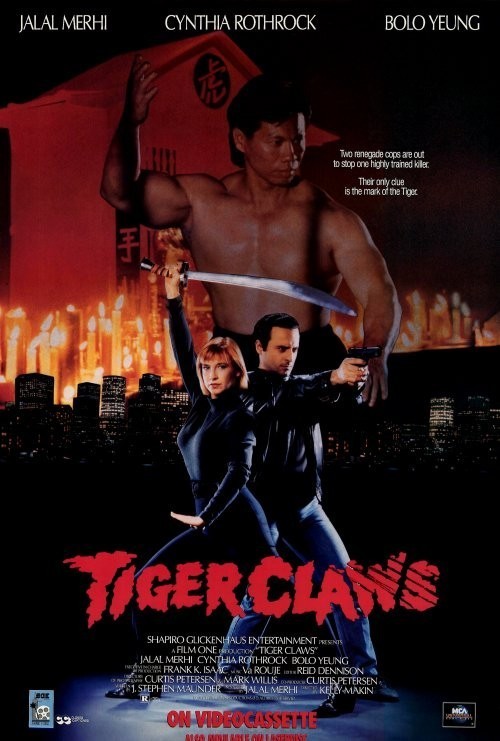




 B-Movie Dragons