
SPOILERS
AHEAD
At
the end of the 80s, a Lebanese-Canadian martial arts competitor sold
his jewelry business and entered the world of karate flicks. His name
is Jalal Merhi, and through money and persistence, he became a staple
name of the U.S. video scene. Nicknamed “Beirut’s Steven Seagal”
(despite his accent making him comparable to Jean-Claude Van Damme),
what set him apart from virtually everyone else on the U.S. martial
arts scene was his desire to showcase Chinese martial arts over their
more common Japanese and Korean counterparts. He tried this first
with Fearless Tiger (1991), a
tournament flick that didn’t see an
American release until three
years after completion, but had greater luck with the more unique
Tiger Claws. Merhi’s
recipe for this endeavor?
– lots of kung
fu, established stars, and a capable
director. The result is a
thoroughly watchable adventure that grew on me over time. It’s an
examination of fanaticism in martial arts, and arguably the best film
Merhi would ever star in.
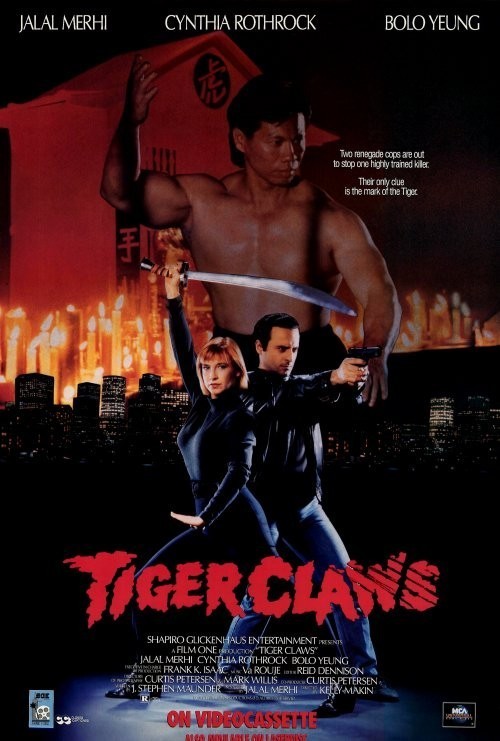
The
movie opens in New York City with a woman (Cynthia Rothrock) hounded
on the street by a suspicious man (Nick Dibley). He corners her with
evil intent, but she fights back and utterly decimates him in a
brawl, knocking him out before he’s arrested. It turns out she’s
Detective Linda Masterson, supercop, and the guy who attacked her was
a suspect in a crime spree. She’s disgusted that her wolf-whistling
partner (Fern Figueiredo) wasn’t anywhere to be found when the
fight happened, but more so that she’s wasting her time “dressing
up like a whore and working on these two-bit cases.” Shortly
thereafter, we meet our other hero: Det. Tarek Richard (Jalal Merhi),
who’s carrying out an undercover drug deal that, somehow, is also
the purview of rival detectives Roberts (Robert Nolan) and Vince
(Kedar Brown). It’s unclear who’s actually out of line, but
Tarek’s suspended when his counterparts initiate a fight/shootout
and the dealer is blown up in his car.
The
case they’re both headed for – Linda by intent and Tarek by
accident – is that of the Death Dealer, a serial killer targeting
martial artists. The victims’ claw-like head wounds lead Linda to
believe that the killer’s also a martial artist and that he can be
unconvered by identifying his fighting style. This impresses her
superior, Sergeant Reeves (John Webster), who assigns her to the case
over a sexist cohort but also demands she work with the
still-suspended Tarek. Linda’s not pleased but has no choice,
especially when Tarek promptly identifies the style as “fu jow . .
. some people call it tiger claw.”
Let’s
pause to examine the story’s unusual take on martial arts
awareness. Usually in these features, a martial artist is teamed up
with someone who has no such experience and thinks “chop socky”
is nonsense. That approach is subverted, here: Linda’s already a
master martial artist but still needs the insight of a “specialist”
like Tarek when it comes to exotic styles. Again, this is part of
Jalal Merhi’s unique formula: not only was he featuring kung fu in
his movies when few others were, but doing so at a time when these
styles weren’t even widely practiced outside of films. It’s less
of a deal now that Hong Kong flicks are widely distributed and it’s
easy to find modern kung fu fight scenes, but at the time, Merhi
capitalized on a market opening and used the opportunity to build up
the Chinese arts grandly. The movie’s stance is that, while you can
be a well-studied martial artist, there’s always more to learn by
looking to the past. If you don’t, you’ll be at a disadvantage.
This sentiment isn’t explored and thus feels a little like martial
arts propaganda (“Your kung fu is strong, but mine is better!”),
but I think Merhi was merely trying to set a precedent at this point.

Photo source | Jalal Merhi, Kedar Brown, Robert Nolan
Tarek
and Linda search Chinatown for the school where the killer trains.
Specifically, they’re searching for a secret studio that only
trains serious fighters – like Tarek says, “This is not a sport
for any bozo with 50 bucks.” They eventually receive a tip from a
drunken boxing student (Rick Sue) who they rescue from a gang
beating. It’s a cool fight, but doesn’t go very far in
distinguishing our heroes’ differing approaches to martial arts:
Tarek has some flowing movements, but he’s still as hard-edged as
his partner. Ironically, it’s Linda who wields a Chinese rope dart.
Anyway, they’re directed to a local tournament to find Sifu Chow
(Mo Chow) – the only fu jow teacher in the area. Tarek not only
finds him, but also an old friend and tournament competitor, John
Atkinson (playing himself). A huge and mysterious man in the crowd
(Bolo Yeung) looks on ominously as John wins the championship.
Shortly thereafter, he shows up in John’s home and attacks him –
killing him with a tiger strike to the face. Afterwards, we see the
guy before a tiger-themed altar decorated with trophies from the
other beaten martial artists. This is our killer.
Tarek
and Linda follow Chow to an abandoned movie theater which Tarek
immediately identifies as his school. He wants to go in right away,
but Linda demands he stay. When a night of waiting results in nothing
but the aforementioned death of his friend, Tarek impatiently sneaks
into the studio on his own. He’s promptly discovered, but –
immediately crafting his cover – earns a chance at tutelage by
revealing that Chow and he studied under the same master. (Stroke of
luck, huh?) Before leaving, Tarek notices his friend’s killer
painting a mural on the wall, but of course doesn’t know who Chong
is.

Photo source | Cynthia Rothrock, John Webster
TRIVIA:
A subsequent scene features Tarek and Linda arguing whether to go to
an Italian or Chinese restaurant to eat. This mirrors a real-life
event wherein Merhi, Rothrock, Yeung, and some production members
were deciding where to eat after a day of filming. Everyone voted for
Italian, with the exception of Yeung. Merhi, who idolized Yeung,
immediately changed his vote and attempted to sway the group in favor
of Bolo’s choice. He was overruled and the group went to the
Italian locale, where Yeung refused to order anything.
Tarek
returns to the secret studio and earns his spot
by holding his own in against the other students. This is the first
fully-fledged kung fu fight scene, and the difference to previous
brawls is noticeable. The pacing is more restrained and the tiger
claw choreography reminds me of classic Hong Kong fights. You
get the impression that the filmmakers are genuinely trying to make
the fu jow
aspects
stand out, and this continues as Tarek engages
in a necessity for
any
good kung fu
flick – a training scene. He twirls weapons, strikes form, and
toughens his hands by submerging them in a wok of boiling water
filled with chains. Sifu Chow doesn’t do much on-the-ground
teaching, preferring
to beat a drum while his students go
at it, but he does step in
as a rivalry between Tarek and fellow
student James (Ho
Chow) threatens to get out of hand.
In
an unexpected turn, another student (Gary Wong) invites Tarek to a
go-go club, and they take Chong with them. The movie twists
expectations by showing Chong as a normal guy who drinks and laughs
with his comrades, but eventually, the scene’s mainly there so
Tarek can find out how good of a fighter the muralist is when they
have to thwart a mafia attack on the joint. Additionally, Chong keeps
Tarek from killing one of the guys – highlighting the theme of
martial excess that I’ll get into later. In the aftermath, Tarek
still isn’t certain which of the practitioners is the killer, but
Linda thinks it’s the hotheaded James. She confronts him at a
billiard bar, and despite beating up him and half the establishment
in the process, it turns out that he has an alibi. This faux pas
results in Linda and Tarek being removed from the case and being
replaced by the insufferable Roberts and Vince. In the meantime,
Chong kills Sifu Chow and some of the students.

Photo source | Bolo Yeung
This
scene is an enigmatic as it is essential. The final exchange between
Chong and Chow features Chinese dialogue with no subtitles, so while
their exchange may offers clues to Chong’s motives, I can’t be
certain. We
don’t find out otherwise
why Chong is a serial killer. The head-spinning
sequel throws a ton of new, outrageous information into the
continuity, but where only
this movie is concerned, it’s
ambiguous. The only theory
that’d
tie into
an existing theme is that Chong, having taken his training to the
extreme, has literally been driven crazy
by kung fu. Tarek’s spent the picture making sure we know how
demanding and encompassing fu jow is, having mentioned that his wife
left him when last
he trained – implying that
he, like Chong, has the potential to become a menace if
not kept in check. Tarek’s
also the only character to voice a
theory on Chong’s motives, saying that perhaps he’s
trying to “drum up lost respect for his style.” This may in fact
be a part of the reason,
given how the movie venerates
kung fu. Chong may see his
victims and
their martial arts as temporary and weak and is thus trying to
exemplify
the “true” martial art. This isn’t entirely without real-world
parallel: fierce inter-style
competition goes back centuries, and Chinese styles have often been
ridiculed in modern times
by “hard style” practitioners for being impractical and fancy.
Altogether, this information
comprises pieces to Chong’s puzzle, but the picture still isn’t
clear. Perhaps that’s why the movie reveals the killer relatively
early: it’s not bad writing, but an intended opportunity for
viewers to ponder Chong’s motives.
Tarek
and Linda refuse to drop the case, and they somehow
determine that Chong is their
prime suspect. Their suspicions are confirmed when they enter the
studio, finding the others
dead and Chong in attack
mode. He flees after a quick
duel with Linda, who spends the rest of the night searching for him
with Tarek. They find him at the pier, but not before the bumbling
Roberts and Vince arrive and handcuff
Tarek, suspecting him of the murders. Linda and Chong fight again –
possibly the best one-on-one match of the film – but the finale
pits the still-handcuffed Tarek against Chong in a warehouse. In a
bit of egoism, Jalal Merhi’s character is able to best Chong while
spending the majority of the fight with his hands bound. The
film ends with with Chong apprehended, Tarek and Linda commended, and
the former reinstated while the two share an awkwardly-earned
kiss on Tarek’s boat.

Photo source | David Stevenson
TRIVIA:
The movie draws on real-life characteristics for many of its
characters. For example… Linda is from Scranton, PA and
Chong is from Canton, China – just like their actors. Jalal Merhi
wasn’t divorced, but like Tarek, he was single at the time of
production. John Atkinson was indeed a successful karate fighter and
multi-time grand champion. Mo Chow is a martial arts
instructor who operates his own studio.
Bill Pickels – Chong’s first victim – is a former cable TV
personality in Canada. Three actors share similar or identical names
with their characters: Mo Chow, John Atkinson, and Bill Pickels.
I
wasn’t a Jalal Merhi fan when I first saw this, and only held onto
the tape for Cynthia Rothrock. I can still see why the guy didn’t
click with me right away. Merhi lacks the charisma that makes even a
questionable actor like Rothrock fun to watch, and despite his
emphasis on kung fu being genuinely unique at the time, it doesn’t
make him stand out to the average viewer. Despite his efforts, Merhi
isn’t comparable to Steven Seagal introducing aikido in the late
80s or Tony Jaa rewriting action choreography with muay thai in the
2000s. Nevertheless, the more of this subgenre you consume, the more
Jalal’s effort does in fact stand out. The Chinese martial arts
help give this movie a unique flavor that you won’t find in other
kick flicks of the same budget. The crisp forms, traditional uniforms
and decent training montages eventually give the movie an air of
importance that I kind of miss in other features. This approach won’t
click with viewers who’d rather limit martial arts exclusively to
fight scenes, but it might be unique enough for those who’ve grown
tired of repetitious kickboxing.
Merhi’s
use of eye-catching names to star alongside him is a sound decision,
but again, you can’t help but chuckle at the scene that features
him defeating Bolo Yeung as Cynthia
Rothrock fishes a buffoonish
detective out of the bay.
Nevertheless, treating his own
character as exemplary
doesn’t mean the others are treated as jokes. This is one of
Yeung’s most interesting non-Hong
Kong roles, and even though
Rothrock hangs back many
times, both she
and Bolo are given ample
opportunity to steal the show in
fight scenes. To tell the
truth, Merhi is
elevated by their presence because
they bring out a lot in him. I’ve seen the guy do flashier moves,
but he’s never looked as tight and collected as he does here. To
date, Merhi is the only Arab martial arts star who’s had a solo
career in North America, and he really puts his best foot forward in
making a first impression here.
Exploring
the martial arts theme yields contradictory results. We’re to
presume that fu jow – and “old” martial arts in general – are
superior to modern forms, because when they come into contact, the
former tends to triumph. Nevertheless, Linda seems to be the
exception: she isn’t versed in fu jow but still defeats a hardcore
practitioner in direct combat. We’re also led to believe that
respect and mastery of the martial arts is limited to the experience
of immigrants and minority characters, but the majority of Chong’s
victims fall under the same labels. There’s also a theme of martial
arts bringing people together – i.e. Linda and Tarek bonding over
their practice of the fighting arts – but this ignores that Tarek’s
wife left him because of his training and that Chong’s obsession
with the martial arts may be the cause of his murderous behavior. I
wish the film were more consistent in what it’s saying.
Nevertheless,
it’s still enjoyable and that’s got much to do with director
Kelly Makin. Merhi had a knack for selecting inexperienced directors
who’d later go on to critical acclaim, and Makin displays his
talent via style in what would otherwise have been a humdrum-looking
picture. Though I’m not sure whether anyone would think this is an
A-grade production, Makin delivers a consistently clean look and
takes time to highlight the soundtrack, indulge in interesting camera
angles, and even film an occasional arty establishing shot. Though
not the best in this regard, he can shoot a fight scene surprisingly
well.
Tiger
Claws is a
fun watch for genre fans and definitely worth
hooking up the old VCR for. The
cast is a supergroup of genuine martial talent and
the filmmakers
know how
to make them shine. There are plenty of things I’d change, but
overall, this is one experiment that pays off. People interested in
coming into these types of movies should definitely consider it, and
established viewers
who’ve yet to see this particular one shouldn’t hesitate much
longer. Check it out!

Tiger
Claws
(1991)
Directed
by
Kelly Makin (Mickey
Blue Eyes)
Written
by J.
Stephen Maunder (writer for almost all of Jalal Merhi’s movies)
Starring
Jalal Merhi, Cynthia Rothrock (China
O’Brien),
Bolo Yeung (Bloodsport),
John Webster
Cool
costars:
Gary Wong, Michael Bernardo (WMAC
Masters),
Rick
Sue (Expect
No Mercy),
David Stevenson (Death
House),
Bill Pickels (Sworn
to Justice),
Mo
Chow (Talons
of the Eagle)
and Ho Chow
(Kung
Fu: The Legend Continues)
are
all legitimate martial artists playing the part. Wing chun legend
Dunn Wah (AKA Sunny Tang) plays a master
but doesn’t have
any fight scenes. IMDb credits gang member William Cheung as the
William
Cheung – kung
fu
master and contemporary
of Bruce Lee
– but I don’t think they’re the same person. Similarly,
John
Atkinson is identified as an English TV actor who died in ‘07,
whereas the real performer currently operates a martial arts studio
in Arizona. Robert
Nolan
(Sixty
Minutes to Midnight)
is
a fairly
acclaimed dramatic
actor
while his onscreen partner
Kedar Brown has
been building a career in
voice acting.
Content
warning: Sexist
dialogue, attempted
sexual assault, group
violence, WTC imagery
Copyright
Tiger Claws Productions, Ltd. / MCA Universal Home Video (now
Universal Pictures Home Entertainment)
 B-Movie Dragons