
*SPOILERS
AHEAD*
When it comes to cult movies, the original Bloodsport
has its own shelf in the annals of nostalgia. Though I’m not the biggest fan of
that one, I recognize its significance and respect it for helping to reignite interest
in martial arts cinema in the post-Bruce Lee world. Given such status, it’s
inevitable that unfavorable comparisons would dog its lesser-known sequel,
especially since Jean-Claude Van Damme is nowhere to be seen here. Personally, I give
the movie more credit than just being a follow-up. Bloodsport II: The Next Kumite isn’t a perfect film, but it is an absolute opus of onscreen karate. This is as good as it gets for martial arts tournament
flicks, and I’d match it against any picture of the same description.

The generic titles and the opening scene of kids in a dojo don’t
exactly imbue the movie with promise, but luckily,
here comes James Hong – one of my favorite actors – to play the role of Master
Sun. He calms the children by beginning a lengthy story about Alex Cardo
(Daniel Bernhardt), a professional thief whose tale begins with crashing the party of a wealthy businessman in Thailand (Pat Morita). Cardo
describes himself as a speaker of multiple languages, a specialist in Chinese
antiquities, and as being “quite good with [his] hands” – in other hands, he’s
as cocky as they come. Luckily, his arrogance doesn’t last long:
he’s come to steal an antique sword, and even though he
succeeds and beats up three guards in the process, his nefarious partner John (Philip Tan) double-crosses him and Alex is arrested. In
the words of Master Sun, “His greed had led him to a very dark place.”
The impression that Daniel Bernhardt makes on viewers during these opening
scenes is the impression of the film thus far, and I can empathize with
people who don’t take to it right away. The fact that Bernhardt uncannily looks,
sounds, and kicks like Van Damme almost makes me wonder why the filmmakers
didn’t just have him carry on the Frank Dux character from the original…but then again, even a good imitation is merely an imitation. Daniel
Bernhardt can’t help the way he looks, but perhaps the film would have been
better served with a more unique persona. The knockoff factor is high.
TRIVIA: The Bernhardt-Van Damme
connection encompasses more than just physical similarities. The two of them had
previously appeared together in a commercial for Versace Jeans, and
producer Mark DiSalle takes credit for having “discovered” both of them.
Alex is sent to prison. This seems to bring out his better side, as his
first act is to defend a fellow newbie being assaulted by the inmates. He subsequently makes the acquaintance of two other main characters: the sadistic prison guard Demon (Hans Ong) and the imprisoned Sun, who advises
Alex against fighting the guards. Sun is a lifer, imprisoned for the murder of
a rapist, and the bleakness of his situation is illustrated by that
his primary occupation seems to be sweeping a prison yard that’s
entirely made of sand. However, he has more interesting talents than that: Alex’s second
meeting with the bullying thugs doesn’t go well, and Sun demonstrates some
impressive tai chi to decimate the attackers. This sparks a mentor-pupil
relationship between the two, with Sun agreeing to teach Alex his secret – the
Iron Hand system.

Also called Iron Palm, Iron Hand is not actually a martial arts style but a system
of conditioning techniques meant to increase striking power and bolster the
durability of the fingers and palms. Sun’s variation includes
fancy kicks and extinguishing candles with a punch, and this makes for a reasonably
fun training montage. I set no store by Sun’s concept
of chi and I think his armchair diagnosis of Alex’s psychological state is
silly, but he does make mention of something we’ve been waiting for since the beginning: the Kumite tournament, which he claims to have competed in. Alex is intrigued,
but Sun informs him that he will first have to earn an invitation – foreshadowing the trial Alex will have to go through after their chat. An attempt is made on Alex’s life by
the same thugs as before, and when he successfully defends himself, the
complicit Demon has Alex placed in a sweatbox.
Alex survives his presumably lengthy punishment by maintaining a spiritual connection
with Sun, with both of them striking hard surfaces to simulate their synchronized heartbeat. Mythically, this is Alex’s belly of the whale, and he emerges
prepared to undergo a heroic metamorphosis. He begins to excel in his training
– now able to extinguish candles with both fists and feet – and demonstrates a
newfound ability to get along with fellow inmates by playing checkers with them. You get the impression that he’s learned all he can here, so it’s
fortunate when he’s mysteriously freed. On his way out,
Alex makes two promises to Sun: that he will free him as well, and that he will
“make the Kumite a spiritual event again” – in response to the
sadistic Demon having been invited to compete.
When Alex finds out that his
liberator is none other than the businessman whose sword he stole – David
Leung – he makes one more promise: to retrieve the sword from his villainous
ex-partner and return it to Leung. The sword, you see, is the grand prize of
the Kumite, and Leung needs Alex’s help to get it back.
TRIVIA: All inmates in the prison wear
conspicuous pink outfits. This costume design wasn’t planned, but was decided
on when director Alan Mehrez got a good deal on the fabric.
Alex arrives at the Kumite, and I think these initial scenes divide viewers
by how they deconstruct the tournament. For starters, the involvement of David Leung throws back the aura of secrecy from the first film. (How secret can a tournament be if a public businessman is supplying the prize?) Also, Alex is able to show up there
even though he hasn’t received an invitation, whereas the original film required the hero to pass through checkpoints. And perhaps more surprising than anything, we see that the
returning Ray “I ain’t your pal, dickface” Jackson (Donald Gibb) is now
involved in the tournie’s organization. It’s not explained how he went from being
a competitor to an associate, and given that he’s still the loudmouthed brawler he was in the past, you can’t help but wonder who the heck thought he was
supervisory material.

Much to Alex’s benefit, Ray has an odd way of doing his job. See, when
the head judge (Hee Il Cho) refuses Alex entry because he doesn’t have an invitation, Ray sets up an opportunity for Alex to win the invite of a fighter he’d just expelled (Jeff Wolfe). (It’s sort of a jerk move, given that Ray’s sole reason for tossing him out is that he
didn’t think he was good enough.) He does this for unexplained reasons, and after Alex wins a one-sided fight and the right to compete, the two of them become buddies. Weird.
We’re introduced to a handful of fighters with just enough screen time to count as characters. Cliff (Ron Hall) was the one who suggested
Alex consult Ray for help. Sergio (Nicholas Hill) is a self-proclaimed street
fighter and another of Alex’s impromptu friends. And Kim (Lisa McCullogh) is…well, not a
man. Admittedly, all of these characters have equally little substance, but how the film handles Kim is particularly irritating.
The screenplay *cannot* get over the fact that she’s a woman. She’s introduced
as the first female fighter to compete in the Kumite, and her reception in entering into an exclusively male domain is kinda harrowing. Her peers
hit on her, treat fights with her as a mockery, and go out of their way to try to
humiliate her. There are sexual jokes, and Ray feels compelled to protect her
more than he would any other fighter. At one point, she’s kissed against her
will. To be fair, the spotlight shines on her a little more than the other
fighters, but it’s disappointing what the filmmakers chose to
focus on.
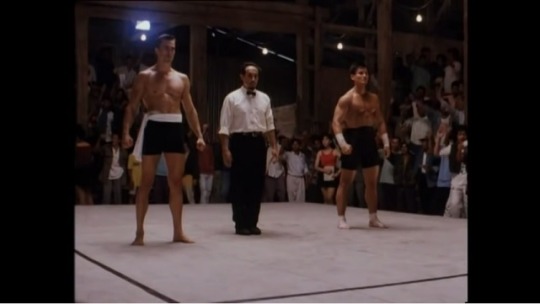
Once the Kumite commences, I ascend to martial arts heaven. While it’s boring in the sense that the story all but stops, it’s
exciting in that I’ve rarely come across a collection of fight scenes that
consistently maintains such a high standard. While it lacks the original movie’s
theatrical touch, it nevertheless surpasses its predecessor in substance by presenting all
fights in their entirety. Nothing against montages, but give me any number of
consecutive brawls over a collection of snippets any day. There’s a lot of
back-and-forth action and long, uninterrupted shots – the foundations of any
great fight scene. The only real disappointment here is Demon, who – like Alex
– is very obviously modeled after his counterpart in the first film. Demon is arrogant,
plays to the crowd and flexes his muscles a lot, but the performance has a forced
look and can’t touch Bolo Yeung as Chong Li. A reenactment
of the judges turning their backs on the villain after he kills a competitor feels particularly desperate.

As he advances through the tournament, Alex also has to worry about retrieving
the sword. Despite having been offered David Leung’s vast resources, Alex is determined to carry out the recovery by himself.
It’s not clear why, but his plan bears fruit: he tricks
John into appearing for a faux transaction, then has the police show up to
arrest him – but not before a quick fight.
Ray and Sergio are searching for Alex at the same time, and in coming upon the
scene, Sergio is shot in the leg by John’s bodyguard. They don’t make a huge
deal about this, but I’m a little indignant. After all, Sergio had a real
shot of winning the tournament by now, and his injury could have been avoided if Alex hadn’t been all lone
wolf about this.
TRIVIA: Eight months after the film’s release, Nicholas Hill competed in the World Vale Tudo Championships under the ring name
Niccolaus. Though Hill was a legitimate martial artist who owned a dojo, he hadn’t competed before and lost to his opponent, future UFC star Pedro Rizzo. While the promoters viewed this as a one-off adventure and publicity stunt, Hill was in fact eager to compete and thus embarked on a six-year career as a pro MMA fighter.
With the sword retrieved, Alex has an excellent match against another
semifinalist (Chad Stahelski) en route to meeting Demon in the finals. Things start out bad for Alex: he goes down following a few hard strikes, exclaiming that “[Demon’s] arms are like
cement.” Demon nearly eliminates
Alex by targeting his leg, but the protagonist rallies upon receiving help
from an unexpected source. Unbeknownst to him, David has already freed Sun, who
is present at the match and is able to remind Alex of his training. By
channeling his inner strength, Alex is able to defeat Demon’s ‘cement arms’
with his Iron Palm. Upon victory, Alex is awarded the sword, but later presents
it to Sun in gratitude.
The film ends with a thoroughly unearned kiss between Alex and Janine (Lori
Lynn Dickerson). She’s technically been his love interest throughout the movie,
but has been so underutilized that I haven’t bothered mentioning her.
I have to admit, the storyline seems a little less sound than when I first saw
the movie. The narrative hops around a
little and, with the exception of Alex and Sun, it doesn’t do a great job of
building character relationships. Nevertheless, the film
largely succeeds in recapturing the first film’s ambience. No mention is made of the
original’s protagonist, Frank Dux, but it feels like this is the same world he
inhabits. My favorite aspect of this is the extensive assortment of fighters,
which measures up well to the first movie’s. It’s the same kind of cattle call
for martial artists, and the varied personalities that show up are impressive.
Nicholas Hill, Philip Tan, and grappler Gokor Chivichyan are (or would be) champions in
their respective disciplines; judge Hee Il Cho and fighter Jerry Piddington
give the roster some clout as legitimate masters; Ron Hall is hands-down one of
the most exciting performers in America. It’s a great ensemble,
unmatched in size and skill in all but a few movies.
On the surface, Bloodsport II seems
like a pretty straightforward film with an unambitious story. However, given that
the script supposedly underwent considerable rewrites, it’s worth looking at a
little more closely for signs of intrigue. Sure enough, there seem to
be traces of a deeper story here. The mention of Alex’s past as the unhappy son
of missionaries, Sun’s backstory as an immigrant in Thailand, and the
hints of a more established relationship between Alex, Cliff, and Sergio
provide some fodder for headcanon. However, the part that got me thinking more than
anything is an almost overlookable snippet in the film’s first half. When Alex is
thrown into the sweatbox, he experiences a series of
hallucinations; many of these are just replayed footage of past events, but
there’s also a momentary shot of him placing a damp cloth on a prone Sun’s
head. This scene never occurs elsewhere in the movie, and it’s actually the reverse
of what happens when Sun nurses Alex back to health. This may simply be
salvaged footage from a deleted scene, but I interpret it as Alex’s realization
of his transformation. The relationship between him and Sun had almost
exclusively been to his benefit until then, but soon after, Alex makes his commitment
to free his teacher. Alex seems to have been endowed with a sense of purpose during the
sweatbox torture and comes to see himself as Sun’s savior. Such extraordinary conviction
may explain his confidence in handling a life & death situation later (i.e.
the bust on John), and it even justifies the seemingly empty spiritual talk
throughout the movie. Basically, I think Alex received a supernatural
premonition in the hotbox. After all, heat exhaustion is often used as a
catalyst in trances.
In an interview on The Voice Versus
TV show, the real-life Frank Dux claimed that the reason Bloodsport II “never went anywhere” was because he wasn’t involved
in its production and it lacked his style of fight choreography. It seems more likely that the film’s obscurity is
due to that it was a low-budgeted limited release produced by
filmmakers who specialized in DTV work and didn’t star Van Damme. Daniel
Bernhardt has since played supporting villains in major pictures, but I don’t
think there are too many casual viewers looking up his past work. As such, Bloodsport II doesn’t stand on accolades
or cult fame; it stands solely on its merits, and in that regard, I’d argue
that it definitely does go places. It has a good cast, excellent fight scenes, and it’s colorful and fun to look at. It’s
a smooth, exhilarating adventure whose faults don’t come close to dragging it
down. I’d even say that as far as pure DTV martial arts flicks go, this is one
of the very best. Check it out!
TRIVIA: The movie features 28 full-length
fight scenes – seven more than its predecessor. This officially makes it one of the
most fight-crammed U.S. productions ever released.

Bloodsport
II: The Next Kumite (1996)
Directed by Alan Mehrez (Bloodsport III)
Written by Jeff Schechter (creator
of the TV show Stitchers)
Starring Daniel Bernhardt (True Vengeance), James Hong (Big Trouble in Little China), Donald
Gibb, Pat Morita (The Karate Kid series)
Cool costars: Hans Ong (Dragon: The Bruce Lee Story), Philip Tan
(Martial Law), Ron Hall (Triple Impact), Nicholas Hill (Fists of Iron), Hee Il Cho (Best of the Best), Jeff Wolfe (Once Upon a Time in China and America),
Nils Allen Stewart (Mercenary), Earl
White (Heatseeker), Gokor Chivichyan
(Streets of Rage). Lisa McCullogh was
one of Uma Thurman’s stunt doubles in Kill
Bill Vol. 1. Chad Stahelski has since become one of the top Hollywood fight
choreographers. Fighters Jerry Piddington and Ken Harte don’t have many other
credits but are respected as masters in the martial arts community. The
credits claim that good ol’ Eric Lee is in here, playing a character called
Seng, but I haven’t been able to identify him.
Title refers to: The tournament. Whether it’s actually the next Kumite – i.e. the one following the original film’s – isn’t clear.
Content warning: Prison violence and abuse, group violence, torture, sexual harassment and assault
Copyright FM Entertainment
International N.V.
 B-Movie Dragons