For reasons I can’t
explain, I hadn’t thought to look into the Never Back Down
series before now
and thereby completely
overlooked
that Michael Jai White had
expanded from martial arts star to
filmmaker. This
movie
actually gives me some hope for the future, as it’s virtually the
only one I’ve seen
show an interest in actually
carrying on the legacy of
martial arts videos’ glory days. Don’t give me another boring
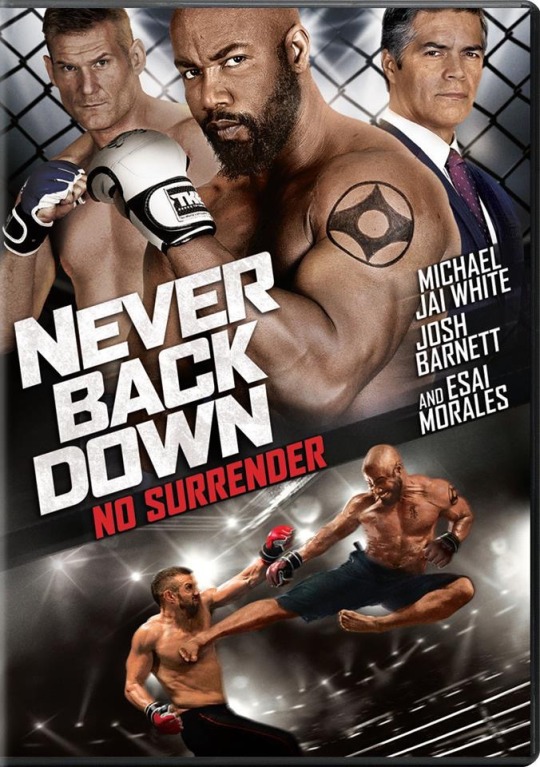
Dolph Lundgren production if White’s making films. Of course, Never
Back Down: No Surrender’s
not perfect – it’s
actually one of the few
movies of this sort where the problematic screenplay bothers me more
than any technical shortcomings. As
is, this one works best as a blueprint to improve on, but in
the meantime, it’s a very
watchable blueprint.
The story: Legendary
fighter Case Walker (Michael Jai White) travels to Thailand to train
his comrade Brody James (Josh Barnett) for a high-stakes title match,
but soon realizes that the promoter (Esai Morales) has shady
intentions.
NBD3
has so many real-life
influences that it’s practically
meta. There are numerous
connections
between Josh Barnett’s character and the actor’s
real-life competitive career,
many of them unflattering. Additionally,
the movie tackles the
ever-relevant issue of steroids in sports with
surprising zeal. Ironically,
this approach makes the
film’s frequent idealistic stances feel haphazard and naive, as
it presents
simplistic solutions to complex problems. Also, I didn’t like that
the story is full of unresolved issues: aside from the loose
thread of Casey taking on a couple of young proteges, it’s
uncomfortable that
the feature
allows
things like Brody’s blatant infidelity and the racism of some
supporting characters to
fade into the background. I also
didn’t like how a side-story regarding sexism towards a character
played by Jeeja Yanin is “resolved” via sexism. Despite
all of this, the screenplay isn’t
weak: Case
Walker is likable enough,
and the story eschews
typical life-and-death setups in
favor of a political approach
that feels more suitable to
modern sports promotion. Not
every idea it has
pans out, but I can
appreciate a film for showing
me that it at least had thought behind
it.
How
much you enjoy the action content depends
on your tolerance of
unnecessary slow motion. Fight
choreographer Larnel Stovall delivers good stuff, but the fact that
only a couple of the eight fights
aren’t mucked about with
this editing technique
is disappointing.
Nevertheless, Michael Jai White remains one of the best performers in
modern martial arts films,
and this is apparent throughout the feature. Though he achieves
Hector Echavarria levels of self-glorification by including a scene
that puts him over a genuine MMA star
like Josh Barnett, he looks fantastic in whatever he does and
whoever he fights. He’s got
a great cast of supporting
kickers,
including Nathan Jones as the rival champion and genre
staples Brahim Achabbakhe,
Eoin
O’Brien, and Ron Smoorenburg as
various brawlers.
More impressive on paper but less so onscreen are the Thai stars: the
aforementioned Jeeja Yanin has a
single
fight and is barely a character, while Tony Jaa only shows up to make
a fool of himself in a comedy cameo. Seriously,
if
the poor quality and
infrequency of
Jaa’s most recent output
hasn’t
caused you to lose esteem for him, his buffoonish
scenes
here will do the trick.
Despite these disappointments, NBD3
is an enjoyable watch. Again, I’m pleased that MJW
chose
to be
a filmmaker: it’s good
knowing that the legacy of U.S. martial arts videos has a competent
torchbearer, and it’s important that the subgenre contains
perspectives other than those of white men.
The main problem remains
the movie’s screenplay, but
I’m hopeful that White will improve in that regard in
time. Even so, this one is
worth a look.
Written
by
Chris Hauty (Never
Back Down 1
& 2), Michael Jai White
Starring
Michael Jai White, Josh Barnett (Absolution),
Gillian White (Bamboozled),
Esai Morales (NYPD
Blue)
Cool
costars:
Stephen Quadros (Sworn
to Justice),
Nathan Jones (Tom
Yum Goong),
Jeeja Yanin (Raging
Phoenix),
Brahim Achabbakhe (Dragonwolf),
Ron Smoorenburg (Who
Am I),
Damian Mavis (Kung
Fu Yoga),
Amarin Cholvibul (Hard
Target 2),
Eoin O’Brien (Kill
‘Em All),
and Creighton Mark Johnson (Risk
for Honor)
all appear in martial roles. Pro fighter Quinton Jackson cameos in a
little scene. Tony Jaa also cameos, but…I just can’t.
Content
warning:
Sexist
and racist dialogue, racially-motivated violence,
police brutality. There’s
also a scene where a transsexual prostitute is “humorously” outed
against her will.
A
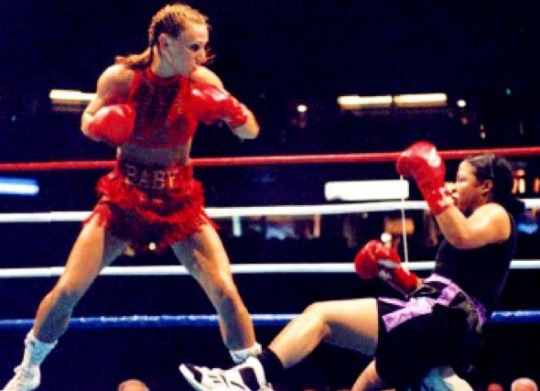
career in the fighting arts wasn’t what people expected of Bridgett
Riley, a former cheerleader who was working as a flight attendant
when she made the transition to professional kickboxing. Her
nickname, “Baby Doll,” was bestowed on her in her teens by a
karate instructor who was amazed by the small-statured young woman’s
fighting ability. Nowadays, people are less surprised, given
Bridgett’s thorough domination of the pro kickboxing scene and five
world championship reigns. What’s more, Riley bridged
the gap between martial arts and boxing – becoming a top rated
pugilist and securing a 15-3 record with one IFBA World Championship
reign. All the while, Riley successfully balanced her fighting
careers with one in show business: though still mainly known for her
stuntwork in major blockbusters, she’s also notable for a handful
of fighting parts in DTV films and television.
Films
to See Triple Impact (1992)
– lead role Bare Knuckles
(2013) – supporting role WMAC Masters
(1995-1996) – recurring role
Trivia:
In her first professional kickboxing match, Riley defeated
U.S.
national champion Denise Taylor in a major upset. Taylor grabbed a microphone and demanded a rematch, calling
her loss a fluke.
A month later, Riley defeated Taylor again
via
technical knockout – breaking her nose in the process.
When it comes to cult movies, the original Bloodsport
has its own shelf in the annals of nostalgia. Though I’m not the biggest fan of
that one, I recognize its significance and respect it for helping to reignite interest
in martial arts cinema in the post-Bruce Lee world. Given such status, it’s
inevitable that unfavorable comparisons would dog its lesser-known sequel,
especially since Jean-Claude Van Damme is nowhere to be seen here. Personally, I give
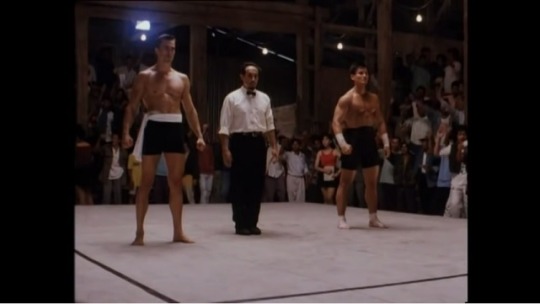
the movie more credit than just being a follow-up. Bloodsport II: The Next Kumite isn’t a perfect film, but it is an absolute opus of onscreen karate. This is as good as it gets for martial arts tournament
flicks, and I’d match it against any picture of the same description.
The generic titles and the opening scene of kids in a dojo don’t
exactly imbue the movie with promise, but luckily,
here comes James Hong – one of my favorite actors – to play the role of Master
Sun. He calms the children by beginning a lengthy story about Alex Cardo
(Daniel Bernhardt), a professional thief whose tale begins with crashing the party of a wealthy businessman in Thailand (Pat Morita). Cardo
describes himself as a speaker of multiple languages, a specialist in Chinese
antiquities, and as being “quite good with [his] hands” – in other hands, he’s
as cocky as they come. Luckily, his arrogance doesn’t last long:
he’s come to steal an antique sword, and even though he
succeeds and beats up three guards in the process, his nefarious partner John (Philip Tan) double-crosses him and Alex is arrested. In
the words of Master Sun, “His greed had led him to a very dark place.”
The impression that Daniel Bernhardt makes on viewers during these opening
scenes is the impression of the film thus far, and I can empathize with
people who don’t take to it right away. The fact that Bernhardt uncannily looks,
sounds, and kicks like Van Damme almost makes me wonder why the filmmakers
didn’t just have him carry on the Frank Dux character from the original…but then again, even a good imitation is merely an imitation. Daniel
Bernhardt can’t help the way he looks, but perhaps the film would have been
better served with a more unique persona. The knockoff factor is high.
TRIVIA: The Bernhardt-Van Damme
connection encompasses more than just physical similarities. The two of them had
previously appeared together in a commercial for Versace Jeans, and
producer Mark DiSalle takes credit for having “discovered” both of them.
Alex is sent to prison. This seems to bring out his better side, as his
first act is to defend a fellow newbie being assaulted by the inmates. He subsequently makes the acquaintance of two other main characters: the sadistic prison guard Demon (Hans Ong) and the imprisoned Sun, who advises
Alex against fighting the guards. Sun is a lifer, imprisoned for the murder of
a rapist, and the bleakness of his situation is illustrated by that
his primary occupation seems to be sweeping a prison yard that’s
entirely made of sand. However, he has more interesting talents than that: Alex’s second
meeting with the bullying thugs doesn’t go well, and Sun demonstrates some
impressive tai chi to decimate the attackers. This sparks a mentor-pupil
relationship between the two, with Sun agreeing to teach Alex his secret – the
Iron Hand system.
Also called Iron Palm, Iron Hand is not actually a martial arts style but a system
of conditioning techniques meant to increase striking power and bolster the
durability of the fingers and palms. Sun’s variation includes
fancy kicks and extinguishing candles with a punch, and this makes for a reasonably
fun training montage. I set no store by Sun’s concept
of chi and I think his armchair diagnosis of Alex’s psychological state is
silly, but he does make mention of something we’ve been waiting for since the beginning: the Kumite tournament, which he claims to have competed in. Alex is intrigued,
but Sun informs him that he will first have to earn an invitation – foreshadowing the trial Alex will have to go through after their chat. An attempt is made on Alex’s life by
the same thugs as before, and when he successfully defends himself, the
complicit Demon has Alex placed in a sweatbox.
Alex survives his presumably lengthy punishment by maintaining a spiritual connection
with Sun, with both of them striking hard surfaces to simulate their synchronized heartbeat. Mythically, this is Alex’s belly of the whale, and he emerges
prepared to undergo a heroic metamorphosis. He begins to excel in his training
– now able to extinguish candles with both fists and feet – and demonstrates a
newfound ability to get along with fellow inmates by playing checkers with them. You get the impression that he’s learned all he can here, so it’s
fortunate when he’s mysteriously freed. On his way out,
Alex makes two promises to Sun: that he will free him as well, and that he will
“make the Kumite a spiritual event again” – in response to the
sadistic Demon having been invited to compete.
When Alex finds out that his
liberator is none other than the businessman whose sword he stole – David
Leung – he makes one more promise: to retrieve the sword from his villainous
ex-partner and return it to Leung. The sword, you see, is the grand prize of
the Kumite, and Leung needs Alex’s help to get it back.
TRIVIA: All inmates in the prison wear
conspicuous pink outfits. This costume design wasn’t planned, but was decided
on when director Alan Mehrez got a good deal on the fabric.
Alex arrives at the Kumite, and I think these initial scenes divide viewers
by how they deconstruct the tournament. For starters, the involvement of David Leung throws back the aura of secrecy from the first film. (How secret can a tournament be if a public businessman is supplying the prize?) Also, Alex is able to show up there
even though he hasn’t received an invitation, whereas the original film required the hero to pass through checkpoints. And perhaps more surprising than anything, we see that the
returning Ray “I ain’t your pal, dickface” Jackson (Donald Gibb) is now
involved in the tournie’s organization. It’s not explained how he went from being
a competitor to an associate, and given that he’s still the loudmouthed brawler he was in the past, you can’t help but wonder who the heck thought he was
supervisory material.
Much to Alex’s benefit, Ray has an odd way of doing his job. See, when
the head judge (Hee Il Cho) refuses Alex entry because he doesn’t have an invitation, Ray sets up an opportunity for Alex to win the invite of a fighter he’d just expelled (Jeff Wolfe). (It’s sort of a jerk move, given that Ray’s sole reason for tossing him out is that he
didn’t think he was good enough.) He does this for unexplained reasons, and after Alex wins a one-sided fight and the right to compete, the two of them become buddies. Weird.
We’re introduced to a handful of fighters with just enough screen time to count as characters. Cliff (Ron Hall) was the one who suggested
Alex consult Ray for help. Sergio (Nicholas Hill) is a self-proclaimed street
fighter and another of Alex’s impromptu friends. And Kim (Lisa McCullogh) is…well, not a
man. Admittedly, all of these characters have equally little substance, but how the film handles Kim is particularly irritating.
The screenplay *cannot* get over the fact that she’s a woman. She’s introduced
as the first female fighter to compete in the Kumite, and her reception in entering into an exclusively male domain is kinda harrowing. Her peers
hit on her, treat fights with her as a mockery, and go out of their way to try to
humiliate her. There are sexual jokes, and Ray feels compelled to protect her
more than he would any other fighter. At one point, she’s kissed against her
will. To be fair, the spotlight shines on her a little more than the other
fighters, but it’s disappointing what the filmmakers chose to
focus on.
Once the Kumite commences, I ascend to martial arts heaven. While it’s boring in the sense that the story all but stops, it’s
exciting in that I’ve rarely come across a collection of fight scenes that
consistently maintains such a high standard. While it lacks the original movie’s
theatrical touch, it nevertheless surpasses its predecessor in substance by presenting all
fights in their entirety. Nothing against montages, but give me any number of
consecutive brawls over a collection of snippets any day. There’s a lot of
back-and-forth action and long, uninterrupted shots – the foundations of any
great fight scene. The only real disappointment here is Demon, who – like Alex
– is very obviously modeled after his counterpart in the first film. Demon is arrogant,
plays to the crowd and flexes his muscles a lot, but the performance has a forced
look and can’t touch Bolo Yeung as Chong Li. A reenactment
of the judges turning their backs on the villain after he kills a competitor feels particularly desperate.
As he advances through the tournament, Alex also has to worry about retrieving
the sword. Despite having been offered David Leung’s vast resources, Alex is determined to carry out the recovery by himself.
It’s not clear why, but his plan bears fruit: he tricks
John into appearing for a faux transaction, then has the police show up to
arrest him – but not before a quick fight.
Ray and Sergio are searching for Alex at the same time, and in coming upon the
scene, Sergio is shot in the leg by John’s bodyguard. They don’t make a huge
deal about this, but I’m a little indignant. After all, Sergio had a real
shot of winning the tournament by now, and his injury could have been avoided if Alex hadn’t been all lone
wolf about this.
TRIVIA: Eight months after the film’s release, Nicholas Hill competed in the World Vale Tudo Championships under the ring name
Niccolaus. Though Hill was a legitimate martial artist who owned a dojo, he hadn’t competed before and lost to his opponent, future UFC star Pedro Rizzo. While the promoters viewed this as a one-off adventure and publicity stunt, Hill was in fact eager to compete and thus embarked on a six-year career as a pro MMA fighter.
With the sword retrieved, Alex has an excellent match against another
semifinalist (Chad Stahelski) en route to meeting Demon in the finals. Things start out bad for Alex: he goes down following a few hard strikes, exclaiming that “[Demon’s] arms are like
cement.” Demon nearly eliminates
Alex by targeting his leg, but the protagonist rallies upon receiving help
from an unexpected source. Unbeknownst to him, David has already freed Sun, who
is present at the match and is able to remind Alex of his training. By
channeling his inner strength, Alex is able to defeat Demon’s ‘cement arms’
with his Iron Palm. Upon victory, Alex is awarded the sword, but later presents
it to Sun in gratitude.
The film ends with a thoroughly unearned kiss between Alex and Janine (Lori
Lynn Dickerson). She’s technically been his love interest throughout the movie,
but has been so underutilized that I haven’t bothered mentioning her.
I have to admit, the storyline seems a little less sound than when I first saw
the movie. The narrative hops around a
little and, with the exception of Alex and Sun, it doesn’t do a great job of
building character relationships. Nevertheless, the film
largely succeeds in recapturing the first film’s ambience. No mention is made of the
original’s protagonist, Frank Dux, but it feels like this is the same world he
inhabits. My favorite aspect of this is the extensive assortment of fighters,
which measures up well to the first movie’s. It’s the same kind of cattle call
for martial artists, and the varied personalities that show up are impressive.
Nicholas Hill, Philip Tan, and grappler Gokor Chivichyan are (or would be) champions in
their respective disciplines; judge Hee Il Cho and fighter Jerry Piddington
give the roster some clout as legitimate masters; Ron Hall is hands-down one of
the most exciting performers in America. It’s a great ensemble,
unmatched in size and skill in all but a few movies.
On the surface, Bloodsport II seems
like a pretty straightforward film with an unambitious story. However, given that
the script supposedly underwent considerable rewrites, it’s worth looking at a
little more closely for signs of intrigue. Sure enough, there seem to
be traces of a deeper story here. The mention of Alex’s past as the unhappy son
of missionaries, Sun’s backstory as an immigrant in Thailand, and the
hints of a more established relationship between Alex, Cliff, and Sergio
provide some fodder for headcanon. However, the part that got me thinking more than
anything is an almost overlookable snippet in the film’s first half. When Alex is
thrown into the sweatbox, he experiences a series of
hallucinations; many of these are just replayed footage of past events, but
there’s also a momentary shot of him placing a damp cloth on a prone Sun’s
head. This scene never occurs elsewhere in the movie, and it’s actually the reverse
of what happens when Sun nurses Alex back to health. This may simply be
salvaged footage from a deleted scene, but I interpret it as Alex’s realization
of his transformation. The relationship between him and Sun had almost
exclusively been to his benefit until then, but soon after, Alex makes his commitment
to free his teacher. Alex seems to have been endowed with a sense of purpose during the
sweatbox torture and comes to see himself as Sun’s savior. Such extraordinary conviction
may explain his confidence in handling a life & death situation later (i.e.
the bust on John), and it even justifies the seemingly empty spiritual talk
throughout the movie. Basically, I think Alex received a supernatural
premonition in the hotbox. After all, heat exhaustion is often used as a
catalyst in trances.
In an interview on The Voice Versus
TV show, the real-life Frank Dux claimed that the reason Bloodsport II “never went anywhere” was because he wasn’t involved
in its production and it lacked his style of fight choreography. It seems more likely that the film’s obscurity is
due to that it was a low-budgeted limited release produced by
filmmakers who specialized in DTV work and didn’t star Van Damme. Daniel
Bernhardt has since played supporting villains in major pictures, but I don’t
think there are too many casual viewers looking up his past work. As such, Bloodsport II doesn’t stand on accolades
or cult fame; it stands solely on its merits, and in that regard, I’d argue
that it definitely does go places. It has a good cast, excellent fight scenes, and it’s colorful and fun to look at. It’s
a smooth, exhilarating adventure whose faults don’t come close to dragging it
down. I’d even say that as far as pure DTV martial arts flicks go, this is one
of the very best. Check it out!
TRIVIA: The movie features 28 full-length
fight scenes – seven more than its predecessor. This officially makes it one of the
most fight-crammed U.S. productions ever released.
Bloodsport
II: The Next Kumite (1996) Directed by Alan Mehrez (Bloodsport III) Written by Jeff Schechter (creator
of the TV show Stitchers) Starring Daniel Bernhardt (True Vengeance), James Hong (Big Trouble in Little China), Donald
Gibb, Pat Morita (The Karate Kid series) Cool costars: Hans Ong (Dragon: The Bruce Lee Story), Philip Tan
(Martial Law), Ron Hall (Triple Impact), Nicholas Hill (Fists of Iron), Hee Il Cho (Best of the Best), Jeff Wolfe (Once Upon a Time in China and America),
Nils Allen Stewart (Mercenary), Earl
White (Heatseeker), Gokor Chivichyan
(Streets of Rage). Lisa McCullogh was
one of Uma Thurman’s stunt doubles in Kill
Bill Vol. 1. Chad Stahelski has since become one of the top Hollywood fight
choreographers. Fighters Jerry Piddington and Ken Harte don’t have many other
credits but are respected as masters in the martial arts community. The
credits claim that good ol’ Eric Lee is in here, playing a character called
Seng, but I haven’t been able to identify him. Title refers to: The tournament. Whether it’s actually the next Kumite – i.e. the one following the original film’s – isn’t clear. Content warning: Prison violence and abuse, group violence, torture, sexual harassment and assault Copyright FM Entertainment
International N.V.
The No Retreat, No Surrender series
is a benchmark of western martial arts cinema and a personal favorite of mine.
Ask a casual fan how many installments it contains and they’ll say three, but
ask me and I’ll say seven – pointing to the stylistic similarities between all
seven of the U.S. movies produced by the Seasonal Film Corporation. In this
regard, The King of the Kickboxers
may be called No Retreat, No
Surrender IV, and I’m happy to say that it retains many of its predecessors’
strengths. A few glaring shortcomings make it pretty weak in some respects and
repeat viewings have definitely sobered my initial impression, but nevertheless,
it’s still a cult classic and arguably the last good movie that Loren Avedon
starred in. Fight fans with a taste for the exotic will love this.
The film opens energetically in 1981 at the Samrong Stadium of Bangkok, where
American kickboxer Sean Donahue (Michael DePasquale, Jr.) wins the “Thai
Kickboxing Grand Championship” while his younger brother Jake (Patrick Shuck) cheers
him on. As the brothers depart the arena in a tuk-tuk taxi, Jake expresses
concern that some of the spectators seemed angry at an American winning the
title, and it turns out that his fears aren’t unfounded. In a rural part of
town, the taxi is stopped and Sean is accosted by a group of thugs. Their
leader, a rifle-toting man of African descent (Billy Blanks), informs him that
“An American can never be champion. You should not have won the fight tonight,
and you won’t win this one.” He attacks Sean, easily killing him with a set of
three devastating kicks. For good measure, the stranger breaks the
championship belt in half and beats Jake unconscious, leaving him with a facial
scar and a singed photograph as reminders of the night.
The assailant’s name is Khan, and in case this post fails to convey it
otherwise, know that he’s one of the most over-the-top villains I’ve
seen in a martial arts movie.
TRIVIA: The stadium in the movie may
allude to two actual locations in Bangkok – Muay Samrong Boxing Stadium and
Samrong Boxing Stadium. Both are located on Samrong Road and feature fights on
Friday and Sunday nights.
Ten years into the future, Jake has become a New York detective of particular
caliber. Our first scene of the grown boy – now played by Loren Avedon – is of him engaging in an
undercover drug deal. After the dealers incriminate themselves (and
voice a disregard for the wellbeing of children to boot), Jake purposely blows
his cover so’s to fight the aggressors hand-to-hand. After
thoroughly beating them and using a space heater to fry the face of their
leader (Jerry Trimble), his backup arrives, furious because Jake purposely
provided them with the wrong location. In summary, Jake is the consummate 80s
karate cop: too good for guns and too ahead of the curve to regard protocol,
whose use of police brutality is only fleetingly mentioned afterwards. New
York’s crime scene is no match for him, so his enraged captain (Oscar nominee Richard Jaeckel) assigns him to an Interpol case regarding snuff films produced
in Bangkok.
Clearly feeling his dark past, Jake is initially against the idea of working in
Thailand, but once he realizes that the man beating people to death on the tape
is none other than Khan, he becomes determined to take
revenge. Naturally, he decides against telling anyone about his personal
investment – not his captain, and not his Bangkok contact (Don
Stroud).
It’s interesting that while Jake is upset by the memories the tape
brings up, he regains his cocky confidence by the time he makes it to
Southeast Asia. He looks like a tourist in the introductory montage, and even
after he meets with his contact, he doesn’t seem particularly perturbed that the
three agents who’ve worked on the case before him have been killed. To be fair,
he can take care of himself: in an attempt to get noticed by the criminals, he
shoots his mouth off at the “Bangkok Kickboxing Academy” and handily wins an
impromptu brawl against three boxers. Perhaps he’d be a little more cautious if
he knew that Khan had only recently killed a fighter who likewise had held his
own against three attackers, after being tricked onto the set of the latest
snuff movie. While Jake will have the opportunity to address his own arrogance, the unfortunate fighter – played by Bruce Fontaine – is
left hanging by his jaw on a meat hook.
Khan and Jake are indirectly connected through a new character: Molly (Sherrie
Rose), an American model who’s presented to Khan by his unscrupulous filmmakers
as an unwilling prize. Molly escapes a near-rape but is pursued by Khan’s
thugs, from whom she’s rescued by Jake. Jake finds a temporary haven at her apartment,
and to be honest, the scene which follows is where I begin to tire of the
character. Not only is Jake an ace cop and awesome warrior, he’s now also
presented as a reader of women who lays Molly’s backstory bare for her – no
need for her to assert her character at all. The movie ends up handling the
relationship between these two with relative decency, but Jake’s become a real
problem. He’s way too cocky for me to admire the extent of his talents, and just isn’t very likable.
TRIVIA: Loren Avedon and Sherrie Rose
didn’t actually get along. Following a rocky behind-the-scenes relationship, Rose reportedly bad-mouthed Avedon to producers at the PM Entertainment studio after landing a contract with the company. Avedon claims that word got around and he was effectively blackballed from Hollywood.
Luckily, the humbling of Jake Donahue begins the following morning, when he’s
accosted by a fighter from the gym. “Thasi” (Ong Soo Han) engages
him in a quick fight, showing him that in fact even a modest boxer can actually
best him. Upon hearing that Jake is after Khan, the spirit of comradery moves Thasi to point Jake in the direction of Master Prang – a secluded hermit living
in the jungle, and the only fighter to have almost beaten Khan. Jake
ventures there but is disappointed that the master (Keith Cooke)
appears to be an alcoholic loser who shares his home with a pet chimpanzee.
Jake leaves in disgust, but not before the chimp steals his passport. When Jake comes back looking for it, he finds Prang confronted by a gang of knife-wielding thugs – likely
sent by the malicious filmmakers to abduct him for their upcoming
film. Jake holds his own, but as things get tough, Prang leaps into action and
demolishes the attackers with a series of amazing kicks.
Prang builds a rapport with Jake, and their exchanges end up being a highlight
of the movie. Prang’s alcoholism is revealed as a façade to make
him appear less threatening to Khan following their close fight. He
agrees to train Jake, and as tends to be the case in martial arts movies, these
scenes are a blast to watch. Prang’s methods are a combination of novelty and
brute force: instead of teaching Jake new fighting techniques, he primarily
assaults him with a club and tortures him with rope & pulley contraptions.
Prang claims that the point of the training is to prepare Jake for Khan’s
fearsome triple kick attack, and to simulate this, he swings whole logs at him.
It’s refreshingly human to see Jake lose patience at times, but it’s sort of amazing
that he survives the ordeal.
I wish that the screenplay focused more on Prang and his quest. While
Jake’s journey is a direct parallel to the mythical hero’s, Prang is in the
unique situation of having downplayed his own heroic qualities. He assumes the
role of the mentor, though the interactions between Jake and him (not to
mention the closeness between the actors’ ages) make them seem like equals. Most
unconventionally, Prang has very little moral high ground: though he claims that
he won’t train a murderer, that’s largely what he ends up doing, and despite
his attempts at emotional detachment, it’s not a stretch to assume that he
resents his predicament and wouldn’t mind seeing Khan dead. Prang’s
story is probably more interesting than it’s given credit for, and it’d be neat
if he had more time in the spotlight.
Having recently evaded another kidnapping attempt, Molly ventures to Prang’s
place, and Prang arranges for her to spend the night with Jake. There’s a scene
wherein Molly joins Jake in the bathtub, and the story behind it is worth a
tangent… According to writer Keith Strandberg, an actress who had previously
been cast for the role pulled out due to the required nudity. Sherrie Rose objected as well once filming had begun, being unwilling to
film the part where Molly bares her breasts. Shooting was halted as the
filmmakers tried to persuade her, going so far as to argue that someone who
had posed for Playboy shouldn’t
object to onscreen nakedness. Eventually, the nudity takes a condensed
form, with Rose’s breasts visible for only about two seconds. Rose’s protest – and especially her
successful compromise – is a rarity within the B-movie world, where catering
to male demographics could result in a demanding environment for actresses
and where a refusal to perform nude could end a career. (For a more complete take on
the state of sexuality within B-movies during the ‘90s, see Odette Springer’s
documentary Some Nudity Required.)
With his training complete, Jake engages in a series of underground fights and
successfully catches the eye of one of the snuff producers (David Michael
Sterling). He’s recruited with promises of starring in an action movie, and
despite the protests of his police superiors, he’s determined to risk death in
order to stop the crime ring. Following one more night with Molly and a
final exchange with Prang, Jake rows off to the shooting location. The set is an
enormous bamboo cage built in a river, with platforms to fight on rising out of
the water. Dozens of extras dressed in aboriginal garb watch as he enters the
cage, wearing an ornate mask and costume. It’s an impressive sight.
Jake takes on a number of spear-wielding assailants, but these guys are a mere warm-up for his true opponent. Khan appears, likewise
garbed in costume, and to Jake’s horror, he’s carrying the unconscious
Molly under his arm. He’s also carrying a sack, which he throws into the water
to reveal the body of the murdered Prang. With Molly now held in a rope net
and the filmmakers’ desired pathos achieved, Jake and Khan commence fighting. The
match is one of my all-time favorites, filled with back-and-forth action, and
both performers are at their best. Particularly Billy Blanks looks extremely powerful and more than capable of
hanging with the Hong Kong-style choreography.
TRIVIA: The outfits worn by Jake and
Khan are costumes from Thailand’s khon theater. Jake’s outfit
appears to represent Hanuman, the Hindu monkey god, whileKhan’s probably represents the demon lord
Ravana. In Hindu mythology, Hanuman was instrumental in the vanquishing of
Ravana by the avatar Rama.
Jake eventually defeats his opponent, and Khan is mortally wounded when he’s
thrown under the spiked gate of the entryway. His last act is an attempt to
kill Molly by loosening the rope holding her up, but Jake catches her.
As the filmmakers revel in excitement, thinking they’ll be able to replace Khan
with Jake, the Thai police and Jake’s superiors arrive to chase everyone into
the jungle. As the cage is incinerated with a rocket launcher – presumably
destroying the bodies of Khan and Prang inside – Jake and Molly embrace in
front of the flames. Richard Yuen’s pleasant
soundtrack ushers us into the end credits.
The King of the Kickboxers was
released a year after Jean-Claude Van Damme’s Kickboxer,
and while strong parallels between their screenplays are apparent, the former
manages to stand out for its style. Whereas Kickboxer
is clearly an American movie, The King of
the Kickboxers has a much stronger Hong Kong flavor. Personally, I think it has the more believable and stronger
characters. But like Kickboxer, I’m disappointed by the
lack of actual Thai performers among the prominent cast. Ong Soo Han is Malaysian, but Thai actors are uniformly relegated to bit parts. Billy Blanks doesn’t pass as Oriental at all,
despite the use of eyeliner.
Speaking of Blanks, I was so curious about his casting that I contacted Keith
Strandberg and asked about the character. I wanted to know whether Khan was in
fact anything other than a “pure” Thai, and I speculated that he may be
half-Thai or even a foreign expatriate. Strandberg – who was very pleasant and
can be contacted through his website – affirmed my former suggestion and
explained the basis for Khan’s antagonism. He said that Khan is the son of a
Thai mother and a U.S. serviceman who abandoned them while Khan was young,
thereby sparking his hatred of Americans. This is illuminating, but makes me
wonder about Khan’s relationship to the snuff filmmakers. They
certainly appear to be American, yet seem to have such control over Khan that
the Marlon Brando lookalike (William Long, Jr.) is able to make fun of
him without repercussion. There’s probably a lot more to this than I’m privy to, but despite being a
murderer and a sadist, Khan comes across as someone controlled by anger but who’s also been taken advantage of by other people.
The action content is really darn good, thanks in large part to the innovation
of fight choreographer Tony Leung. Leung would later work on the martial arts epic Ip Man, and you can definitely see a lot of his skill here in how he directs so many diverse performers to grand
results. I truly love the martial cast in this one, but the only real
drawbacks are the shortness of some of the fights and the fact that most of the
fighters only have one or two brawls apiece. Fans of Hong Kong regulars Steve
Tartalia and Vincent Lyn will be disappointed how uninvolved they are in Loren
Avedon’s first fight.
Speaking of Avedon, you have to love his enthusiasm. Loren would grow into a more
skillful actor as time went on, but at this point, all he had going for him was
fervor and the kind of natural charisma that most successful B-movie stars
have. Most of the acting in the film is along these lines, so if you can’t
stand extra raw drama, this isn’t for you. Of course, there’s some skillful
acting in here too, and while some viewers may name Richard Jaeckel or Don Stroud
the best performer, I give the title to Sherrie Rose. Jaeckel and Stroud play
stock characters they probably could have done in their sleep, while
the onus to create an original persona is on Rose. While she isn’t
given the opportunity to excel, she definitely gets her personality through and
is noticeably more nuanced than everyone she interacts with.
The King of the Kickboxers is
predictable and thematically unambitious, but no one can say that the
filmmakers didn’t put a lot of effort into it. As one of the most colorful
entries of the Seasonal Film series, it’s worth owning for both established
fans and general karate lovers alike. It’s definitely required viewing for
serious followers of the martial arts B-movie subgenre. Check it out!
The
King of the Kickboxers (1990) Directedby Lucas Lowe (American
Shaolin) Writtenby Keith W. Strandberg (screenplay, original story), Ng See-Yuen
(original story), John Kay (uncredited) Starring Loren Avedon, Billy Blanks
(Tough and Deadly), Keith Cooke (Mortal Kombat), Sherrie Rose (Me and Will) Cool costars: Hans Ong (Dragon: The Bruce Lee Story), Jerry
Trimble (The Master), Bruce Fontaine
(Outlaw Brothers), Michael
DePasquale, Jr. (China Heat), Steve
Tartalia (Death Cage), Vincent Lyn (Operation Condor). Hong Kong regular Mark King (Once Upon a Time in China) plays an uncredited police officer. Title refers to: It’s written on a film slate visible after Khan’s death. Presumably, this is the name of the snuff film being shot and therefore would refer to Jake. Potential triggers: Extreme violence, child abuse, violence against women Copyright Seasonal Film Corporation






 B-Movie Dragons