Industry insiders
know Michael and Martin McNamara as the guys who sued Miramax for
copyright infringement over the release of Jackie Chan’s Twin
Dragons. Followers of the
Canadian
martial art scene know them for their ongoing struggle to legalize
kickboxing competition in
Ontario. Before now,
I knew them as the assassins who fight Billy Blanks in Back
in Action, and as of recently, I
also recognize
them as the stars of the first Canadian martial arts film here.
Thanks to that title, Twin Dragon Encounter
will always have something to brag about, but truly, the
movie’s nothing to go on
about. I love indie action flicks, but this poorly-planned,
micro-budgeted
adventure just isn’t worth the effort it takes to track down a VHS
copy.
The
story: Martial arts instructors Michael and Martin (McNamara) take
their girlfriends on a rural getaway, only to be accosted by a
violent group of mercenaries.
The
movie is a pretty hardcore vanity project, with the brothers being
presented as practically
heirs to Chuck Norris’ title of badassery. I’ve seen worse
self-aggrandizement, but it’s rare to see so much mustachioed
machismo stuffed into a 79-minute runtime, my favorite moment of
which being
when the McNamaras put off swimming with their girlfriends to saw
logs while shirtless.
It doesn’t help that everyone else falls over themselves to make
them
look good. The villains compose the biggest collection of boobs I’ve
ever seen, with not a single one able to stand against the brothers’
mighty kicks. Girlfriend Nancy McKenna (Death in Hollywood)
acquires some fighting skills after being
rescued early on, but it’s ultimately meaningless ‘cause the bros
repeatedly save her anyway.
The
movie’s also just poorly written. It ends on a cliffhanger, teasing
its Dragon Hunt sequel,
but does so after wasting a lot of time on throwaway scenes like the
lovers
getting chased into a tree house by a bear. The
plot is needlessly prolonged, to the point that our heroes can avoid
almost all of their
peril by practicing some common sense. Worst of all, the action
scenes leave
a lot to be desired. The film’s got more than its share of onscreen
karate, but I can’t
remember a single time I remarked
how cool a brawl is. The McNamaras – who also produced the movie –
have a bad habit of highlighting regular moves with slow motion, with
the effect that they actually become worse because you can now see
the
imperfections in the choreography.
I
will give the film credit for some unexpectedly decent visuals, no
doubt thanks to director Paul Dunlop’s background in
cinematography. Of course, this isn’t nearly enough to save the
show. Neither cool
enough as a regular action picture
nor exotic enough as a foreign curiosity, I can’t recommend Twin
Dragon Encounter.
Twin Dragon
Encounter
(1986) Directed
by
Paul Dunlop (cinematographer for Blind
Eye) Written
by
Gary Hart, Michael McNamara Starring
Michael & Martin McNamara, B. Bob, Nancy McKenna Cool
costars:
Kickboxing champ Karl Adhihetty appears as an enforcer. Content
warning:
Violence against women, sexist dialogue, kidnapping, sexual assault Copyright
Manesco Films / Vidmark Entertainment
No collection of
martial arts greats is complete without Shihan Christine
Bannon-Rodrigues. A New England native who chose karate over other
sports because of its high level of participation (less “time on
the bench,” as she says), she would soon realize it was her
calling. She was 17 when she earned her first black belt, and was
successfully competing at the world championship level by 25.
Competition earned Bannon-Rodrigues 135 grand championship wins, her
most notable being nine world titles at the WAKO games – two in
forms, three in weapons, and four in fighting. The “Lady Lightning”
balanced this career with one in show business, netting stunt roles
in major productions while shining as a featured fighter on the small
screen. Now retired from competition and appearing only infrequently
on film, she co-owns and teaches at the Don Rodrigues Karate Academy
in Warwick, RI.
Styles &
Accomplishments Oki-Ryu
Kenpo (9th
Dan; 9-time
WAKO World Champion)
Kickboxing
Wushu
Judo
Jujutsu
Krav
Maga
Films to
See Xtreme
Fighter
(2004) – co-starring role WMAC
Masters
(1995-1996) – recurring role The
Martial Arts Kid
(2015)
–
cameo
Trivia Bannon-Rodrigues
set back-to-back world records at the WAKO games. At the 1991 world
championships, she became the first competitor to win three titles at
the same event. When
critics dismissed this as
a fluke, she repeated the feat two years later at the 1993 world
championships.
When
it comes to living a rich and exciting life, not many can compete
with the scope and thrill that Don Nakaya Nielsen experienced.
Starting out as a college football player, Nielsen moved on to a
career of combat sports that began with amateur boxing and
transitioned to professional kickboxing. Tough and charismatic, Don
became an international
superstar while
capturing three major
championships. His
popularity allowed an easy move
to pro wrestling in Japan,
wherein
Nielsen competed in shoot-style matches while wearing boxing gloves.
Around
this time, Nielsen initiated a
short but successful film
career and
co-starred
in three movies.
These were
Filipino productions but
made
for the western film market, and subsequently
found homes in retail
and rental shops during
home video’s
heyday.
Eventually,
Don traded
his fighting career for one
in chiropractic and
opened
the first official clinic of
Thailand in 1993.
He continued
this practice until
the end of his life on
August 15, 2017 – the
result of a heart attack
stemming
from surgical complications.
He was cremated nine days later.
Styles
& Accomplishments
Kickboxing
(WKA US National Champion; WKA International Champion; UKF
International Champion)
Muay Thai
Tang Soo Do
Films
to See Blood
Ring
(1991) – co-starring
role Eternal
Fist
(AKA Fist of
Steel)
(1992) – co-starring
role Blood
Ring 2
(1995) – supporting role
Trivia:
Nielsen played an important role in the establishment of Japan’s
mixed martial arts scene
when
he faced Frank Shamrock in a 1992
mixed
rules bout. [VIDEO]
Though Don lost, the match itself was a popular success and helped
lead
to the founding of the Pancrase Hybird Wrestling promotion in
1993.
A
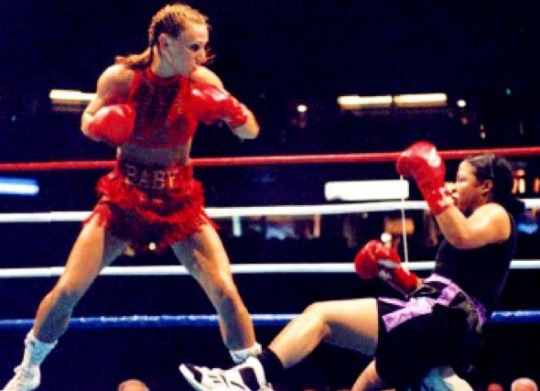
career in the fighting arts wasn’t what people expected of Bridgett
Riley, a former cheerleader who was working as a flight attendant
when she made the transition to professional kickboxing. Her
nickname, “Baby Doll,” was bestowed on her in her teens by a
karate instructor who was amazed by the small-statured young woman’s
fighting ability. Nowadays, people are less surprised, given
Bridgett’s thorough domination of the pro kickboxing scene and five
world championship reigns. What’s more, Riley bridged
the gap between martial arts and boxing – becoming a top rated
pugilist and securing a 15-3 record with one IFBA World Championship
reign. All the while, Riley successfully balanced her fighting
careers with one in show business: though still mainly known for her
stuntwork in major blockbusters, she’s also notable for a handful
of fighting parts in DTV films and television.
Films
to See Triple Impact (1992)
– lead role Bare Knuckles
(2013) – supporting role WMAC Masters
(1995-1996) – recurring role
Trivia:
In her first professional kickboxing match, Riley defeated
U.S.
national champion Denise Taylor in a major upset. Taylor grabbed a microphone and demanded a rematch, calling
her loss a fluke.
A month later, Riley defeated Taylor again
via
technical knockout – breaking her nose in the process.
In
1979, three amateur kickboxers – Maurice Smith, Peter Cunningham, and
Rod Kei – met at a WKA event and collectively predicted their
destinies to become great world champions. While Smith and Cunningham
have since then been
more often remembered by mainstream history, Kei proved himself no
less impressive of an individual.
Arguably the most diversely-talented of the trio, Kei competed in at
least four different styles of martial arts
and won world titles in several of them. His film career was likewise
multifaceted, with Rod
spanning the gambit from background fighter to supporting villain and
even leading man – excelling in all roles
through his standout athletic ability. Today,
Kei teaches boxing, kickboxing, and personal
fitness at the EXF Boxing and Kickboxing Academy and the Sweet Science MMA gym
in California. He also works for American
Airlines.
Styles &
Accomplishments
Kickboxing
– 2-time WKA World Champion, KICK World Champion
Muay
Thai – Ranked 4th in the world by the International Muay Thai
Federation
Savate
– World Cup Champion
Judo
– 3rd Dan, Metro Champion
Taekwondo
– 3rd Dan
Hung
Gar
Sil
Lum
Films
to See Blind
Vengeance (1994)
– lead role L.A.
Task Force (1994)
– lead role Dragon
Fire (1993)
– supporting role Full
Impact (1993)
– featured fight scene
Trivia: Kei
was involved in an infamous 1989 kickboxing match wherein
his opponent – Saekson Janjira – kneed him in the face while the
referee was attempting to separate them. A disqualification victory
for Kei was indicated, after which both fighters’ cornermen began
brawling. The fight turned into a full-scale riot with spectators
throwing chairs into the ring. A
video of the incident can be seen HERE.
The No Retreat, No Surrender series
is a benchmark of western martial arts cinema and a personal favorite of mine.
Ask a casual fan how many installments it contains and they’ll say three, but
ask me and I’ll say seven – pointing to the stylistic similarities between all
seven of the U.S. movies produced by the Seasonal Film Corporation. In this
regard, The King of the Kickboxers
may be called No Retreat, No
Surrender IV, and I’m happy to say that it retains many of its predecessors’
strengths. A few glaring shortcomings make it pretty weak in some respects and
repeat viewings have definitely sobered my initial impression, but nevertheless,
it’s still a cult classic and arguably the last good movie that Loren Avedon
starred in. Fight fans with a taste for the exotic will love this.
The film opens energetically in 1981 at the Samrong Stadium of Bangkok, where
American kickboxer Sean Donahue (Michael DePasquale, Jr.) wins the “Thai
Kickboxing Grand Championship” while his younger brother Jake (Patrick Shuck) cheers
him on. As the brothers depart the arena in a tuk-tuk taxi, Jake expresses
concern that some of the spectators seemed angry at an American winning the
title, and it turns out that his fears aren’t unfounded. In a rural part of
town, the taxi is stopped and Sean is accosted by a group of thugs. Their
leader, a rifle-toting man of African descent (Billy Blanks), informs him that
“An American can never be champion. You should not have won the fight tonight,
and you won’t win this one.” He attacks Sean, easily killing him with a set of
three devastating kicks. For good measure, the stranger breaks the
championship belt in half and beats Jake unconscious, leaving him with a facial
scar and a singed photograph as reminders of the night.
The assailant’s name is Khan, and in case this post fails to convey it
otherwise, know that he’s one of the most over-the-top villains I’ve
seen in a martial arts movie.
TRIVIA: The stadium in the movie may
allude to two actual locations in Bangkok – Muay Samrong Boxing Stadium and
Samrong Boxing Stadium. Both are located on Samrong Road and feature fights on
Friday and Sunday nights.
Ten years into the future, Jake has become a New York detective of particular
caliber. Our first scene of the grown boy – now played by Loren Avedon – is of him engaging in an
undercover drug deal. After the dealers incriminate themselves (and
voice a disregard for the wellbeing of children to boot), Jake purposely blows
his cover so’s to fight the aggressors hand-to-hand. After
thoroughly beating them and using a space heater to fry the face of their
leader (Jerry Trimble), his backup arrives, furious because Jake purposely
provided them with the wrong location. In summary, Jake is the consummate 80s
karate cop: too good for guns and too ahead of the curve to regard protocol,
whose use of police brutality is only fleetingly mentioned afterwards. New
York’s crime scene is no match for him, so his enraged captain (Oscar nominee Richard Jaeckel) assigns him to an Interpol case regarding snuff films produced
in Bangkok.
Clearly feeling his dark past, Jake is initially against the idea of working in
Thailand, but once he realizes that the man beating people to death on the tape
is none other than Khan, he becomes determined to take
revenge. Naturally, he decides against telling anyone about his personal
investment – not his captain, and not his Bangkok contact (Don
Stroud).
It’s interesting that while Jake is upset by the memories the tape
brings up, he regains his cocky confidence by the time he makes it to
Southeast Asia. He looks like a tourist in the introductory montage, and even
after he meets with his contact, he doesn’t seem particularly perturbed that the
three agents who’ve worked on the case before him have been killed. To be fair,
he can take care of himself: in an attempt to get noticed by the criminals, he
shoots his mouth off at the “Bangkok Kickboxing Academy” and handily wins an
impromptu brawl against three boxers. Perhaps he’d be a little more cautious if
he knew that Khan had only recently killed a fighter who likewise had held his
own against three attackers, after being tricked onto the set of the latest
snuff movie. While Jake will have the opportunity to address his own arrogance, the unfortunate fighter – played by Bruce Fontaine – is
left hanging by his jaw on a meat hook.
Khan and Jake are indirectly connected through a new character: Molly (Sherrie
Rose), an American model who’s presented to Khan by his unscrupulous filmmakers
as an unwilling prize. Molly escapes a near-rape but is pursued by Khan’s
thugs, from whom she’s rescued by Jake. Jake finds a temporary haven at her apartment,
and to be honest, the scene which follows is where I begin to tire of the
character. Not only is Jake an ace cop and awesome warrior, he’s now also
presented as a reader of women who lays Molly’s backstory bare for her – no
need for her to assert her character at all. The movie ends up handling the
relationship between these two with relative decency, but Jake’s become a real
problem. He’s way too cocky for me to admire the extent of his talents, and just isn’t very likable.
TRIVIA: Loren Avedon and Sherrie Rose
didn’t actually get along. Following a rocky behind-the-scenes relationship, Rose reportedly bad-mouthed Avedon to producers at the PM Entertainment studio after landing a contract with the company. Avedon claims that word got around and he was effectively blackballed from Hollywood.
Luckily, the humbling of Jake Donahue begins the following morning, when he’s
accosted by a fighter from the gym. “Thasi” (Ong Soo Han) engages
him in a quick fight, showing him that in fact even a modest boxer can actually
best him. Upon hearing that Jake is after Khan, the spirit of comradery moves Thasi to point Jake in the direction of Master Prang – a secluded hermit living
in the jungle, and the only fighter to have almost beaten Khan. Jake
ventures there but is disappointed that the master (Keith Cooke)
appears to be an alcoholic loser who shares his home with a pet chimpanzee.
Jake leaves in disgust, but not before the chimp steals his passport. When Jake comes back looking for it, he finds Prang confronted by a gang of knife-wielding thugs – likely
sent by the malicious filmmakers to abduct him for their upcoming
film. Jake holds his own, but as things get tough, Prang leaps into action and
demolishes the attackers with a series of amazing kicks.
Prang builds a rapport with Jake, and their exchanges end up being a highlight
of the movie. Prang’s alcoholism is revealed as a façade to make
him appear less threatening to Khan following their close fight. He
agrees to train Jake, and as tends to be the case in martial arts movies, these
scenes are a blast to watch. Prang’s methods are a combination of novelty and
brute force: instead of teaching Jake new fighting techniques, he primarily
assaults him with a club and tortures him with rope & pulley contraptions.
Prang claims that the point of the training is to prepare Jake for Khan’s
fearsome triple kick attack, and to simulate this, he swings whole logs at him.
It’s refreshingly human to see Jake lose patience at times, but it’s sort of amazing
that he survives the ordeal.
I wish that the screenplay focused more on Prang and his quest. While
Jake’s journey is a direct parallel to the mythical hero’s, Prang is in the
unique situation of having downplayed his own heroic qualities. He assumes the
role of the mentor, though the interactions between Jake and him (not to
mention the closeness between the actors’ ages) make them seem like equals. Most
unconventionally, Prang has very little moral high ground: though he claims that
he won’t train a murderer, that’s largely what he ends up doing, and despite
his attempts at emotional detachment, it’s not a stretch to assume that he
resents his predicament and wouldn’t mind seeing Khan dead. Prang’s
story is probably more interesting than it’s given credit for, and it’d be neat
if he had more time in the spotlight.
Having recently evaded another kidnapping attempt, Molly ventures to Prang’s
place, and Prang arranges for her to spend the night with Jake. There’s a scene
wherein Molly joins Jake in the bathtub, and the story behind it is worth a
tangent… According to writer Keith Strandberg, an actress who had previously
been cast for the role pulled out due to the required nudity. Sherrie Rose objected as well once filming had begun, being unwilling to
film the part where Molly bares her breasts. Shooting was halted as the
filmmakers tried to persuade her, going so far as to argue that someone who
had posed for Playboy shouldn’t
object to onscreen nakedness. Eventually, the nudity takes a condensed
form, with Rose’s breasts visible for only about two seconds. Rose’s protest – and especially her
successful compromise – is a rarity within the B-movie world, where catering
to male demographics could result in a demanding environment for actresses
and where a refusal to perform nude could end a career. (For a more complete take on
the state of sexuality within B-movies during the ‘90s, see Odette Springer’s
documentary Some Nudity Required.)
With his training complete, Jake engages in a series of underground fights and
successfully catches the eye of one of the snuff producers (David Michael
Sterling). He’s recruited with promises of starring in an action movie, and
despite the protests of his police superiors, he’s determined to risk death in
order to stop the crime ring. Following one more night with Molly and a
final exchange with Prang, Jake rows off to the shooting location. The set is an
enormous bamboo cage built in a river, with platforms to fight on rising out of
the water. Dozens of extras dressed in aboriginal garb watch as he enters the
cage, wearing an ornate mask and costume. It’s an impressive sight.
Jake takes on a number of spear-wielding assailants, but these guys are a mere warm-up for his true opponent. Khan appears, likewise
garbed in costume, and to Jake’s horror, he’s carrying the unconscious
Molly under his arm. He’s also carrying a sack, which he throws into the water
to reveal the body of the murdered Prang. With Molly now held in a rope net
and the filmmakers’ desired pathos achieved, Jake and Khan commence fighting. The
match is one of my all-time favorites, filled with back-and-forth action, and
both performers are at their best. Particularly Billy Blanks looks extremely powerful and more than capable of
hanging with the Hong Kong-style choreography.
TRIVIA: The outfits worn by Jake and
Khan are costumes from Thailand’s khon theater. Jake’s outfit
appears to represent Hanuman, the Hindu monkey god, whileKhan’s probably represents the demon lord
Ravana. In Hindu mythology, Hanuman was instrumental in the vanquishing of
Ravana by the avatar Rama.
Jake eventually defeats his opponent, and Khan is mortally wounded when he’s
thrown under the spiked gate of the entryway. His last act is an attempt to
kill Molly by loosening the rope holding her up, but Jake catches her.
As the filmmakers revel in excitement, thinking they’ll be able to replace Khan
with Jake, the Thai police and Jake’s superiors arrive to chase everyone into
the jungle. As the cage is incinerated with a rocket launcher – presumably
destroying the bodies of Khan and Prang inside – Jake and Molly embrace in
front of the flames. Richard Yuen’s pleasant
soundtrack ushers us into the end credits.
The King of the Kickboxers was
released a year after Jean-Claude Van Damme’s Kickboxer,
and while strong parallels between their screenplays are apparent, the former
manages to stand out for its style. Whereas Kickboxer
is clearly an American movie, The King of
the Kickboxers has a much stronger Hong Kong flavor. Personally, I think it has the more believable and stronger
characters. But like Kickboxer, I’m disappointed by the
lack of actual Thai performers among the prominent cast. Ong Soo Han is Malaysian, but Thai actors are uniformly relegated to bit parts. Billy Blanks doesn’t pass as Oriental at all,
despite the use of eyeliner.
Speaking of Blanks, I was so curious about his casting that I contacted Keith
Strandberg and asked about the character. I wanted to know whether Khan was in
fact anything other than a “pure” Thai, and I speculated that he may be
half-Thai or even a foreign expatriate. Strandberg – who was very pleasant and
can be contacted through his website – affirmed my former suggestion and
explained the basis for Khan’s antagonism. He said that Khan is the son of a
Thai mother and a U.S. serviceman who abandoned them while Khan was young,
thereby sparking his hatred of Americans. This is illuminating, but makes me
wonder about Khan’s relationship to the snuff filmmakers. They
certainly appear to be American, yet seem to have such control over Khan that
the Marlon Brando lookalike (William Long, Jr.) is able to make fun of
him without repercussion. There’s probably a lot more to this than I’m privy to, but despite being a
murderer and a sadist, Khan comes across as someone controlled by anger but who’s also been taken advantage of by other people.
The action content is really darn good, thanks in large part to the innovation
of fight choreographer Tony Leung. Leung would later work on the martial arts epic Ip Man, and you can definitely see a lot of his skill here in how he directs so many diverse performers to grand
results. I truly love the martial cast in this one, but the only real
drawbacks are the shortness of some of the fights and the fact that most of the
fighters only have one or two brawls apiece. Fans of Hong Kong regulars Steve
Tartalia and Vincent Lyn will be disappointed how uninvolved they are in Loren
Avedon’s first fight.
Speaking of Avedon, you have to love his enthusiasm. Loren would grow into a more
skillful actor as time went on, but at this point, all he had going for him was
fervor and the kind of natural charisma that most successful B-movie stars
have. Most of the acting in the film is along these lines, so if you can’t
stand extra raw drama, this isn’t for you. Of course, there’s some skillful
acting in here too, and while some viewers may name Richard Jaeckel or Don Stroud
the best performer, I give the title to Sherrie Rose. Jaeckel and Stroud play
stock characters they probably could have done in their sleep, while
the onus to create an original persona is on Rose. While she isn’t
given the opportunity to excel, she definitely gets her personality through and
is noticeably more nuanced than everyone she interacts with.
The King of the Kickboxers is
predictable and thematically unambitious, but no one can say that the
filmmakers didn’t put a lot of effort into it. As one of the most colorful
entries of the Seasonal Film series, it’s worth owning for both established
fans and general karate lovers alike. It’s definitely required viewing for
serious followers of the martial arts B-movie subgenre. Check it out!
The
King of the Kickboxers (1990) Directedby Lucas Lowe (American
Shaolin) Writtenby Keith W. Strandberg (screenplay, original story), Ng See-Yuen
(original story), John Kay (uncredited) Starring Loren Avedon, Billy Blanks
(Tough and Deadly), Keith Cooke (Mortal Kombat), Sherrie Rose (Me and Will) Cool costars: Hans Ong (Dragon: The Bruce Lee Story), Jerry
Trimble (The Master), Bruce Fontaine
(Outlaw Brothers), Michael
DePasquale, Jr. (China Heat), Steve
Tartalia (Death Cage), Vincent Lyn (Operation Condor). Hong Kong regular Mark King (Once Upon a Time in China) plays an uncredited police officer. Title refers to: It’s written on a film slate visible after Khan’s death. Presumably, this is the name of the snuff film being shot and therefore would refer to Jake. Potential triggers: Extreme violence, child abuse, violence against women Copyright Seasonal Film Corporation
When I initially began exploring the martial arts film stars of the western
hemisphere, one of the first ones I investigated was Don “The Dragon” Wilson.
Though I knew that few performers approached fight flicks with the level of
credibility that Wilson did, I admit that I wasn’t very appreciative of
what he brought to the table and let my dislike of his fight scenes cloud many
earlier reviews. Nevertheless, there was something about the guy that kept me
buying his movies even though I’d end up trashing them online. Now, with
approximately eight years of reviewing behind me, I realize that I’ve been
harsh. I believe I’ve learned a significant lesson about the importance
of personality in B-movies and the significance of Wilson’s film
career. This won’t be a retrospective of everything he’s done, but in this
review, I’ll highlight some of the features that have contributed to his
status as one of the more unique stars of the low-budget realm.
TRIVIA: Wilson made his name in the
martial arts world as an international kickboxer. Over a 20-year career, Wilson
won 11 world championships – as well as three championships in state, national,
and continental divisions – and amassed a record of 72 wins, five losses, and
two draws.
Ring of Fire is Don Wilson’s third
starring vehicle and his first movie that premiered on video. It was
produced by the PM Entertainment Group, a studio specializing in action films which contributed greatly to the golden era of home video. PM had a knack for
producing screenplays that paid more attention to drama than typical
direct-to-video schlock, and Ring of Fire
is a good example of this. It’s essentially a Los Angeles-set retelling of Romeo and Juliet with a martial arts
backdrop, and explores themes of racism, interracial relationships, and machismo.
The film begins in a small arena where two gangs
cheer on their representatives in a no-holds-barred match. The foundation of the story is the conflict between these groups – the Asian
Gang and the Surfer Gang – and it’s worth pointing out what a unique conflict
it is. The Asians and the Surfers take no part in typical gang-related crime,
and seemingly exist only to do battle with each other. They’re not inspired by
money or territory, but solely by racial tension. The Surfers are led
by the increasingly unstable Brad (Dale Jacoby), whose hatred of his Chinese
neighbors seems to stem from his father’s death in Vietnam. The opposing gang
is headed by Terry Woo (Steven Vincent Leigh), the son of an immigrant
restauranteur, who is so tired of prejudice that he’s decided to fight fire
with fire. There’s no shortage of animosity between the two groups, but both seem
to agree that the best means of expressing their hatred is not through
drive-byes but hand-to-hand combat.
Martial arts fans will quickly realize a stylistic difference between the gangs
during the opening matches: Terry’s gang clearly comes from a kung fu
background while the Surfers seem to favor kickboxing and karate. As a matter
of fact, the very first fight features Terry wearing a traditional sash
while his opponent (Stan Longinidis) wears trunks emblazoned with the words
“KICK BOXING.” The theme of inter-discipline competition goes back to Hong Kong
wuxia pictures, and criticism of the “fancy” Chinese styles by “hard” stylists
had been an issue in U.S. martial arts communities for decades. In the movie,
the difference underscores the conflict between the two factions.
Trivia: Wilson – a student of pai lum tao – began competing in kickboxing to counter the widespread prejudice that kung fu practitioners couldn’t actually fight.
The only person at the arena who’s opposed to what’s going on is Julie (Maria
Ford), Brad’s sister and fiancée of his friend Chuck (Vince Murdocco). Julie is
repulsed by fighting and refuses to watch, fearing that somebody will get
hurt. Her fears are vindicated when one of Terry’s friends (Ron Yuan) is hospitalized after a vicious beating. His attending physician is Terry’s cousin,
Jonny Woo (Don Wilson) – a legendary fighter who nevertheless rebuffs Terry’s
request to fight on his behalf. While Jonny seems to consider
Terry’s activities so inevitable as to never outright discourage them, he is so
against the idea of involving himself that it seems to create an inexplicable
bond between Julie and him when they meet shortly thereafter. Julie visits the
restaurant of Terry’s mother (Jane Chung) and mistakes Jonny for a waiter. He
takes it in stride and there’s an instant attraction between them, which seems to symbolize their mutual rejection of racial
prejudice.
The two engage in a genuinely romantic courtship after Jonny – dressed as the
Phantom of the Opera – crashes a masquerade party to dance with Julie. She goes
out with him despite being engaged, but it’s important to note that Chuck is
making himself increasingly irredeemable by succumbing to Brad’s influence.
Chuck is never seen displaying quite the level of racism of his pal, but his
time is continually monopolized by Brad and he seems completely oblivious
why this repels his fiancée. Julie makes a few efforts to maintain their relationship,
but Chuck’s preoccupation seems to justify her doubts about marriage.
Tensions between the gangs rise when Kwong (Eric Lee) – Terry’s resident
goofball and possible kung fu instructor – is badly beaten outside of the ring and
Terry retaliates at the expense of one of the culprits (Gary Daniels).
This leads to the film’s biggest combat scene – a massive gang brawl – but when the battle is dispersed by the police, the factions
agree to settle their differences via a one-on-one match between Brad and
Terry. While the two of them train in their own unique ways – Brad focusing on
technique and precision while Terry builds strength and endurance –
the relationship between Maria and Jonny grows to the point that Maria breaks
up with Chuck. Feeling scorned and sensing Jonny’s involvement,
Chuck tells Julie about the upcoming fight and indicates that Brad intends to
seriously injure Terry. Later, Jonny approaches Terry and asks him not to fight,
revealing that he’s in love with his opponent’s sister. Terry is moved but
argues that he can’t back out of the fight without losing face. Unwittingly
setting the stage for disaster, Jonny suggests that Terry demand that they fight “Thai style,” with their knuckles covered in glue and broken
glass. He’s certain that Brad will back down rather than compete like this,
and Terry agrees. However, both have underestimated Brad’s casual attitude towards
violence, and when the gangs meet at night for the showdown, Brad readily
accepts the challenge.
TRIVIA: There is much dispute whether fighting
with broken glass was ever a genuine practice among Thai boxers. In the book Comprehensive Asian Fighting Arts, Donn
F. Draeger and Robert W. Smith hypothesize that this particular practice occurred only in wartime, and many other sources claim that it was
an uncommon event at best.
What follows is a montage wherein shots of the fighters gearing up are
interspersed with shots of Jonny and Julie getting intimate. It’s an example of one of the most persistent and
controversial B-movie tropes: the mingling of sensuality with violence. Nevertheless,
it’s interesting that despite the film’s license to exploit, both the sexy shots
of this scene and the nature of the romance are remarkably
wholesome by low-budget standards. Wilson’s character is utterly decent and the
buildup to sex is very well-paced. Rather than actually depicting the act,
all this scene shows is the characters slowly disrobing each other. Against
all expectations, the film depicts the undressing of one’s partner as a pinnacle
of sensuality. Much of this modesty may be thanks to Wilson, who – in addition to
cultivating wholesome onscreen personas – seems concerned about how women are
treated in his films. In the future, Wilson would personally minimize violence
against female characters in at least one screenplay, and in doing so seems to challenge
the general perception of women in B-movies. To this end, Maria Ford – regularly
typecast in sexual roles – can direct her efforts to her dramatic performance
rather than titillation.
[UPDATE 8/4/18: For his review in Videohound’s Video Premiers, Mike Mayo alludes to “one of the hottest love scenes you’ll ever see on video” taking place in this movie. Unless Mayo is especially titillated by chasteness, I’ve reason to think that what I’ve described above may reflect an edited version of the original film. Whatever the case, my review is based on the Reel Entertainment Digital (RED) release, and it’s possible that a different version has been released by another distributor.]
Their tranquility is shattered when Julie realizes Jonny’s plan
and assures him that her brother is indeed capable of killing. They rush to the
combat zone – literally a ring of fire, created with gasoline –
only to find Terry near death from a massive neck wound. Brad is so driven that
he attacks Jonny as he tries to attend to his cousin, but he and the others flee at the arrival of the police. Later, Brad has become so so unhinged that he leads
the gang to crash Terry’s funeral, seeking to collect Julie after she defied
him by attending. Julie seems to feel some responsibility for Terry’s death,
and her guilt is augmented by indirectly causing this disruption. The cold stares she receives from the other funeral attendees certainly don’t help, and she
attempts to stem future harm by breaking up with Jonny and leaving with Brad’s
gang.
A heroic intervention by Julie’s grandmother (Shirley Spiegler Jacobs) brings
the two back together, after Jonny publicly makes a bid for Julie’s heart in
the middle of her aerobics class. The Surfer Gang inexplicably turns up to challenge
Jonny, and Brad strikes Julie after she pleads with him to stay out of their
relationship. This finally pushes Jonny beyond his limit, and he meets Brad in
the arena. Julie is present as well, perhaps agreeing to watch because she
cares more for Jonny than she did for Chuck, and witnesses her boyfriend being
true to his legend. Jonny handily overwhelms Brad and even rallies after Chuck
interferes. Frustrated, Brad grabs a
katana he had been training with earlier and charges Jonny. Oddly, the only person who
rushes to Jonny’s defense is Julie, but while Jonny is able to avoid Brad’s
attack, Julie is slashed across the torso. The brawl immediately comes to an
end and animosities turn to concern over the injured Julie. As Jonny carries her
from the ring, the melancholy soundtrack makes us fear for Julie’s life, but
within the final seconds before the credits, she raises her head to look into
Jonny’s eyes. We’re to believe that Julie survives, and the film’s sequel – Ring of Fire II: Blood and Steel –
assures us that this is indeed the case.
The ending is abrupt and leaves core issues of the film
unresolved, but in its most drastic departure from the Romeo and Juliet template, I appreciate how it concludes the feature
with a tinge of hope. If Julie can live, perhaps the gangs can resolve their
conflict.
Racism sparked the gangs’ conflict, but machismo is what drives it. I can’t
come up with a better explanation why two gangs who hate each other would cooperate to the extent of securing a boxing ring to
exercise their grievances. Fight culture and the history of feuds between
professional fighters seem to influence their thinking, and the concept of
honor definitely plays a part, but these things don’t fully explain the absurdity
of the setups and thus convince me that the characters are bound by masculine ideals. While machismo provides the benefit of the
gang members eschewing guns (after all, anybody can pull a trigger),
it ultimately makes mutual problem-solving
impossible. It may even be viewed as an infectious condition: in addition to Chuck’s
increasing fascination with Brad’s violent world, Jonny spends the entire movie vowing not to fight – even when his cousin is killed – but when Brad strikes
Julie, he forgoes all rationality by agreeing to a fight in
front of spectators. The demands of masculinity turn fiancées into
villains and healers into participants of bloody rituals.
Speaking of blood, the film’s fight content is an interesting study. The unique
collection of performers promises spectacular results, but the fights are a
mixed set. An ugly trend of editing fight scenes at the time was to cut shots
right before a performer landed a strike and switching to a different shot for
the impact. Ring of Fire does this a lot, though curiously only for its
ring-based matches: the street fights feature longer shots with follow-through.
Don Wilson only has a single genuine fight – the finale – and I’m sorry to say
that it seems to cue an increase in such icky editing. It’s a style that’s present
throughout Wilson’s movies, and it really played against my opinion of the guy
when all I was interested in was the quality of fight scenes. While I’m still
not a big fan, I’ve since
learned that this style may be the result of noble intentions. Wilson claims to
go out of his way not to make contact with his onscreen opponents, and this is
probably reflected in the editing tricks. It doesn’t do much for the
presentation, but after hearing stories of how Steven Seagal and Jean-Claude Van
Damme have hurt costars while shooting fights, it’s easier to give Don credit
for being a human being.
TRIVIA: In the late 1980s, after Wilson
publicly disputed Jean-Claude Van Damme’s claim of having been a world kickboxing
champion, producer Roger Corman hyped a proposed fight between the two and
offered Van Damme $100,000 if he could defeat Wilson. Van Damme turned the
fight down, reasoning that he made much more money through acting (see Black Belt
Magazine, Nov. 1989).
Nevertheless, I mainly have a good impression of Ring of Fire. The filmmakers get absolutely everything they can out
of their production without giving the impression of scraping bottom. It’s a
flamboyant movie filled with nice cinematography of Venice Beach and Los
Angels’ Chinatown, not to mention an eyeful of early 90s fashion. The dramatic performances
are really out there and bombastic, though solidly anchored by Don Wilson’s
likable presence and Maria Ford’s pure talent. Despite its representation of
real-life problems and a smattering of racist language, it’s not a hardline
picture and I largely consider it harmless for adult viewers who know what
they’re getting into. General martial arts fans ought to consider it, and Don
Wilson fans will definitely want to own this one.
Ring
of Fire (1991) Directed by Richard W. Munchkin (Dance or Die), Rick Jacobson (Bitch Slap) Written by Jake Jacobs, Richard W.
Munchkin, Steve Tymon (Death Match) Starring Don Wilson, Maria Ford (Angel of Destruction), Steven Vincent Leigh (Deadly Bet), Dale Jacoby (No Retreat, No Surrender) Cool costars: Vince Murdocco (Kickboxer 2: The Road Back), Eric Lee (Weapons of Death), Ron Yuan (White Tiger), Gary Daniels (Bloodmoon). The gang brawl features too
many cool people to count, but some of my favorites include Jon Agro, Art
Camacho, Harold Hazeldine, and Rod Kei. Stan Longinidis is
Terry Woo’s first opponent and an 8-time world kickboxing champion. Also, IMDb.com credits Michael Jai White (Black Dynamite) as being
in this movie, but I’ve never seen him. Title refers to: The literal fighting space created for the Terry-Brad showdown. Content warning: Racist dialogue, violence against women, group violence Copyright PM Entertainment Group
Inc. / Reel Entertainment Digital




 B-Movie Dragons