My opinion regarding kickboxer/actor/activist Ian Jacklin is a little more complicated than with most karate stars, but in a nutshell, I thought the guy was pretty cool until I realized that he spends his life promoting quackery to cancer patients. Nevertheless, I enjoy his acting career and see it as a microcosm of a successful B-movie trajectory, with Death Match being the climax. Created outside of the major video studios, it has an unambitious story but a good production with a huge amount of martial talent. It’s required watching for fans of the subgenre and easily the best of Jacklin’s film career.
The story: An ex-fighter (Jacklin) goes undercover in a deadly fighting circuit to rescue his kidnapped best friend (Nicholas Hill).
I need to emphasize the state of the production, even though it may seem odd to praise a film for looking average. Keep in mind how easy it is for indie movies to turn out like crud. By all rights, Death Match should’ve been interchangeable with a typical Cine Excel production (underpopulated vistas, dubbed dialogue, etc.) but it’s actually indistinguishable from most Pepin-Merhi or Shapiro-Glickenhaus actioneers. As a matter of fact, it would be pretty aspirant for a PM or SG production, given the impressive list of names in the cast. To be fair, we sometimes only get a little taste of them – cult stars Richard Lynch and Jorge Rivero have only one scene apiece as Mafia bosses – but the list of talent goes on. Martin Kove and Matthias Hues are good as the lead villains, with Kove supplying the drama and Hues most of the fighting. Steven Leigh, Eric Lee, and Benny Urquidez don’t have any fights but do well in their dramatic scenes. Michele Krasnoo, Butch Togisala, Randall Ideishi, Ed Neal and Peter Cunningham partake in some of the highlighted brawls, and many more show up elsewhere. If these names aren’t clicking, you haven’t been watching movies like this long enough. The sheer accumulation of performers with reputations in the genre is amazing, especially since your average PM production sometimes wouldn’t even spring for half.
Of course, presence isn’t as important as utilization. The real question is how good the 16 fight scenes are, and the answer is that they’re a mixed bag. On the bright side, there are no downright bad matches and the choreography is nicely varied – some street-fighting, some shoot boxing, and even a lone stick fight. There are some some surprisingly long shots highlighting lengthy exchanges, and a few performers have standout moments of action. (I really enjoyed the Matthias Hues-Dino Homsey bout.) However, for the most part, nobody performs the best work of their career. Michele Krasnoo is made the least of, being introduced as a fighter but then only engaging in half a match. I have the impression that the choreographers were simply stretched too thin by crafting this many fights on a limited schedule. If so, then I wish the number of brawls had been cut in half and the remaining ones given more flair.
Socially, the movie has good points and bad points. Where the latter is concerned, the fact that two women are cast in fighting roles is undermined by the female lead (Renee Allman) abandoning the sparks of characterization to play a formulaic love interest. Additionally, a sexual harasser (played by Bob Wyatt) is inexplicably made a
supporting character. However, I like that the movie seems to be championing an anti-capitalist message, using organized crime and fighting as metaphors. The villains trap fighters in a system that depends on their toil while devaluing their lives, and the same villains consider theft against them to be the single greatest crime. Threatening their income by refusing to fight by their rules is likewise punishable. The protagonist sets himself apart from this system by having abandoned organized fighting and claiming to compete solely “for the competition” – not exactly a fair outlook in light of all the pro fighters in real life who earn their income via competition, but it’s nevertheless a repudiation of the metaphorical wage slavery in the feature. Death Match isn’t The Godfather when it comes to allegory, but it’s effective in delivering its message.
There’s a moment in the film when Jacklin’s character is weirded out by Martin Kove’s belief in the supernatural powers of crystals. Retrospectively, it’s funny to see Jacklin in the role of the skeptic (even though crystal power seems to be one of the few areas of nonsense that Ian hasn’t stated a belief in), but I have to admit that he does well enough as the lead. He doesn’t have quite the charisma of, say, Don Wilson, but that’s not to say he wouldn’t have made a good star in the long run. Indeed, I wish he would’ve been handed another top role before the end of the martial arts genre’s video golden age. Nevertheless, his undisputed high point here is worth hunting down if you’re a collector. Death Match encapsulates many of the essentials seen in movies like this and adds just enough of an inspired touch earn a recommendation from me. Check it out wherever you can.
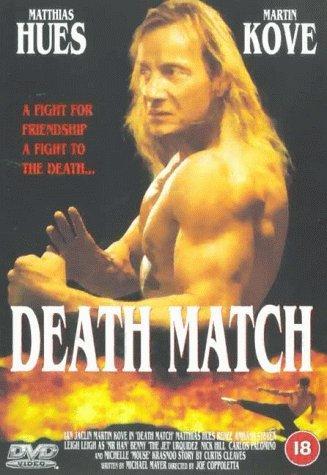
Death Match (1994) Directed by Joe Coppoletta (The New Adventures of Robin Hood) Written by Curtis Gleaves (story & screenplay), Bob Wyatt, Steve Tymon (Ring of Fire II: Blood and Steel) Starring Ian Jacklin (Kickboxer 3), Martin Kove (The Karate Kid), Matthias Hues (Bounty Tracker), Renee Allman (The Stoned Age) Cool costars: Martial arts regulars Steven Vincent Leigh (Sword of Honor) and Eric Lee (Ring of Fire) appear in acting roles but don’t fight. Similarly, kickboxing hall of famer Benny Urquidez (Wheels on Meals) is limited to a training montage but offers his Jet Center studio as a filming location. Sexy pro wrestler Stevie “Puppet” Lee appears as the arena gong beater. Richard Lynch (Puppet Master III) and Jorge Rivero (Centennial) have one scene apiece as non-fighting Mafiosos. Onscreen fighters include Nicholas Hill (Bloodsport II), Michele Krasnoo (Kickboxer 4), Ed Neal (Breathing Fire), Butch Togisala (Firepower), Dino Homsey (Deadly Bet), Randall Shiro Ideishi (Black Scorpion), Debra “Madusa” Miceli (Shootfighter II), Jamie Krasnoo (Full Contact), and Nick Koga (Red Sun Rising). A performer called Hector Pena appears in a stick fight, but I’m not sure whether he’s the actual Hector “Aztec Warrior” Peña, world champion fighter. Also, kickboxing legend Peter Cunningham is inexplicably credited as “Peter ‘Sugarfoot’ London” – leading to a snafu on IMDb where the film credit goes to porn actor Peter London. Cool crew: Composer Marco Beltrani – who’d go on to earn two Oscar nominations for his work on The Hurt Locker (2008) and 3:10 to Yuma (2007) – makes his feature composition debut with this one. He is directly heard on the soundtrack playing guitar and keyboards. Content warning: Group violence, violence against women, violence against children, sexual harassment, sexual assault, ableist dialogue, graphic description of an execution Title refers to: Either the main attraction of the underground fight ring or the fights-to-the-death taking place at the end of the film. A “death match” also refers to a hardcore pro wrestling contest – a fact which may be relevant in light of stunt coordinator Brandon Pender’s history as a World Championship Wrestling producer. Cover accuracy: Different covers exist, but the most widely-distributed one is dominated by an image of Matthias Hues. Hues is one of the two lead villains, but relegating leading man Ian Jacklin to a teeny-tiny graphic is misleading. Heck, Jacklin can’t even get top billing, with Hues and Martin Kove claiming the large print. Number of full-length fight scenes: 16 Crazy credit: “No music by Giancomo Puccini was used in connection with this picture” – even though Richard Lynch’s character specifically mentions the composer’s works. Copyright Horseplay Productions, Inc.
Does anyone else remember Ron Pohnel? He had that awesome ring match against Jean-Claude Van Damme in No Retreat, No Surrender (1986) – the one right before the finale. After that, he practically ceased to exist until IMDb informed us last decade that he was finally working on another movie. And not just any movie, but a full-blown vehicle for himself! I didn’t care that it was going to be a very low-budget effort – I just wanted to see the guy again. However, after waiting almost ten years for a release and then only accessing the film through Pohnel’s Youtube channel, my expectations steadied a little. Little did I know that even then I was in for disappointment. Drifter TKD is a micro action flick burdened by a terrible screenplay and the filmmakers’ failure to take advantage of what resources they have. It’s a poor directorial debut for Pohnel and really just a passion project gone awry.
The story: After giving up his taekwondo school to a greedy corporation, Master Harrison Luke (Pohnel) takes on the life of a destitute drifter. Settling in a homeless community, the master takes a stand for the disenfranchised against a golf club owner trying to intimidate them.
Tempting as it is, I’m not going to compare this to the other movie Pohnel did. However, even judging it on its own merits yields little praise. To be fair, there’s no sense bemoaning its lack of budget and shot-on-video presentation: given his limitations, director/producer/cameraman Ron does well enough. And while the fight scenes are definitely in trouble for being too short most of the time and questionably shot/edited, they reveal that Pohnel is still packing some moves. Nevertheless, the movie does everything else wrong. With the exception of ex-Power Ranger Blake Foster as Harrison’s student, none of the supporting martial stars engage in any of the action – not Mel Novak as the evil CEO, nor Ron Hall as his henchman, nor Leo Fong as Harris’ fellow master. The lighting is off in several scenes and the dialogue isn’t always audible over the soundtrack. The dialogue is weak, frequently sounding contrived and unnatural (“To be a CEO, your heart has to be cold and hard”) and with characters repeat their backstories multiple times. Some prominent characters are just outright unlikable, with David Fultz as Harrison’s bumpkin sidekick generating some particular vitriol in my notes.
Worst of all, the story ends up going absolutely nowhere. After almost 90 minutes of testing my patience with poor pacing, the movie resolves none of the problems it’s set up. Harrison remains a drifter, his loyal student returns to his heartless father, the corporation maintains a monopoly on local taekwondo schools, the homeless people remain homeless, and even though the leader of the local gang gets beaten up, both they and the evil club owner are left with no curb on their homeless-harassing and human-trafficking shenanigans. The film kind of addresses this with a last-second philosophy about going with the flow and making the best of a bad situation, but it just feels like a badly-planned story. The characters end up in almost exactly the same place they started, making me feel like I’ve wasted my time.
While I’m criticizing, I might as well also point out the film’s social failings as well, beginning with almost every non-white actor with a speaking role being cast as a villain. Also, at least two female characters are martial artists (Sohara Key and Charl Pohnel) but are also depicted as no match for their male aggressors, making their previous training scenes amount to nothing. One of them gets seriously creeped on by David Fultz’s character with no consequence. Seriously, he’s more harshly reprimanded for incorrectly throwing a kick during martial arts practice, which suggests that even in a movie where sex trafficking is a thing, disappointing your male teacher is a bigger faux pas than threatening women.
As eager as I am to promote indie cinema, it’s hard to recommend this one. It doesn’t take itself very seriously, but the grinding pace and lack of engaging content makes it a chore to sit through. Check it out if you really want to see what’s become of Ron Pohnel, but otherwise just skip to the end of No Retreat, No Surrender again.
THE COPYRIGHT HOLDER HAS MADE THIS TITLE AVAILABLE FOR FREE. YOU CAN FIND IT HERE.
Drifter TKD (2008) Directed by Ron Pohnel Written by Ron Pohnel, Charl Pohnel Starring Ron Pohnel, Blake Foster, Solara Key (Thunderkick), Ron Encarnacion (Parts of the Same Circle) Cool costars: Martial arts stars Mel Novak (Game of Death), Ron Hall (Bloodsport II), and Leo Fong (Low Blow) are here but don’t fight. Jacob Stiver, Charl Pohnel, and Omar Lizarranga do fight. Longtime TV actor Richard Pines plays the greedy golf club owner. Content warning: Kidnapping, human trafficking, sexual harassment, homophobic dialogue Title refers to: “Drifter” refers to the protagonist’s occupation. “TKD” – short for taekwondo – refers to the martial art featured most prominently in the film. Cover accuracy: A close-up of Ron Pohnel with a wide shot of him (or possibly Blake Foster) walking in the background is appropriate. The billing refers to Charl Pohnel by her full name, Charlene Oka-Pohnel, in contrast to how it appears in the onscreen credits. Number of full-length fight scenes: 5 Copyright Webgeeks Productions
For the longest time I actively avoided MMA-themed action movies, especially the direct-to-video features that began coming out in the 2000s. Overall, I wasn’t wrong to do so, and Circle of Pain is an example why. While rising above the sheer unpleasantness of Never Surrender (2009) – the crown jewel of terrible cage fighting movies – this particular flick is heavily flawed from surface to core and ticks off a lot of personal peeves. Poor writing and bad fight scenes ahead.
The story: An ex-fighter (Tony Schiena) is strong-armed into a high stakes match with a cold-hearted champion (Heath Herring) by a greedy promoter (Bai Ling).
I watched the movie twice in one day, the second time with the commentary track, and this definitely made me appreciate it more. The film was shot in 12 days and the studio meddled with the script, so I’m more forgiving of its more obvious limitations – the small scale and rushed feel. Director Daniel Zirilli shows that he can do a lot with a little, so I’m interested to see what he’d do with more resources and less interference.
…Kinda. Even with regard to its disadvantages, the production doesn’t carry a lot of promise. Foremost, it doesn’t do much with its cast. Aside from the fact that it oversells three of the four stars on its cover (Kimbo Slice, Frank Mir, and Roger Huerta have a combined total of six scenes), the only performer coming out of it relatively well is Heath Herring, who knows how to play an asshole villain. Tony Schiena has some moves and charisma, but he comes across as a blockhead and isn’t particularly likable. Bai Ling will get her own paragraph in a moment. TV’s Louis Herthum is sort of a poor man’s Geoffrey Lewis as the lead’s tough old trainer. And then there’s Dean Cain, playing Schiena’s wheelchair-riding sidekick and no doubt handling the role even better than a genuine disabled actor could… Yeah, right! (It’s not a great role, though: he spends the film living vicariously through the protagonist, and the writers never realize that this isn’t a particularly positive trait.)
The film’s most exploitative feature isn’t violence but sex and nudity. There’s the expected breast shots, and they’re followed up by two or three scenes that are straight up softcore porn. This is strikingly at odds with the rest of the movie’s tone, and for good reason. Zirilli candidly admits that these parts were demanded by producers and that he doesn’t like them, saying that he’d probably prefer the TV version of the film. My biggest gripe on the matter is how it affects Bai Ling, who plays the only substantive female role in the picture. Ling’s part was rewritten from a male role, and the imposed changes seem to mainly be sexing her up ridiculously. (I just can’t see her male counterpart screwing Heath Herring in the gym.) The character’s overt sexuality symbolizes her power, but it’s also meant to demean her, especially when she’s rebuffed. It’s a messy, ungainly dynamic that’s only here because a woman is playing the role. For an infinitely less sexual take on a woman playing a villainous promoter, check out the English language Hong Kong flick Extreme Challenge (2001).
The fight scenes could be better. For some reason, MMA-themed action always looks better in theatrical features than on video, and the same is true here. The fights are kept down-to-earth and realistic out of necessity, but even though they improve throughout the picture, they’re just not very fun. Tony Schiena is a legitimate karate champion, and when he shows off some powerful-looking forms, I couldn’t help but wish he were in a Bloodsport sequel instead of this muddy schlock. The pro fighters do well enough, but having seen Roger Huerta fight in Tekken (2010), I was disappointed that he didn’t get a proper brawl. (He’s Herring’s trainer.)
Again, you can do worse than Circle of Pain in the MMA video genre, but why even go there? It’s bearable if you go in with low expectations and enjoy seat-of-the-pants filmmaking, but c’mon – that’s not what you’re here for. You’re here to watch your favorite pro fighters headline a killer action movie, and that’s just not what happens. Leave it be.
Written by Bobby Mort (Scorched Earth), Daniel Zirilli (story), Sean Patrick O’Reilly (story)
Starring Tony Schiena (Locked Down), Bai Ling (Game of Assassins), Dean Cain (Lois & Clark: The New Adventures of Superman), Heath Herring (Chavez: Cage of Glory)
Cool costars: Louis Herthum (Westworld) as the trainer. The list of supporting fighters include Kimbo Slice (Blood and Bone), Frank Mir (Hell’s Chain), Roger Huerta (Tekken), Yves Edwards (Beatdown), Miguel Torres, Conner Brantley, and Carlo Prater.
Content warning: Sexual harassment, sexist & ableist dialogue, violence against the disabled
Title refers to: Literally, the caged ring which the fighters compete it…even though it’s not actually circular. Figuratively, it may refer to the destructive cycle of doubt and guilt that the protagonist deals with after paralyzing his best friend.
Cover accuracy: Slice, Mir, Huerta, and Herring certainly do appear in the movie, but their billing and promotion come at the expense of the actual leads. Also putting Slice ahead of Herring – both in billing and in placement – is a hard faux pas. The Tapout logo is better-placed, though, as it’s featured very prominently throughout.
Copyright Grindstone Entertainment Group / Lionsgate Home Entertainment
It’s a shame that
the phenomenon of supergroup casting has grown old long before all of
its possibilities have been exhausted. The sad reality of filmmakers
regularly not making the most of all the names they can get under one
title is evident in Mark Dacascos’ freshman effort as a director,
which further depresses me by not making a strong case for
yesterday’s action heroes becoming filmmakers. Possibly the
greatest coming together of stars since the original Expendables films, Showdown in Manila nevertheless
feels like a forgettable
action-thriller featuring a bunch of nobodies.
The
story: Private investigators Nick Peyton (Alexander Nevsky) and
Charlie Benz (Casper Van Dien) track an assassination to an
international terrorist group. Eventually, they call in some comrades
to help capture its deadly leader (Cary-Hiroyuki Tagawa).
How
good the
movie is depends largely on
how well its big-name stars are utilized. Here’s my take on ‘em:
Alexander
Nevsky – This
huge bodybuilder seems to be more of a star in Russia than North
America,
and thus I question having
him lead
a movie filled
with more recognizable action guys.
Judged on his merits, he’s not terrible
–
he makes more of his physical
size
than Dolph Lundgren and does well enough in
action scenes –
but
he’s in
desperate
need of charisma. For all his good looks, Nevsky remains a virtual
stranger to me even after the credits
rolled.
I
wouldn’t mind seeing him improve, but I don’t predict many U.S.
producers will line
up to put him in another starring role.
Casper
Van Dien –
As probably the cheapest ex-
A-lister on the market right now, it doesn’t
surprise me
that
ol’ Casper’s present,
but it
sure irritates
me.
He’s
playing yet another womanizing jerk, albeit with more chagrin and
humility
than expected.
It
breaks my heart to admit it,
but
he’s
actually one of the best things about th4
film. He’s not the only cast member with genuine charisma and
acting ability, but he is
the one with the most scenes. For
better or worse, he keeps the film from sinking until the other big
names show up.
Cary-Hiroyuki
Tagawa – One
of the genre’s quintessential villain actors is well-placed
as the
bad guy, but he’s the first cast
member whose
presence is over-hyped. The number of scenes he’s in can be counted
on one hand, and while you can count on his considerable screen
presence whenever he’s on camera, he barely gets in on any of the
action. Also, for what could’ve
been a monumental B-movie, his character’s pretty weak and
comes to kind of a disappointing end.
Tia
Carrere – As
Carrere hasn’t
had much to do as an action hero since Relic
Hunter,
I
wasn’t expecting much of her and thus was delighted when she
briefly partakes in a quick fight scene! Honestly, though, there’s
no reason to get excited. Despite
being an important character, she
largely drops out of the film after the early scenes and is wasted as
a draw.
Mark
Dacascos –
Already
taking on the role of
director, it may have been wiser
for Mark to remain behind the camera entirely
and
not tease us with an early appearance. He has a single scene, and
while he manages to fit a brawl
in there, I
can’t help but miss him throughout the remaining runtime. His
character is the linchpin of the story but I would’ve preferred a
lesser-known actor in the role, as I wouldn’t have spent the rest
of the movie thinking about how much better it would
be if he were
still in it.
Matthias
Hues –
Hues
plays pretty much the same blonde enforcer he
always
has
but with a lot less screen time. Ironically, he has more lines in his
handful of scenes than he’s had in entire
vehicles.
He’s also in
the
only
dream match-up this film offers,
as he engages Casper Van Dien in a short and one-sided fistfight.
Afterwards,
Nevsky
takes him out with one punch.
Don
Wilson, Cythnia Rothrock, and Olivier Gruner –
I list these three as a unit because they arrive and leave the film
at the same time and share the same scenes. They comprise the group
that Nevsky calls in to storm Tagawa’s base (along with Dmitriy
Dyuzhev, an
acclaimed Russian actor who’s nevertheless unknown in the west) and
bring with them the majority of the action content. It’s what I’ve
come for, but the characters
feel tacked-on, as
though
they’re
indulging
a last-minute favor from Dacascos to appear in his movie. While
their segments remain the best in the picture, they
aren’t in
top form:
Gruner’s acting is somehow worse than usual, and weapons
specialist
Cynthia Rothrock inexplicably
looks like a complete amateur when handling a pair of batons.
With the utilization of this ultimate gathering of B-movie dragons
falling way short of hopes, do any other parts of the movie stack up?
Well, I’ve seen worse first-time directors than Dacascos, who
proves he can at least craft a professional-looking feature. The
problem is that his run-of-the-mill style works against a picture
whose adrenaline spikes never reach higher than “meh.” I would’ve
been more entertained by a big disasterpiece with an unpredictable
storyline and actors imploding under crazy direction. As is, Showdown
in Manila and its paint-by-the-numbers plot have nothing wrong
with them other than the disappointment they generate. I’d rather
have seen director Dacascos drop all his plates in spectacular
fashion than realize that, even with all he had going for him, the
best he could do was something I’ll have forgotten about in a week.
With literally nothing going for it other than the opportunity of
seeing some of its stars in the same action scene, I can’t
recommend this film with any kind of enthusiasm. As always, fans of
the stars might want to pick it up to complete their libraries, but
everyone else can treat it mildly.
Showdown in
Manila
(2016) Directed
by
Mark Dacascos Written
by
Craig Hamann (Boogie
Boy),
Alexander Nevsky (story), Mark Dacascos (story) Starring
Alexander Nevsky (Moscow
Heat),
Casper Van Dien (Starship
Troopers),
Cary-Hiroyuki Tagawa (Mortal
Kombat),
Tia Carrere Cool
costars:
Mark Dacascos, Matthias Hues (No
Retreat, No Surrender 2: Raging Thunder),
Don Wilson (Bloodfist
series), Cynthia Rothrock (China
O’Brien series),
Olivier Gruner (Angel
Town),
Dmitriy Dyuzhev (The
Island).
World champion martial artist Emanuel Bettencourt (Kebab
Connection)
plays one of the lead villain’s bodyguards, as does Filipino action
star and Olympic taekwondoka Monsour Del Rosario (Bloodfist
II).
There’s
also a surprising amount of critically-acclaimed
Filipino stars in various supporting roles, including Iza Calzado
(Bliss),
Mon Confiado (Heneral
Luna),
and Jake Macapagal (Metro
Manila). Content
warning:
Human trafficking, violence towards women Copyright
Hollywood Storm / ITN Distribution
Industry insiders
know Michael and Martin McNamara as the guys who sued Miramax for
copyright infringement over the release of Jackie Chan’s Twin
Dragons. Followers of the
Canadian
martial art scene know them for their ongoing struggle to legalize
kickboxing competition in
Ontario. Before now,
I knew them as the assassins who fight Billy Blanks in Back
in Action, and as of recently, I
also recognize
them as the stars of the first Canadian martial arts film here.
Thanks to that title, Twin Dragon Encounter
will always have something to brag about, but truly, the
movie’s nothing to go on
about. I love indie action flicks, but this poorly-planned,
micro-budgeted
adventure just isn’t worth the effort it takes to track down a VHS
copy.
The
story: Martial arts instructors Michael and Martin (McNamara) take
their girlfriends on a rural getaway, only to be accosted by a
violent group of mercenaries.
The
movie is a pretty hardcore vanity project, with the brothers being
presented as practically
heirs to Chuck Norris’ title of badassery. I’ve seen worse
self-aggrandizement, but it’s rare to see so much mustachioed
machismo stuffed into a 79-minute runtime, my favorite moment of
which being
when the McNamaras put off swimming with their girlfriends to saw
logs while shirtless.
It doesn’t help that everyone else falls over themselves to make
them
look good. The villains compose the biggest collection of boobs I’ve
ever seen, with not a single one able to stand against the brothers’
mighty kicks. Girlfriend Nancy McKenna (Death in Hollywood)
acquires some fighting skills after being
rescued early on, but it’s ultimately meaningless ‘cause the bros
repeatedly save her anyway.
The
movie’s also just poorly written. It ends on a cliffhanger, teasing
its Dragon Hunt sequel,
but does so after wasting a lot of time on throwaway scenes like the
lovers
getting chased into a tree house by a bear. The
plot is needlessly prolonged, to the point that our heroes can avoid
almost all of their
peril by practicing some common sense. Worst of all, the action
scenes leave
a lot to be desired. The film’s got more than its share of onscreen
karate, but I can’t
remember a single time I remarked
how cool a brawl is. The McNamaras – who also produced the movie –
have a bad habit of highlighting regular moves with slow motion, with
the effect that they actually become worse because you can now see
the
imperfections in the choreography.
I
will give the film credit for some unexpectedly decent visuals, no
doubt thanks to director Paul Dunlop’s background in
cinematography. Of course, this isn’t nearly enough to save the
show. Neither cool
enough as a regular action picture
nor exotic enough as a foreign curiosity, I can’t recommend Twin
Dragon Encounter.
Twin Dragon
Encounter
(1986) Directed
by
Paul Dunlop (cinematographer for Blind
Eye) Written
by
Gary Hart, Michael McNamara Starring
Michael & Martin McNamara, B. Bob, Nancy McKenna Cool
costars:
Kickboxing champ Karl Adhihetty appears as an enforcer. Content
warning:
Violence against women, sexist dialogue, kidnapping, sexual assault Copyright
Manesco Films / Vidmark Entertainment
Acts of Vengeance
is a ham-fisted but satisfying revenge thriller about a lawyer
(Antonio Banderas) searching for his family’s killer. With
this, director Isaac
Florentine continues to revert to his old style
of producing simple vehicles for any action hero he can get his hands
on. The simplicity
might just
be a matter of the movie
failing to
live
up to its artistic
aspirations, but the result is an enjoyable little brawler with a
touch
of class.
One
of the story’s
selling points is Banderas taking
a vow of silence for the
duration of his quest, but
this is undercut by (1) not happening until after the first 30
minutes and (2) him continuing to narrate the story throughout.
Nevertheless, our star
is well-utilized here, conveying intensity and performing amazingly
well in the fight scenes, particularly in
his showdown with Karl Urban.
Tim Man is quickly becoming
one of the best fight
choreographers in history, showing that he can make anybody look
their absolute best.
Socially,
the movie is very critical of cops. I don’t think this was the
makers’ intent, but the police are roundly portrayed as either
incompetent, apathetic, or murderously vindictive – justifying the
hero’s vigilante status. There’s also an attempt to paint
Banderas’ character as an immoral, get-anyone-off-at-any-cost
sort of attorney, but because this is only stated but not seen, the
balance the filmmakers sought just isn’t there. Personally, I don’t
mind.
Acts of Vengeance
is a worthy purchase
purchase for fans of early Florentine, before Scott Adkins became
his golden boy, and
also a strong initiation for Antonio Banderas into the martial arts
genre
Starring
Antonio Banderas (El
Mariachi
series),
Paz Vega (Sex
and Lucia),
Karl Urban (Star
Trek
trilogy),
Johnathan Schaech (Legends
of Tomorrow)
Cool
costars:
Raicho Vasilev (Spartacus
series) plays a Russian
combatant,
while director Isaac Florentine and choreographer Tim Man play
martial art instructors.
Content
warning:
Police brutality, violence towards women, implied child murder,
implied
child sexual abuse
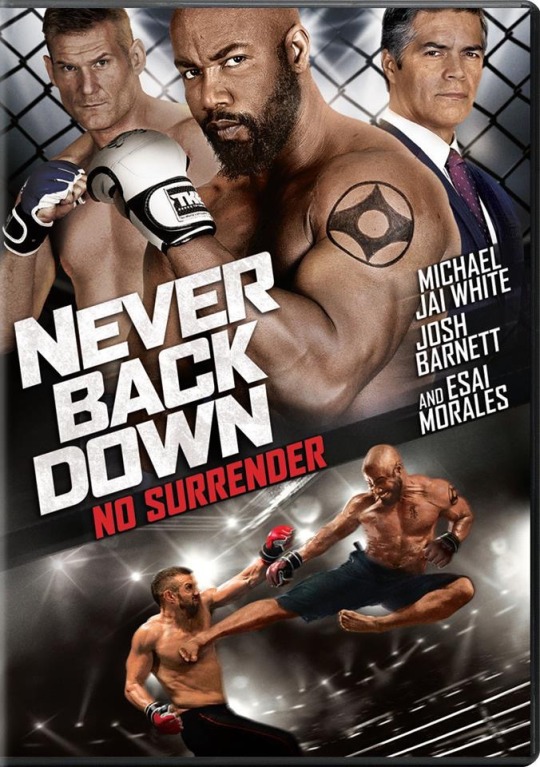
For reasons I can’t
explain, I hadn’t thought to look into the Never Back Down
series before now
and thereby completely
overlooked
that Michael Jai White had
expanded from martial arts star to
filmmaker. This
movie
actually gives me some hope for the future, as it’s virtually the
only one I’ve seen
show an interest in actually
carrying on the legacy of
martial arts videos’ glory days. Don’t give me another boring
Dolph Lundgren production if White’s making films. Of course, Never
Back Down: No Surrender’s
not perfect – it’s
actually one of the few
movies of this sort where the problematic screenplay bothers me more
than any technical shortcomings. As
is, this one works best as a blueprint to improve on, but in
the meantime, it’s a very
watchable blueprint.
The story: Legendary
fighter Case Walker (Michael Jai White) travels to Thailand to train
his comrade Brody James (Josh Barnett) for a high-stakes title match,
but soon realizes that the promoter (Esai Morales) has shady
intentions.
NBD3
has so many real-life
influences that it’s practically
meta. There are numerous
connections
between Josh Barnett’s character and the actor’s
real-life competitive career,
many of them unflattering. Additionally,
the movie tackles the
ever-relevant issue of steroids in sports with
surprising zeal. Ironically,
this approach makes the
film’s frequent idealistic stances feel haphazard and naive, as
it presents
simplistic solutions to complex problems. Also, I didn’t like that
the story is full of unresolved issues: aside from the loose
thread of Casey taking on a couple of young proteges, it’s
uncomfortable that
the feature
allows
things like Brody’s blatant infidelity and the racism of some
supporting characters to
fade into the background. I also
didn’t like how a side-story regarding sexism towards a character
played by Jeeja Yanin is “resolved” via sexism. Despite
all of this, the screenplay isn’t
weak: Case
Walker is likable enough,
and the story eschews
typical life-and-death setups in
favor of a political approach
that feels more suitable to
modern sports promotion. Not
every idea it has
pans out, but I can
appreciate a film for showing
me that it at least had thought behind
it.
How
much you enjoy the action content depends
on your tolerance of
unnecessary slow motion. Fight
choreographer Larnel Stovall delivers good stuff, but the fact that
only a couple of the eight fights
aren’t mucked about with
this editing technique
is disappointing.
Nevertheless, Michael Jai White remains one of the best performers in
modern martial arts films,
and this is apparent throughout the feature. Though he achieves
Hector Echavarria levels of self-glorification by including a scene
that puts him over a genuine MMA star
like Josh Barnett, he looks fantastic in whatever he does and
whoever he fights. He’s got
a great cast of supporting
kickers,
including Nathan Jones as the rival champion and genre
staples Brahim Achabbakhe,
Eoin
O’Brien, and Ron Smoorenburg as
various brawlers.
More impressive on paper but less so onscreen are the Thai stars: the
aforementioned Jeeja Yanin has a
single
fight and is barely a character, while Tony Jaa only shows up to make
a fool of himself in a comedy cameo. Seriously,
if
the poor quality and
infrequency of
Jaa’s most recent output
hasn’t
caused you to lose esteem for him, his buffoonish
scenes
here will do the trick.
Despite these disappointments, NBD3
is an enjoyable watch. Again, I’m pleased that MJW
chose
to be
a filmmaker: it’s good
knowing that the legacy of U.S. martial arts videos has a competent
torchbearer, and it’s important that the subgenre contains
perspectives other than those of white men.
The main problem remains
the movie’s screenplay, but
I’m hopeful that White will improve in that regard in
time. Even so, this one is
worth a look.
Written
by
Chris Hauty (Never
Back Down 1
& 2), Michael Jai White
Starring
Michael Jai White, Josh Barnett (Absolution),
Gillian White (Bamboozled),
Esai Morales (NYPD
Blue)
Cool
costars:
Stephen Quadros (Sworn
to Justice),
Nathan Jones (Tom
Yum Goong),
Jeeja Yanin (Raging
Phoenix),
Brahim Achabbakhe (Dragonwolf),
Ron Smoorenburg (Who
Am I),
Damian Mavis (Kung
Fu Yoga),
Amarin Cholvibul (Hard
Target 2),
Eoin O’Brien (Kill
‘Em All),
and Creighton Mark Johnson (Risk
for Honor)
all appear in martial roles. Pro fighter Quinton Jackson cameos in a
little scene. Tony Jaa also cameos, but…I just can’t.
Content
warning:
Sexist
and racist dialogue, racially-motivated violence,
police brutality. There’s
also a scene where a transsexual prostitute is “humorously” outed
against her will.
Game
Over is a well-made independent
flick in that none of its flaws are the result of its budget. I’ll
always recognize
director Peter Sullivan for
having helmed more Christmas movies than anyone else, but it’s fairer
to distinguish him as someone who brings class and competence to any
genre of film, including martial arts action. While
far from the best adrenaline production
of its time,
this is
a solid
example of what can be accomplished at a
lower economic level and
the go-to vehicle for star Andre “Chyna” McCoy.
The
story: An out-of-work and persecuted parolee (McCoy) enters a
mysterious fighting circuit in hopes that the $100,000 prize will be
enough to rebuild his life.
Chyna
McCoy’s been near the top of the top of a cast list before, but
this is his first starring role. I
see room for improvement where his acting and charisma is concerned,
but his look and martial moves are
memorable. At
any rate, his costars and the screenplay help
keep the film
interesting enough to forgive any related
slip-ups. I’ve seen this
template of movie
done better, but the perspective of McCoy’s character gives it an
urgent freshness that I wasn’t expecting. Paul Green plays a
properly deplorable parole
officer who keeps the pressure on the protagonist, and
while this ongoing angle of racism and police corruption definitely
makes for some uncomfortable scenes, the story would’ve been
generic without it.
The
action content’s almost entirely made up of fight scenes, and while
their quality fluctuates, I give ‘em an overall passing mark. The
film was made with the involvement of the Zero Gravity Stunt Team –
the same group that gave us Lateef Crowder – and scenes featuring
them and other high-flying tricksters tend to be the best. Edwin
Villa plays a tailor who attacks our hero with pins and uses his tie
as a whip. McCoy is a
capoeira practitioner and capable of some
flashy stuff, but he
mostly keeps things simple
with down-to-earth
brawling and the occasional
submission technique. His showdown with Blade II’s
(2002) Daz Crawford is built up throughout the film and ends
up being a major
disappointment…but the movie saves itself with a completely
unexpected second finale with co-lead La Trice Harper.
Other
shortcomings include some questionable editing, a couple weird
dream/flashback sequences, the use
of women as trophies, and
a twist ending that could alienate as many viewers as it surprises.
While these aspects
definitely strain
the film for
likability, I think it weathers them nonetheless. Between its
worthy action content and steady direction, this is
a good watch for anyone
seeking a no-frills karate thriller. I hope that Chyna McCoy gets at
least one more
starring vehicle – one with a bigger budget.
THE
COPYRIGHT HOLDER HAS MADE THIS TITLE AVAILABLE FOR FREE. YOU CAN FIND
IT HERE.
Game
Over (2005)
Directed
by
Peter Sullivan (The
Sandman)
Written
by
Max Miller (screenplay), Kasim Saul (story)
Starring
Andre “Chyna” McCoy (T.K.O.),
La Trice Harper (Matthew
26:17),
Daz Crawford, Paul Green
(Blackout)
Cool
costars:
Edwin Villa (Shira:
The Vampire Samurai),
Larnell Stovall (The
Circuit 2),
and
Kerry Wong – co-founder of the Zero Gravity Stunt Team – all play
various opponents. So does the late Orlando Ortega, who
deserves a brief highlight. Ortega was a Nicaraguan-born
taekwondo
practitioner who,
shortly before his death, had taken up the reins of film production
by writing, producing, and starring in his own comedy short. He was
shot to death in May 2007,
at
age 31, in West Hollywood. The
identity and motive of his killer remain a mystery.
Content
warning:
Violence
against women, sexist dialogue, racist dialogue, police corruption
& brutality,
group
violence
Copyright Blackgoldsun
Entertainment, Maverick
Entertainment
Before director
Isaac Florentine limited himself to vehicles for Scott Adkins, he
made movies with every action hero he could, and before the turn of
the century, Dolph Lundgren was his biggest draw yet. Lundgren, fresh
from a disappointing experience on Sweepers
(1998), was pleased to work with someone seasoned
in the action genre. The
production was looking
promising, but then got kinda
weird. Due to serious script
revamping, what might’ve been a
solid war film turned into a
bewildering
sci-fi adventure. Bridge of Dragons is
an entertaining romp but it’s
difficult to love,
thanks in part to
poor utilization of its
cast and characters.
The
story: On a mission to
capture
a princess (Valerie Chow) for the
warmongering General
Ruechang (Cary-Hiroyuki
Tagawa), the
mercenary Warchild (Lundgren)
uncovers a plot by his master to take over the kingdom.
The
most noteworthy aspects of the film are its setting and hodge-podge
aesthetic. Imagine: a
feudalistic society, uniforms
and weaponry spanning the last 70 years, martial arts, horse-drawn
carriages, Eastern chanting on the soundtrack, and
Cary Tagawa seemingly
wearing a Michael Jackson
outfit.
This is a world that feels
very much thrown-together – an environment crafted by an
indiscriminate prop department – but somehow,
it
still
engages
me.
Art director Valentina
Mladenova has a knack for turning trash into functional
onscreen societies, and while
the film isn’t her most striking work, it’s something I haven’t
seen the likes
of before. Disappointingly, the story
that plays out within this place
is bland.
I’m disappointed by how little the screenplay does with its
characters: I’d have loved exploring
the shifting relationship
between Warchild
and the man who raised and
commands him,
or incorporating a
tricky
dynamic
between Princess Halo and the men who want to control her
while still needing to defer
to her out of protocol. As
is, it’s a tired screenplay
filled with boring characters, only occasionally elevated when the
odd performer brightens the
show thru
force of personality – see
Jo Kendall as Halo’s nurse.
Of
course, any dramatic or
aesthetic triumph at this point in Florentine’s films was pure
gravy. His
acclaim was in making the most action-packed pictures you could find,
and that’s what he does here. The movie’s crammed
with adrenaline scenes, from shootouts to explosions and hand-to-hand
fights. But once again, I’m not satisfied. I was anxious to see
Dolph Lundgren wrangled by
the same director (Florentine) and action choreographer (Akihiro
Noguchi) who’d just
done
the Gary Daniels vehicle Cold Harvest
(1999), but their
results are kinda weak. Lundgren’s one of those actors who’re
generally identified as karate stars but doesn’t really build on
their
reputation, and while I wasn’t expecting him to go
full-on kick crazy, I was
expecting more fighting than this. The high point comes early when
Valerie Chow’s stunt double leads some
stick fights on raised poles, and the final duel between Lundgren and
Tagawa is worth a mention, but there’s sparse little karate between
these events. Lundgren
suffers from a lack of credible opponents, sure, but he just seems
readier to shoot a foe than fight
him otherwise – major
disappointment for
a movie by the guy who’d eventually set the standard for martial
arts flicks.
Part
of this karate dearth has to
do with the poor utilization of Princess Halo, who’s established as
a good fighter early on but spends the rest of the film in repeated
need of rescue. This
would peeve me even if the
movie didn’t need
more fights.
Stripping the character of practically all her autonomy after
establishing her so fiercely
is disingenuous: the filmmakers want to have
her be a passive trophy but at the same time also win points for
having her be a strong female co-lead –
somehow. It’s
boring, sexist, and impoverishes the movie all the more.
Bridge of Dragons
is an overall entertaining trip, but
it’s only worth a rental.
Florentine’s early style, with dialogue as overblown as his sound
effects,
will make some viewers wonder whether this is too much like Power
Rangers for their liking.
Combined with the other
shortcomings, this matches the film’s strengths tit-for-tat, but
it’s just not worth the shelf room unless you’re a particularly
big fan of any of the actors.
Trivia:
The film’s curious
title made sense in the original script. The story
was to end with the protagonists trapped in the middle of a bridge
with two armies bearing down on them from either side. The characters
are killed but die heroically, fighting “like dragons.”
Written
by
Carlton Holder (Extreme
Heist),
Greg Latter (uncredited), Clint Lien (uncredited)
Starring
Dolph Lundgren, Valerie Chow (Lover
of the Last Empress),
Cary Hiroyuki-Tagawa (Mortal
Kombat),
Gary Hudson (Martial
Outlaw)
Cool
costars:
Perpetual
onscreen tough guys Scott Schwartz (Ocean’s
Eleven)
and Bashar Rahal (Direct
Contact)
have appropriate roles, as does
Lundgren’s
personal karate
trainer Brian Fitkin. English sketch actor Jo Kendall (Emmerdale)
is pretty
enjoyable in
pure acting role.
Content
warning:
Sexual assault, domestic violence, violence towards women, group
violence, war-related
violence
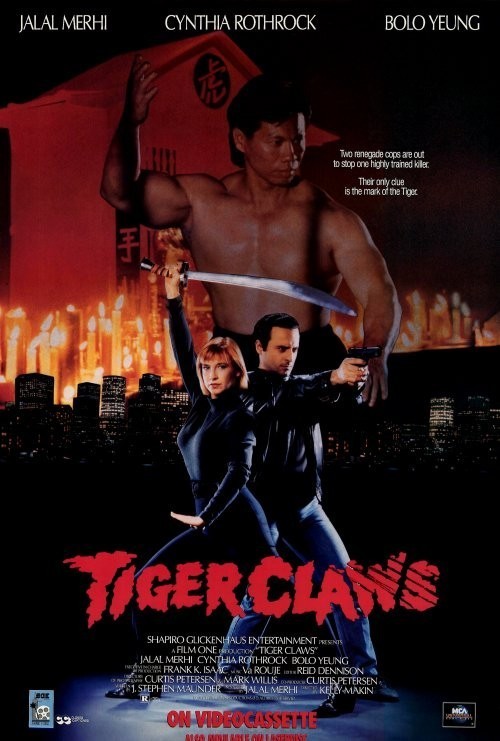
At
the end of the 80s, a Lebanese-Canadian martial arts competitor sold
his jewelry business and entered the world of karate flicks. His name
is Jalal Merhi, and through money and persistence, he became a staple
name of the U.S. video scene. Nicknamed “Beirut’s Steven Seagal”
(despite his accent making him comparable to Jean-Claude Van Damme),
what set him apart from virtually everyone else on the U.S. martial
arts scene was his desire to showcase Chinese martial arts over their
more common Japanese and Korean counterparts. He tried this first
with Fearless Tiger (1991), a
tournament flick that didn’t see an
American release until three
years after completion, but had greater luck with the more unique Tiger Claws. Merhi’s
recipe for this endeavor?
– lots of kung
fu, established stars, and a capable
director. The result is a
thoroughly watchable adventure that grew on me over time. It’s an
examination of fanaticism in martial arts, and arguably the best film
Merhi would ever star in.
The
movie opens in New York City with a woman (Cynthia Rothrock) hounded
on the street by a suspicious man (Nick Dibley). He corners her with
evil intent, but she fights back and utterly decimates him in a
brawl, knocking him out before he’s arrested. It turns out she’s
Detective Linda Masterson, supercop, and the guy who attacked her was
a suspect in a crime spree. She’s disgusted that her wolf-whistling
partner (Fern Figueiredo) wasn’t anywhere to be found when the
fight happened, but more so that she’s wasting her time “dressing
up like a whore and working on these two-bit cases.” Shortly
thereafter, we meet our other hero: Det. Tarek Richard (Jalal Merhi),
who’s carrying out an undercover drug deal that, somehow, is also
the purview of rival detectives Roberts (Robert Nolan) and Vince
(Kedar Brown). It’s unclear who’s actually out of line, but
Tarek’s suspended when his counterparts initiate a fight/shootout
and the dealer is blown up in his car.
The
case they’re both headed for – Linda by intent and Tarek by
accident – is that of the Death Dealer, a serial killer targeting
martial artists. The victims’ claw-like head wounds lead Linda to
believe that the killer’s also a martial artist and that he can be
unconvered by identifying his fighting style. This impresses her
superior, Sergeant Reeves (John Webster), who assigns her to the case
over a sexist cohort but also demands she work with the
still-suspended Tarek. Linda’s not pleased but has no choice,
especially when Tarek promptly identifies the style as “fu jow . .
. some people call it tiger claw.”
Let’s
pause to examine the story’s unusual take on martial arts
awareness. Usually in these features, a martial artist is teamed up
with someone who has no such experience and thinks “chop socky”
is nonsense. That approach is subverted, here: Linda’s already a
master martial artist but still needs the insight of a “specialist”
like Tarek when it comes to exotic styles. Again, this is part of
Jalal Merhi’s unique formula: not only was he featuring kung fu in
his movies when few others were, but doing so at a time when these
styles weren’t even widely practiced outside of films. It’s less
of a deal now that Hong Kong flicks are widely distributed and it’s
easy to find modern kung fu fight scenes, but at the time, Merhi
capitalized on a market opening and used the opportunity to build up
the Chinese arts grandly. The movie’s stance is that, while you can
be a well-studied martial artist, there’s always more to learn by
looking to the past. If you don’t, you’ll be at a disadvantage.
This sentiment isn’t explored and thus feels a little like martial
arts propaganda (“Your kung fu is strong, but mine is better!”),
but I think Merhi was merely trying to set a precedent at this point.
Photo source| Jalal Merhi, Kedar Brown, Robert Nolan
Tarek
and Linda search Chinatown for the school where the killer trains.
Specifically, they’re searching for a secret studio that only
trains serious fighters – like Tarek says, “This is not a sport
for any bozo with 50 bucks.” They eventually receive a tip from a
drunken boxing student (Rick Sue) who they rescue from a gang
beating. It’s a cool fight, but doesn’t go very far in
distinguishing our heroes’ differing approaches to martial arts:
Tarek has some flowing movements, but he’s still as hard-edged as
his partner. Ironically, it’s Linda who wields a Chinese rope dart.
Anyway, they’re directed to a local tournament to find Sifu Chow
(Mo Chow) – the only fu jow teacher in the area. Tarek not only
finds him, but also an old friend and tournament competitor, John
Atkinson (playing himself). A huge and mysterious man in the crowd
(Bolo Yeung) looks on ominously as John wins the championship.
Shortly thereafter, he shows up in John’s home and attacks him –
killing him with a tiger strike to the face. Afterwards, we see the
guy before a tiger-themed altar decorated with trophies from the
other beaten martial artists. This is our killer.
Tarek
and Linda follow Chow to an abandoned movie theater which Tarek
immediately identifies as his school. He wants to go in right away,
but Linda demands he stay. When a night of waiting results in nothing
but the aforementioned death of his friend, Tarek impatiently sneaks
into the studio on his own. He’s promptly discovered, but –
immediately crafting his cover – earns a chance at tutelage by
revealing that Chow and he studied under the same master. (Stroke of
luck, huh?) Before leaving, Tarek notices his friend’s killer
painting a mural on the wall, but of course doesn’t know who Chong
is.
TRIVIA:
A subsequent scene features Tarek and Linda arguing whether to go to
an Italian or Chinese restaurant to eat. This mirrors a real-life
event wherein Merhi, Rothrock, Yeung, and some production members
were deciding where to eat after a day of filming. Everyone voted for
Italian, with the exception of Yeung. Merhi, who idolized Yeung,
immediately changed his vote and attempted to sway the group in favor
of Bolo’s choice. He was overruled and the group went to the
Italian locale, where Yeung refused to order anything.
Tarek
returns to the secret studio and earns his spot
by holding his own in against the other students. This is the first
fully-fledged kung fu fight scene, and the difference to previous
brawls is noticeable. The pacing is more restrained and the tiger
claw choreography reminds me of classic Hong Kong fights. You
get the impression that the filmmakers are genuinely trying to make
the fu jow
aspects
stand out, and this continues as Tarek engages
in a necessity for
any
good kung fu
flick – a training scene. He twirls weapons, strikes form, and
toughens his hands by submerging them in a wok of boiling water
filled with chains. Sifu Chow doesn’t do much on-the-ground
teaching, preferring
to beat a drum while his students go
at it, but he does step in
as a rivalry between Tarek and fellow
student James (Ho
Chow) threatens to get out of hand.
In
an unexpected turn, another student (Gary Wong) invites Tarek to a
go-go club, and they take Chong with them. The movie twists
expectations by showing Chong as a normal guy who drinks and laughs
with his comrades, but eventually, the scene’s mainly there so
Tarek can find out how good of a fighter the muralist is when they
have to thwart a mafia attack on the joint. Additionally, Chong keeps
Tarek from killing one of the guys – highlighting the theme of
martial excess that I’ll get into later. In the aftermath, Tarek
still isn’t certain which of the practitioners is the killer, but
Linda thinks it’s the hotheaded James. She confronts him at a
billiard bar, and despite beating up him and half the establishment
in the process, it turns out that he has an alibi. This faux pas
results in Linda and Tarek being removed from the case and being
replaced by the insufferable Roberts and Vince. In the meantime,
Chong kills Sifu Chow and some of the students.
This
scene is an enigmatic as it is essential. The final exchange between
Chong and Chow features Chinese dialogue with no subtitles, so while
their exchange may offers clues to Chong’s motives, I can’t be
certain. We
don’t find out otherwise
why Chong is a serial killer. The head-spinning
sequel throws a ton of new, outrageous information into the
continuity, but where only
this movie is concerned, it’s
ambiguous. The only theory
that’d
tie into
an existing theme is that Chong, having taken his training to the
extreme, has literally been driven crazy
by kung fu. Tarek’s spent the picture making sure we know how
demanding and encompassing fu jow is, having mentioned that his wife
left him when last
he trained – implying that
he, like Chong, has the potential to become a menace if
not kept in check. Tarek’s
also the only character to voice a
theory on Chong’s motives, saying that perhaps he’s
trying to “drum up lost respect for his style.” This may in fact
be a part of the reason,
given how the movie venerates
kung fu. Chong may see his
victims and
their martial arts as temporary and weak and is thus trying to
exemplify
the “true” martial art. This isn’t entirely without real-world
parallel: fierce inter-style
competition goes back centuries, and Chinese styles have often been
ridiculed in modern times
by “hard style” practitioners for being impractical and fancy.
Altogether, this information
comprises pieces to Chong’s puzzle, but the picture still isn’t
clear. Perhaps that’s why the movie reveals the killer relatively
early: it’s not bad writing, but an intended opportunity for
viewers to ponder Chong’s motives.
Tarek
and Linda refuse to drop the case, and they somehow
determine that Chong is their
prime suspect. Their suspicions are confirmed when they enter the
studio, finding the others
dead and Chong in attack
mode. He flees after a quick
duel with Linda, who spends the rest of the night searching for him
with Tarek. They find him at the pier, but not before the bumbling
Roberts and Vince arrive and handcuff
Tarek, suspecting him of the murders. Linda and Chong fight again –
possibly the best one-on-one match of the film – but the finale
pits the still-handcuffed Tarek against Chong in a warehouse. In a
bit of egoism, Jalal Merhi’s character is able to best Chong while
spending the majority of the fight with his hands bound. The
film ends with with Chong apprehended, Tarek and Linda commended, and
the former reinstated while the two share an awkwardly-earned
kiss on Tarek’s boat.
TRIVIA:
The movie draws on real-life characteristics for many of its
characters. For example… Linda is from Scranton, PA and
Chong is from Canton, China – just like their actors. Jalal Merhi
wasn’t divorced, but like Tarek, he was single at the time of
production. John Atkinson was indeed a successful karate fighter and
multi-time grand champion. Mo Chow is a martial arts
instructor who operateshis own studio.
Bill Pickels – Chong’s first victim – is a former cable TV
personality in Canada. Three actors share similar or identical names
with their characters: Mo Chow, John Atkinson, and Bill Pickels.
I
wasn’t a Jalal Merhi fan when I first saw this, and only held onto
the tape for Cynthia Rothrock. I can still see why the guy didn’t
click with me right away. Merhi lacks the charisma that makes even a
questionable actor like Rothrock fun to watch, and despite his
emphasis on kung fu being genuinely unique at the time, it doesn’t
make him stand out to the average viewer. Despite his efforts, Merhi
isn’t comparable to Steven Seagal introducing aikido in the late
80s or Tony Jaa rewriting action choreography with muay thai in the
2000s. Nevertheless, the more of this subgenre you consume, the more
Jalal’s effort does in fact stand out. The Chinese martial arts
help give this movie a unique flavor that you won’t find in other
kick flicks of the same budget. The crisp forms, traditional uniforms
and decent training montages eventually give the movie an air of
importance that I kind of miss in other features. This approach won’t
click with viewers who’d rather limit martial arts exclusively to
fight scenes, but it might be unique enough for those who’ve grown
tired of repetitious kickboxing.
Merhi’s
use of eye-catching names to star alongside him is a sound decision,
but again, you can’t help but chuckle at the scene that features
him defeating Bolo Yeung as Cynthia
Rothrock fishes a buffoonish
detective out of the bay.
Nevertheless, treating his own
character as exemplary
doesn’t mean the others are treated as jokes. This is one of
Yeung’s most interesting non-Hong
Kong roles, and even though
Rothrock hangs back many
times, both she
and Bolo are given ample
opportunity to steal the show in
fight scenes. To tell the
truth, Merhi is
elevated by their presence because
they bring out a lot in him. I’ve seen the guy do flashier moves,
but he’s never looked as tight and collected as he does here. To
date, Merhi is the only Arab martial arts star who’s had a solo
career in North America, and he really puts his best foot forward in
making a first impression here.
Exploring
the martial arts theme yields contradictory results. We’re to
presume that fu jow – and “old” martial arts in general – are
superior to modern forms, because when they come into contact, the
former tends to triumph. Nevertheless, Linda seems to be the
exception: she isn’t versed in fu jow but still defeats a hardcore
practitioner in direct combat. We’re also led to believe that
respect and mastery of the martial arts is limited to the experience
of immigrants and minority characters, but the majority of Chong’s
victims fall under the same labels. There’s also a theme of martial
arts bringing people together – i.e. Linda and Tarek bonding over
their practice of the fighting arts – but this ignores that Tarek’s
wife left him because of his training and that Chong’s obsession
with the martial arts may be the cause of his murderous behavior. I
wish the film were more consistent in what it’s saying.
Nevertheless,
it’s still enjoyable and that’s got much to do with director
Kelly Makin. Merhi had a knack for selecting inexperienced directors
who’d later go on to critical acclaim, and Makin displays his
talent via style in what would otherwise have been a humdrum-looking
picture. Though I’m not sure whether anyone would think this is an
A-grade production, Makin delivers a consistently clean look and
takes time to highlight the soundtrack, indulge in interesting camera
angles, and even film an occasional arty establishing shot. Though
not the best in this regard, he can shoot a fight scene surprisingly
well.
Tiger
Claws is a
fun watch for genre fans and definitely worth
hooking up the old VCR for. The
cast is a supergroup of genuine martial talent and
the filmmakers
know how
to make them shine. There are plenty of things I’d change, but
overall, this is one experiment that pays off. People interested in
coming into these types of movies should definitely consider it, and
established viewers
who’ve yet to see this particular one shouldn’t hesitate much
longer. Check it out!
Written
by J.
Stephen Maunder (writer for almost all of Jalal Merhi’s movies)
Starring
Jalal Merhi, Cynthia Rothrock (China
O’Brien),
Bolo Yeung (Bloodsport),
John Webster
Cool
costars:
Gary Wong, Michael Bernardo (WMAC
Masters),
Rick
Sue (Expect
No Mercy),
David Stevenson (Death
House),
Bill Pickels (Sworn
to Justice),
Mo
Chow (Talons
of the Eagle)
and Ho Chow
(Kung
Fu: The Legend Continues)
are
all legitimate martial artists playing the part. Wing chun legend
Dunn Wah (AKA Sunny Tang) plays a master
but doesn’t have
any fight scenes. IMDb credits gang member William Cheung as the William
Cheung – kung
fu
master and contemporary
of Bruce Lee
– but I don’t think they’re the same person. Similarly,
John
Atkinson is identified as an English TV actor who died in ‘07,
whereas the real performer currently operates a martial arts studio
in Arizona. Robert
Nolan
(Sixty
Minutes to Midnight)
is
a fairly
acclaimed dramatic
actor
while his onscreen partner
Kedar Brown has
been building a career in
voice acting.
Content
warning: Sexist
dialogue, attempted
sexual assault, group
violence, WTC imagery
Copyright
Tiger Claws Productions, Ltd. / MCA Universal Home Video (now
Universal Pictures Home Entertainment)







 B-Movie Dragons