Game
Over is a well-made independent
flick in that none of its flaws are the result of its budget. I’ll
always recognize
director Peter Sullivan for
having helmed more Christmas movies than anyone else, but it’s fairer
to distinguish him as someone who brings class and competence to any
genre of film, including martial arts action. While
far from the best adrenaline production
of its time,
this is
a solid
example of what can be accomplished at a
lower economic level and
the go-to vehicle for star Andre “Chyna” McCoy.
The
story: An out-of-work and persecuted parolee (McCoy) enters a
mysterious fighting circuit in hopes that the $100,000 prize will be
enough to rebuild his life.
Chyna
McCoy’s been near the top of the top of a cast list before, but
this is his first starring role. I
see room for improvement where his acting and charisma is concerned,
but his look and martial moves are
memorable. At
any rate, his costars and the screenplay help
keep the film
interesting enough to forgive any related
slip-ups. I’ve seen this
template of movie
done better, but the perspective of McCoy’s character gives it an
urgent freshness that I wasn’t expecting. Paul Green plays a
properly deplorable parole
officer who keeps the pressure on the protagonist, and
while this ongoing angle of racism and police corruption definitely
makes for some uncomfortable scenes, the story would’ve been
generic without it.
The
action content’s almost entirely made up of fight scenes, and while
their quality fluctuates, I give ‘em an overall passing mark. The
film was made with the involvement of the Zero Gravity Stunt Team –
the same group that gave us Lateef Crowder – and scenes featuring
them and other high-flying tricksters tend to be the best. Edwin
Villa plays a tailor who attacks our hero with pins and uses his tie
as a whip. McCoy is a
capoeira practitioner and capable of some
flashy stuff, but he
mostly keeps things simple
with down-to-earth
brawling and the occasional
submission technique. His showdown with Blade II’s
(2002) Daz Crawford is built up throughout the film and ends
up being a major
disappointment…but the movie saves itself with a completely
unexpected second finale with co-lead La Trice Harper.
Other
shortcomings include some questionable editing, a couple weird
dream/flashback sequences, the use
of women as trophies, and
a twist ending that could alienate as many viewers as it surprises.
While these aspects
definitely strain
the film for
likability, I think it weathers them nonetheless. Between its
worthy action content and steady direction, this is
a good watch for anyone
seeking a no-frills karate thriller. I hope that Chyna McCoy gets at
least one more
starring vehicle – one with a bigger budget.
THE
COPYRIGHT HOLDER HAS MADE THIS TITLE AVAILABLE FOR FREE. YOU CAN FIND
IT HERE.
Game
Over (2005)
Directed
by
Peter Sullivan (The
Sandman)
Written
by
Max Miller (screenplay), Kasim Saul (story)
Starring
Andre “Chyna” McCoy (T.K.O.),
La Trice Harper (Matthew
26:17),
Daz Crawford, Paul Green
(Blackout)
Cool
costars:
Edwin Villa (Shira:
The Vampire Samurai),
Larnell Stovall (The
Circuit 2),
and
Kerry Wong – co-founder of the Zero Gravity Stunt Team – all play
various opponents. So does the late Orlando Ortega, who
deserves a brief highlight. Ortega was a Nicaraguan-born
taekwondo
practitioner who,
shortly before his death, had taken up the reins of film production
by writing, producing, and starring in his own comedy short. He was
shot to death in May 2007,
at
age 31, in West Hollywood. The
identity and motive of his killer remain a mystery.
Content
warning:
Violence
against women, sexist dialogue, racist dialogue, police corruption
& brutality,
group
violence
Copyright Blackgoldsun
Entertainment, Maverick
Entertainment
Before director
Isaac Florentine limited himself to vehicles for Scott Adkins, he
made movies with every action hero he could, and before the turn of
the century, Dolph Lundgren was his biggest draw yet. Lundgren, fresh
from a disappointing experience on Sweepers
(1998), was pleased to work with someone seasoned
in the action genre. The
production was looking
promising, but then got kinda
weird. Due to serious script
revamping, what might’ve been a
solid war film turned into a
bewildering
sci-fi adventure. Bridge of Dragons is
an entertaining romp but it’s
difficult to love,
thanks in part to
poor utilization of its
cast and characters.
The
story: On a mission to
capture
a princess (Valerie Chow) for the
warmongering General
Ruechang (Cary-Hiroyuki
Tagawa), the
mercenary Warchild (Lundgren)
uncovers a plot by his master to take over the kingdom.
The
most noteworthy aspects of the film are its setting and hodge-podge
aesthetic. Imagine: a
feudalistic society, uniforms
and weaponry spanning the last 70 years, martial arts, horse-drawn
carriages, Eastern chanting on the soundtrack, and
Cary Tagawa seemingly
wearing a Michael Jackson
outfit.
This is a world that feels
very much thrown-together – an environment crafted by an
indiscriminate prop department – but somehow,
it
still
engages
me.
Art director Valentina
Mladenova has a knack for turning trash into functional
onscreen societies, and while
the film isn’t her most striking work, it’s something I haven’t
seen the likes
of before. Disappointingly, the story
that plays out within this place
is bland.
I’m disappointed by how little the screenplay does with its
characters: I’d have loved exploring
the shifting relationship
between Warchild
and the man who raised and
commands him,
or incorporating a
tricky
dynamic
between Princess Halo and the men who want to control her
while still needing to defer
to her out of protocol. As
is, it’s a tired screenplay
filled with boring characters, only occasionally elevated when the
odd performer brightens the
show thru
force of personality – see
Jo Kendall as Halo’s nurse.
Of
course, any dramatic or
aesthetic triumph at this point in Florentine’s films was pure
gravy. His
acclaim was in making the most action-packed pictures you could find,
and that’s what he does here. The movie’s crammed
with adrenaline scenes, from shootouts to explosions and hand-to-hand
fights. But once again, I’m not satisfied. I was anxious to see
Dolph Lundgren wrangled by
the same director (Florentine) and action choreographer (Akihiro
Noguchi) who’d just
done
the Gary Daniels vehicle Cold Harvest
(1999), but their
results are kinda weak. Lundgren’s one of those actors who’re
generally identified as karate stars but doesn’t really build on
their
reputation, and while I wasn’t expecting him to go
full-on kick crazy, I was
expecting more fighting than this. The high point comes early when
Valerie Chow’s stunt double leads some
stick fights on raised poles, and the final duel between Lundgren and
Tagawa is worth a mention, but there’s sparse little karate between
these events. Lundgren
suffers from a lack of credible opponents, sure, but he just seems
readier to shoot a foe than fight
him otherwise – major
disappointment for
a movie by the guy who’d eventually set the standard for martial
arts flicks.
Part
of this karate dearth has to
do with the poor utilization of Princess Halo, who’s established as
a good fighter early on but spends the rest of the film in repeated
need of rescue. This
would peeve me even if the
movie didn’t need
more fights.
Stripping the character of practically all her autonomy after
establishing her so fiercely
is disingenuous: the filmmakers want to have
her be a passive trophy but at the same time also win points for
having her be a strong female co-lead –
somehow. It’s
boring, sexist, and impoverishes the movie all the more.
Bridge of Dragons
is an overall entertaining trip, but
it’s only worth a rental.
Florentine’s early style, with dialogue as overblown as his sound
effects,
will make some viewers wonder whether this is too much like Power
Rangers for their liking.
Combined with the other
shortcomings, this matches the film’s strengths tit-for-tat, but
it’s just not worth the shelf room unless you’re a particularly
big fan of any of the actors.
Trivia:
The film’s curious
title made sense in the original script. The story
was to end with the protagonists trapped in the middle of a bridge
with two armies bearing down on them from either side. The characters
are killed but die heroically, fighting “like dragons.”
Written
by
Carlton Holder (Extreme
Heist),
Greg Latter (uncredited), Clint Lien (uncredited)
Starring
Dolph Lundgren, Valerie Chow (Lover
of the Last Empress),
Cary Hiroyuki-Tagawa (Mortal
Kombat),
Gary Hudson (Martial
Outlaw)
Cool
costars:
Perpetual
onscreen tough guys Scott Schwartz (Ocean’s
Eleven)
and Bashar Rahal (Direct
Contact)
have appropriate roles, as does
Lundgren’s
personal karate
trainer Brian Fitkin. English sketch actor Jo Kendall (Emmerdale)
is pretty
enjoyable in
pure acting role.
Content
warning:
Sexual assault, domestic violence, violence towards women, group
violence, war-related
violence
At
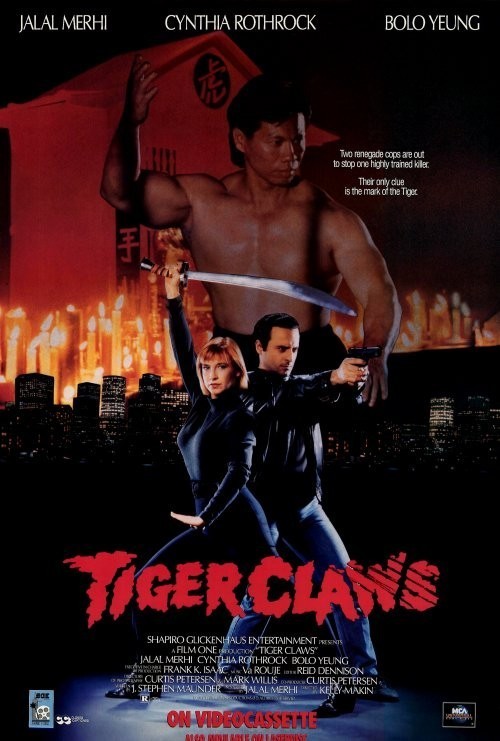
the end of the 80s, a Lebanese-Canadian martial arts competitor sold
his jewelry business and entered the world of karate flicks. His name
is Jalal Merhi, and through money and persistence, he became a staple
name of the U.S. video scene. Nicknamed “Beirut’s Steven Seagal”
(despite his accent making him comparable to Jean-Claude Van Damme),
what set him apart from virtually everyone else on the U.S. martial
arts scene was his desire to showcase Chinese martial arts over their
more common Japanese and Korean counterparts. He tried this first
with Fearless Tiger (1991), a
tournament flick that didn’t see an
American release until three
years after completion, but had greater luck with the more unique Tiger Claws. Merhi’s
recipe for this endeavor?
– lots of kung
fu, established stars, and a capable
director. The result is a
thoroughly watchable adventure that grew on me over time. It’s an
examination of fanaticism in martial arts, and arguably the best film
Merhi would ever star in.
The
movie opens in New York City with a woman (Cynthia Rothrock) hounded
on the street by a suspicious man (Nick Dibley). He corners her with
evil intent, but she fights back and utterly decimates him in a
brawl, knocking him out before he’s arrested. It turns out she’s
Detective Linda Masterson, supercop, and the guy who attacked her was
a suspect in a crime spree. She’s disgusted that her wolf-whistling
partner (Fern Figueiredo) wasn’t anywhere to be found when the
fight happened, but more so that she’s wasting her time “dressing
up like a whore and working on these two-bit cases.” Shortly
thereafter, we meet our other hero: Det. Tarek Richard (Jalal Merhi),
who’s carrying out an undercover drug deal that, somehow, is also
the purview of rival detectives Roberts (Robert Nolan) and Vince
(Kedar Brown). It’s unclear who’s actually out of line, but
Tarek’s suspended when his counterparts initiate a fight/shootout
and the dealer is blown up in his car.
The
case they’re both headed for – Linda by intent and Tarek by
accident – is that of the Death Dealer, a serial killer targeting
martial artists. The victims’ claw-like head wounds lead Linda to
believe that the killer’s also a martial artist and that he can be
unconvered by identifying his fighting style. This impresses her
superior, Sergeant Reeves (John Webster), who assigns her to the case
over a sexist cohort but also demands she work with the
still-suspended Tarek. Linda’s not pleased but has no choice,
especially when Tarek promptly identifies the style as “fu jow . .
. some people call it tiger claw.”
Let’s
pause to examine the story’s unusual take on martial arts
awareness. Usually in these features, a martial artist is teamed up
with someone who has no such experience and thinks “chop socky”
is nonsense. That approach is subverted, here: Linda’s already a
master martial artist but still needs the insight of a “specialist”
like Tarek when it comes to exotic styles. Again, this is part of
Jalal Merhi’s unique formula: not only was he featuring kung fu in
his movies when few others were, but doing so at a time when these
styles weren’t even widely practiced outside of films. It’s less
of a deal now that Hong Kong flicks are widely distributed and it’s
easy to find modern kung fu fight scenes, but at the time, Merhi
capitalized on a market opening and used the opportunity to build up
the Chinese arts grandly. The movie’s stance is that, while you can
be a well-studied martial artist, there’s always more to learn by
looking to the past. If you don’t, you’ll be at a disadvantage.
This sentiment isn’t explored and thus feels a little like martial
arts propaganda (“Your kung fu is strong, but mine is better!”),
but I think Merhi was merely trying to set a precedent at this point.
Photo source| Jalal Merhi, Kedar Brown, Robert Nolan
Tarek
and Linda search Chinatown for the school where the killer trains.
Specifically, they’re searching for a secret studio that only
trains serious fighters – like Tarek says, “This is not a sport
for any bozo with 50 bucks.” They eventually receive a tip from a
drunken boxing student (Rick Sue) who they rescue from a gang
beating. It’s a cool fight, but doesn’t go very far in
distinguishing our heroes’ differing approaches to martial arts:
Tarek has some flowing movements, but he’s still as hard-edged as
his partner. Ironically, it’s Linda who wields a Chinese rope dart.
Anyway, they’re directed to a local tournament to find Sifu Chow
(Mo Chow) – the only fu jow teacher in the area. Tarek not only
finds him, but also an old friend and tournament competitor, John
Atkinson (playing himself). A huge and mysterious man in the crowd
(Bolo Yeung) looks on ominously as John wins the championship.
Shortly thereafter, he shows up in John’s home and attacks him –
killing him with a tiger strike to the face. Afterwards, we see the
guy before a tiger-themed altar decorated with trophies from the
other beaten martial artists. This is our killer.
Tarek
and Linda follow Chow to an abandoned movie theater which Tarek
immediately identifies as his school. He wants to go in right away,
but Linda demands he stay. When a night of waiting results in nothing
but the aforementioned death of his friend, Tarek impatiently sneaks
into the studio on his own. He’s promptly discovered, but –
immediately crafting his cover – earns a chance at tutelage by
revealing that Chow and he studied under the same master. (Stroke of
luck, huh?) Before leaving, Tarek notices his friend’s killer
painting a mural on the wall, but of course doesn’t know who Chong
is.
TRIVIA:
A subsequent scene features Tarek and Linda arguing whether to go to
an Italian or Chinese restaurant to eat. This mirrors a real-life
event wherein Merhi, Rothrock, Yeung, and some production members
were deciding where to eat after a day of filming. Everyone voted for
Italian, with the exception of Yeung. Merhi, who idolized Yeung,
immediately changed his vote and attempted to sway the group in favor
of Bolo’s choice. He was overruled and the group went to the
Italian locale, where Yeung refused to order anything.
Tarek
returns to the secret studio and earns his spot
by holding his own in against the other students. This is the first
fully-fledged kung fu fight scene, and the difference to previous
brawls is noticeable. The pacing is more restrained and the tiger
claw choreography reminds me of classic Hong Kong fights. You
get the impression that the filmmakers are genuinely trying to make
the fu jow
aspects
stand out, and this continues as Tarek engages
in a necessity for
any
good kung fu
flick – a training scene. He twirls weapons, strikes form, and
toughens his hands by submerging them in a wok of boiling water
filled with chains. Sifu Chow doesn’t do much on-the-ground
teaching, preferring
to beat a drum while his students go
at it, but he does step in
as a rivalry between Tarek and fellow
student James (Ho
Chow) threatens to get out of hand.
In
an unexpected turn, another student (Gary Wong) invites Tarek to a
go-go club, and they take Chong with them. The movie twists
expectations by showing Chong as a normal guy who drinks and laughs
with his comrades, but eventually, the scene’s mainly there so
Tarek can find out how good of a fighter the muralist is when they
have to thwart a mafia attack on the joint. Additionally, Chong keeps
Tarek from killing one of the guys – highlighting the theme of
martial excess that I’ll get into later. In the aftermath, Tarek
still isn’t certain which of the practitioners is the killer, but
Linda thinks it’s the hotheaded James. She confronts him at a
billiard bar, and despite beating up him and half the establishment
in the process, it turns out that he has an alibi. This faux pas
results in Linda and Tarek being removed from the case and being
replaced by the insufferable Roberts and Vince. In the meantime,
Chong kills Sifu Chow and some of the students.
This
scene is an enigmatic as it is essential. The final exchange between
Chong and Chow features Chinese dialogue with no subtitles, so while
their exchange may offers clues to Chong’s motives, I can’t be
certain. We
don’t find out otherwise
why Chong is a serial killer. The head-spinning
sequel throws a ton of new, outrageous information into the
continuity, but where only
this movie is concerned, it’s
ambiguous. The only theory
that’d
tie into
an existing theme is that Chong, having taken his training to the
extreme, has literally been driven crazy
by kung fu. Tarek’s spent the picture making sure we know how
demanding and encompassing fu jow is, having mentioned that his wife
left him when last
he trained – implying that
he, like Chong, has the potential to become a menace if
not kept in check. Tarek’s
also the only character to voice a
theory on Chong’s motives, saying that perhaps he’s
trying to “drum up lost respect for his style.” This may in fact
be a part of the reason,
given how the movie venerates
kung fu. Chong may see his
victims and
their martial arts as temporary and weak and is thus trying to
exemplify
the “true” martial art. This isn’t entirely without real-world
parallel: fierce inter-style
competition goes back centuries, and Chinese styles have often been
ridiculed in modern times
by “hard style” practitioners for being impractical and fancy.
Altogether, this information
comprises pieces to Chong’s puzzle, but the picture still isn’t
clear. Perhaps that’s why the movie reveals the killer relatively
early: it’s not bad writing, but an intended opportunity for
viewers to ponder Chong’s motives.
Tarek
and Linda refuse to drop the case, and they somehow
determine that Chong is their
prime suspect. Their suspicions are confirmed when they enter the
studio, finding the others
dead and Chong in attack
mode. He flees after a quick
duel with Linda, who spends the rest of the night searching for him
with Tarek. They find him at the pier, but not before the bumbling
Roberts and Vince arrive and handcuff
Tarek, suspecting him of the murders. Linda and Chong fight again –
possibly the best one-on-one match of the film – but the finale
pits the still-handcuffed Tarek against Chong in a warehouse. In a
bit of egoism, Jalal Merhi’s character is able to best Chong while
spending the majority of the fight with his hands bound. The
film ends with with Chong apprehended, Tarek and Linda commended, and
the former reinstated while the two share an awkwardly-earned
kiss on Tarek’s boat.
TRIVIA:
The movie draws on real-life characteristics for many of its
characters. For example… Linda is from Scranton, PA and
Chong is from Canton, China – just like their actors. Jalal Merhi
wasn’t divorced, but like Tarek, he was single at the time of
production. John Atkinson was indeed a successful karate fighter and
multi-time grand champion. Mo Chow is a martial arts
instructor who operateshis own studio.
Bill Pickels – Chong’s first victim – is a former cable TV
personality in Canada. Three actors share similar or identical names
with their characters: Mo Chow, John Atkinson, and Bill Pickels.
I
wasn’t a Jalal Merhi fan when I first saw this, and only held onto
the tape for Cynthia Rothrock. I can still see why the guy didn’t
click with me right away. Merhi lacks the charisma that makes even a
questionable actor like Rothrock fun to watch, and despite his
emphasis on kung fu being genuinely unique at the time, it doesn’t
make him stand out to the average viewer. Despite his efforts, Merhi
isn’t comparable to Steven Seagal introducing aikido in the late
80s or Tony Jaa rewriting action choreography with muay thai in the
2000s. Nevertheless, the more of this subgenre you consume, the more
Jalal’s effort does in fact stand out. The Chinese martial arts
help give this movie a unique flavor that you won’t find in other
kick flicks of the same budget. The crisp forms, traditional uniforms
and decent training montages eventually give the movie an air of
importance that I kind of miss in other features. This approach won’t
click with viewers who’d rather limit martial arts exclusively to
fight scenes, but it might be unique enough for those who’ve grown
tired of repetitious kickboxing.
Merhi’s
use of eye-catching names to star alongside him is a sound decision,
but again, you can’t help but chuckle at the scene that features
him defeating Bolo Yeung as Cynthia
Rothrock fishes a buffoonish
detective out of the bay.
Nevertheless, treating his own
character as exemplary
doesn’t mean the others are treated as jokes. This is one of
Yeung’s most interesting non-Hong
Kong roles, and even though
Rothrock hangs back many
times, both she
and Bolo are given ample
opportunity to steal the show in
fight scenes. To tell the
truth, Merhi is
elevated by their presence because
they bring out a lot in him. I’ve seen the guy do flashier moves,
but he’s never looked as tight and collected as he does here. To
date, Merhi is the only Arab martial arts star who’s had a solo
career in North America, and he really puts his best foot forward in
making a first impression here.
Exploring
the martial arts theme yields contradictory results. We’re to
presume that fu jow – and “old” martial arts in general – are
superior to modern forms, because when they come into contact, the
former tends to triumph. Nevertheless, Linda seems to be the
exception: she isn’t versed in fu jow but still defeats a hardcore
practitioner in direct combat. We’re also led to believe that
respect and mastery of the martial arts is limited to the experience
of immigrants and minority characters, but the majority of Chong’s
victims fall under the same labels. There’s also a theme of martial
arts bringing people together – i.e. Linda and Tarek bonding over
their practice of the fighting arts – but this ignores that Tarek’s
wife left him because of his training and that Chong’s obsession
with the martial arts may be the cause of his murderous behavior. I
wish the film were more consistent in what it’s saying.
Nevertheless,
it’s still enjoyable and that’s got much to do with director
Kelly Makin. Merhi had a knack for selecting inexperienced directors
who’d later go on to critical acclaim, and Makin displays his
talent via style in what would otherwise have been a humdrum-looking
picture. Though I’m not sure whether anyone would think this is an
A-grade production, Makin delivers a consistently clean look and
takes time to highlight the soundtrack, indulge in interesting camera
angles, and even film an occasional arty establishing shot. Though
not the best in this regard, he can shoot a fight scene surprisingly
well.
Tiger
Claws is a
fun watch for genre fans and definitely worth
hooking up the old VCR for. The
cast is a supergroup of genuine martial talent and
the filmmakers
know how
to make them shine. There are plenty of things I’d change, but
overall, this is one experiment that pays off. People interested in
coming into these types of movies should definitely consider it, and
established viewers
who’ve yet to see this particular one shouldn’t hesitate much
longer. Check it out!
Written
by J.
Stephen Maunder (writer for almost all of Jalal Merhi’s movies)
Starring
Jalal Merhi, Cynthia Rothrock (China
O’Brien),
Bolo Yeung (Bloodsport),
John Webster
Cool
costars:
Gary Wong, Michael Bernardo (WMAC
Masters),
Rick
Sue (Expect
No Mercy),
David Stevenson (Death
House),
Bill Pickels (Sworn
to Justice),
Mo
Chow (Talons
of the Eagle)
and Ho Chow
(Kung
Fu: The Legend Continues)
are
all legitimate martial artists playing the part. Wing chun legend
Dunn Wah (AKA Sunny Tang) plays a master
but doesn’t have
any fight scenes. IMDb credits gang member William Cheung as the William
Cheung – kung
fu
master and contemporary
of Bruce Lee
– but I don’t think they’re the same person. Similarly,
John
Atkinson is identified as an English TV actor who died in ‘07,
whereas the real performer currently operates a martial arts studio
in Arizona. Robert
Nolan
(Sixty
Minutes to Midnight)
is
a fairly
acclaimed dramatic
actor
while his onscreen partner
Kedar Brown has
been building a career in
voice acting.
Content
warning: Sexist
dialogue, attempted
sexual assault, group
violence, WTC imagery
Copyright
Tiger Claws Productions, Ltd. / MCA Universal Home Video (now
Universal Pictures Home Entertainment)
No collection of
martial arts greats is complete without Shihan Christine
Bannon-Rodrigues. A New England native who chose karate over other
sports because of its high level of participation (less “time on
the bench,” as she says), she would soon realize it was her
calling. She was 17 when she earned her first black belt, and was
successfully competing at the world championship level by 25.
Competition earned Bannon-Rodrigues 135 grand championship wins, her
most notable being nine world titles at the WAKO games – two in
forms, three in weapons, and four in fighting. The “Lady Lightning”
balanced this career with one in show business, netting stunt roles
in major productions while shining as a featured fighter on the small
screen. Now retired from competition and appearing only infrequently
on film, she co-owns and teaches at the Don Rodrigues Karate Academy
in Warwick, RI.
Styles &
Accomplishments Oki-Ryu
Kenpo (9th
Dan; 9-time
WAKO World Champion)
Kickboxing
Wushu
Judo
Jujutsu
Krav
Maga
Films to
See Xtreme
Fighter
(2004) – co-starring role WMAC
Masters
(1995-1996) – recurring role The
Martial Arts Kid
(2015)
–
cameo
Trivia Bannon-Rodrigues
set back-to-back world records at the WAKO games. At the 1991 world
championships, she became the first competitor to win three titles at
the same event. When
critics dismissed this as
a fluke, she repeated the feat two years later at the 1993 world
championships.
“Touch that gun, I’ll shove it up your ass and pull the trigger!”
Even
23 years after
its release, Ballistic
is a breath of fresh air. I put off buying it for a long time because
of the
higher-than-average price tag it
goes with these days, but
that was a mistake; it’s
worth every penny.
This isn’t the perfect action movie and
it isn’t
quite unique
enough to be in a class of its own, but it gets
enough of the genre’s necessities
right while also adding
some extra
touches
to make for a genuinely worthy
video entry.
Putting its assets to good use while avoiding any glaring faults,
this is a great vehicle for
first-time star Marjean Holden and
a real hidden gem in the VHS mine.
The
story: When a straight-shooting detective (Holden) is falsely
implicated in a murder, she must prove a conspiracy between the
department and a sleazy arms dealer (Sam Jones).
Marjean
Holden is a fixture of the U.S. action scene, but despite her career
spanning theatrical, video,
and TV
work, she’s been underutilized as
a martial arts star. She’s
best known for her exotic but disappointing role in Mortal
Kombat: Annihilation (1997),
and to date, Ballistic
is the only action picture she stars in. There’s no apparent reason
why she’s seen so little
lead roles, as Holden uses
the opportunity to prove
herself the complete
package. She has an engaging screen presence and more than one note
to her acting. Her martial arts lack the world-class sheen of a
Cynthia Rothrock but she’s yards better than, say, Mimi Lesseos. Or
Michael Dudikoff. In a
perfect world, Ballistic
would be the rough freshman effort that helps lead to a polished solo
career. As is, it’s a good
demonstration of how to build up a potential star, especially when
you have plenty of other
assets at hand.
The
production values are what you’d expect from an upper-level DTV
studio like Imperial, and the cast is surprisingly great for this
kind of film. Sam Jones is an appropriately smug villain, and Charles
Napier brings some dramatic
clout to the ensemble. Cult hero Richard Roundtree plays Holden’s
onscreen father, and while I’ve grown
to regard Roundtree as
someone who gets top billing and then only appears in a handful of
scenes, he’s a genuine character here and is made full use of as an
action veteran. And amid
a fair number of recognizable
enforcers and onscreen combatants, the great star-to-be
Michael Jai White shows off his moves as he does in few films that
he’s not
actually starring
in. Everyone plays to their
strengths, whether that be martial moves or dramatic prowess. While
nobody was about to win awards for this film, no one’s phoning it
in, either.
The
things
that set this movie apart
are Holden’s
relationships to some of the other supporting figures –
specifically Richard Roundtree and her onscreen boyfriend Joel Beeson
(The Dragon Ring). You
can guess that martial artist Beeson will make his way into the
greater story, but it’s not until the film’s second half when
Roundtree’s character is released from prison and joins in the plot
that both assume prominence almost equal to Holden. In a lesser
movie, this might give the impression of
the filmmakers not having
confidence
in their star’s potential to headline, but surprisingly good
writing conveys the importance of family in this scheme.
Thematically, Holden’s
family – defined by their entertaining,
well-established
interrelationships – proves itself stronger than the shifty
criminal enterprise. It’s probably
not what the 18-36 male demographic was demanding, but the film’s
all the better for it.
The
fight content is a mixed bag, but
even here there are definite high points. Again, Michael Jai White is
fantastic, even if he can’t always find opponents to match his
acrobatic skills. Joel Beeson is a pretty decent kickboxer; in any
other incarnation of this film, he’d be the lead. And while Marjean
Holden may technically be the least skilled performer to have more
than one fight, she proves versatile in a weapons-based match and has
a fun climactic brawl against
Corinna Everson – the bodybuilder from Double Impact
who you’ll subsequently
agree was severely
underutilized in her fight with Jean-Claude Van Damme.
All
of this plays out under the direction of Kim Bass. Bass is one of the
very few women who’ve directed a martial arts film in the U.S., and
while her aesthetic approach is
virtually indistinguishable to my eye,
she’s got a sense
for action and deserves much credit for everything she gets out of
her main characters. I can’t
think of many directors who’d produce the same familial kinship in
a picture while also filming skillful karate encounters, and
in light of that, it’s a
shame that Bass has yet to direct another martial arts feature. On
the other hand, that just makes Ballistic
stand out all the more. I like this movie a lot, and
the fact that there are few others like it makes it a little
precious. There’s a good chance others will like it, too, so give
it a look if you happen to find it on TV or in a thrift shop.
Ballistic
(1995) Directed
by Kim
Bass (Kill
Speed) Written
by
Don Lamoreaux (creative consultant for Day
of Days) Starring
Marjean Holden, Joel Beeson, Richard Roundtree (Shaft trilogy),
Sam Jones (Flash
Gordon) Cool
costars: Charles
Napier (The
Silence of the Lambs),
Corinna Everson, James Lew (Balance
of Power),
Julie St. Claire (A.J.’s
Time Travelers),
Michael Jai White (Blood
and Bone),
Vincent Klyn (Cyborg),
Robert Miano (Broken
Blood),
Nils Allen Stewart (Mercenary),
Georges Bejue (Cage
II) Content
warning: Sexist
dialogue Copyright
Imperial Entertainment Corp.
When
it comes to living a rich and exciting life, not many can compete
with the scope and thrill that Don Nakaya Nielsen experienced.
Starting out as a college football player, Nielsen moved on to a
career of combat sports that began with amateur boxing and
transitioned to professional kickboxing. Tough and charismatic, Don
became an international
superstar while
capturing three major
championships. His
popularity allowed an easy move
to pro wrestling in Japan,
wherein
Nielsen competed in shoot-style matches while wearing boxing gloves.
Around
this time, Nielsen initiated a
short but successful film
career and
co-starred
in three movies.
These were
Filipino productions but
made
for the western film market, and subsequently
found homes in retail
and rental shops during
home video’s
heyday.
Eventually,
Don traded
his fighting career for one
in chiropractic and
opened
the first official clinic of
Thailand in 1993.
He continued
this practice until
the end of his life on
August 15, 2017 – the
result of a heart attack
stemming
from surgical complications.
He was cremated nine days later.
Styles
& Accomplishments
Kickboxing
(WKA US National Champion; WKA International Champion; UKF
International Champion)
Muay Thai
Tang Soo Do
Films
to See Blood
Ring
(1991) – co-starring
role Eternal
Fist
(AKA Fist of
Steel)
(1992) – co-starring
role Blood
Ring 2
(1995) – supporting role
Trivia:
Nielsen played an important role in the establishment of Japan’s
mixed martial arts scene
when
he faced Frank Shamrock in a 1992
mixed
rules bout. [VIDEO]
Though Don lost, the match itself was a popular success and helped
lead
to the founding of the Pancrase Hybird Wrestling promotion in
1993.
Since
no such thing seems to exist yet,
I decided to lay a foundation. This chronology is undoubtedly
incomplete, but I’ve tried to mention all events that stand out to
me and ones that would probably stand out to others. To the best of
my knowledge, all information is accurate.
March
23, 1987 – The film production &
distribution
company Imperial Entertainment Corp. is founded. One of the first
studios to focus primarily
on
low-budget action features, its releases include Cynthia
Rothrock’s Lady
Dragon,
Jerry
Trimble’s Breathing
Fire,
and Don
Wilson’s Red
Sun Rising.
August
18, 1988 – The
taekwondo-themed action feature Miami
Connection
receives a limited theatrical release and subsequently bombs, almost
bankrupting star/producer Y.K. Kim. Over 24 years later, mounting
cult
fame inspires
a re-release
for the film on DVD.
1989
– Joseph
Merhi and Richard Pepin found PM Entertainment Group, Inc. – the most
prolific producer of direct-to-video action and martial arts fare of
the 1990s.
February
24, 1989
– American
Ninja 3: Blood Hunt
receives a limited theatrical release before being sent to video.
It’s the first time an installment to
a major martial arts franchise receives anything less than a wide
debut.
February
1990 – Martial
arts legend Cynthia
Rothrock makes her solo debut in the U.S. with China
O’Brien.
Rothrock would subsequently become one of the most prolific
low-budget action heroes and the single
most
successful female martial arts star of the American film market.
February
23, 1990 – Kickboxer
Olivier
Gruner debuts in Angel
Town,
a movie about warring gangs. Ironically, a gang brawl breaks out at a
California drive-in during a screening.
April
12, 1990
– Film
production company Cine Excel Entertainment is founded by director
David Huey. Its first U.S. release, American
Streetfighter,
premieres about two years later on video and is one of the first
starring vehicles of kickboxer
Gary
Daniels.
March
4, 1991
– The
Hong
Kong-based Seasonal
Film Corporation’s No
Retreat, No Surrender
series goes DTV with
its third installment, Blood
Brothers.
Keith W. Strandberg returns as writer, but director Corey Yuen is
replaced by Lucas Lowe. Karate star Keith Vitali makes his debut as a
leading man.
December
18, 1991 – Pro kickboxer Don “The Dragon” Wilson,
America’s most prolific DTV action hero, makes his video debut with Ring
of Fire.
1992
– The film production
company
Nu Image, Inc. is founded by Avi and Danny Lerner, Trevor Short, and
Danny Dimport. Four years later, a subsidiary called Millennium Films
is launched. Producing both theatrical and DTV fare, their output
over the years has included the Undisputed and Ninja
series.
February
7, 1992 – Michael Worth makes his action film debut in Final
Impact,
becoming the first martial arts action hero created by PM
Entertainment. Worth is also the first martial arts star to debut on
the video circuit, without any prior work in theatrical or
international markets.
July
16, 1992
– The release of Tiger
Claws,
one of the first films of the subgenre to feature Chinese martial
arts over karate and kickboxing. Star Jalal Merhi had attempted the
same with his previous vehicle, Fearless
Tiger,
but this wouldn’t receive a U.S. release until 1994.
August
20, 1992
– U.S.
video premiere of Martial
Law II: Undercover,
the first martial arts vehicle of star Jeff Wincott.
October
14, 1992
– Director
Isaac Florentine releases his first U.S. production, Desert
Kickboxer.
November
6, 1992 – Billy Blanks makes his starring debut in Talons
of the Eagle,
which enjoys
a limited release before going to video.
March
3, 1993
– American
Samurai
premieres in
the U.S. on video.
Mark Dacascos co-stars in his first substantial martial
arts-themed role.
May
5, 1993
– Shootfighter:
Fight to the Death is
released, becoming
the
first U.S.
starring
vehicle of Hong
Kong
action
staple
Bolo Yeung.
July,
1993 – At age 13, Ted Jan Roberts makes his video debut in Magic
Kid.
To date, he is the youngest martial arts action hero of
the western hemisphere to
have a substantial solo career.
March
1, 1996 – Almost eight years after the release of the cult hit Bloodsport,
its sequel The
Last Kumite
premieres via a limited theatrical release. With the exception of one
supporting cast member, no one who worked on the original had a hand
in the sequel.
December
8, 1998
– The
release of Champions,
the first U.S. action
film
based on mixed martial arts competition.
February
9, 1999
– Jean-Claude
Van Damme’s Legionnaire
unexpectedly becomes the star’s first DTV release. With a $35 million
budget (adjusted: $52.5 million), it’s officially one of the most
expensive releases of the subgenre.
2002
– PM
Entertainment folds. Its catalog of over 150 features and two TV
shows is acquired for
distribution by
Echo Bridge Home Entertainment.
November
23, 2004 – Unstoppable
becomes the first Wesley Snipes action vehicle to go DTV, following a
limited theatrical release.
2005
– Nicholas Chartier and Dean Devlin found Voltage Pictures, whose
output includes the
DTV rleases Puncture
Wounds, Lady
Bloodfight,
and Eliminators.
In a Variety interview
four years later, Chartier describes
his business strategy of marketing DTV action flicks as a means to
pay for higher-budgeted theatrical productions.
May
31, 2005 – The
DTV action-thriller Submerged is released, and the Uruguayan
national government subsequently threatens legal action against the producers for
its embarrassing
portrayal of the
country.
December
27, 2005 – Multinational conglomerate Sony first becomes a major
player in the DTV action
scene when its subsidiary, Sony Pictures Home Entertainment, releases Black
Dawn.
2008
– The low-budgeted Money
Fight
(aka The
Red Canvas,
aka Art
of Submission)
becomes the first film to receive an “off-planet” premiere
aboard the International Space Station.
April
28, 2009
– Hector
Echavarria releases his MMA-themed
passion
project, Never
Surrender.
For
the next several years, Echavarria
is
the primary producer of movies capitalizing on the MMA craze by
heavily incorporating cage fighting into his plots
and featuring pro fighters in supporting roles.
February
2, 2010 – The Michael Jai White vehicle Black
Dynamite
is released on DVD, following a limited theatrical release. An
instant cult hit, it
wins widespread acclaim and the “Best Film” award at the
Seattle International Film Festival.
February
2, 2010
– Universal
Soldier: Regeneration
is released on DVD in the U.S. Widely regarded as superior to its
predecessor, its
star
–
Jean-Claude
Van Damme –
reportedly
turned down the opportunity to appear in Sylvester Stallone’s
blockbuster The
Expendables
in favor of focusing on the
smaller production.
June
1, 2010
– Undisputed
III is
released to cult acclaim. The vehicle catapults star Scott Adkins to
martial arts superstardom, and the movie is quickly
regarded as a benchmark of martial arts filmmaking.
August
2011 – DTV movie veteran and pro fighter Joe Son is convicted of
torture and sentenced to life in prison. Two
months later,
he receives
another 27 years for the voluntary manslaughter of a
cellmate.
May
6, 2015
– The
Dolph Lundgren/Tony Jaa collaboration Skin
Trade
is released in the U.S. via the internet. In addition to being Jaa’s
first American production to not be released theatrically, it’s the
first U.S. martial arts film to have an online premiere.
April
14, 2016 – The
Martial Arts Kid
becomes the first full-length martial arts movie produced via crowd
funding.
A
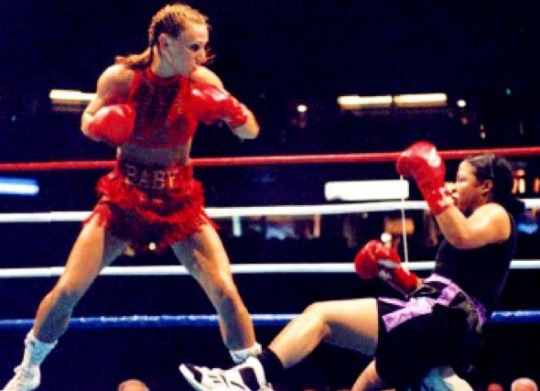
career in the fighting arts wasn’t what people expected of Bridgett
Riley, a former cheerleader who was working as a flight attendant
when she made the transition to professional kickboxing. Her
nickname, “Baby Doll,” was bestowed on her in her teens by a
karate instructor who was amazed by the small-statured young woman’s
fighting ability. Nowadays, people are less surprised, given
Bridgett’s thorough domination of the pro kickboxing scene and five
world championship reigns. What’s more, Riley bridged
the gap between martial arts and boxing – becoming a top rated
pugilist and securing a 15-3 record with one IFBA World Championship
reign. All the while, Riley successfully balanced her fighting
careers with one in show business: though still mainly known for her
stuntwork in major blockbusters, she’s also notable for a handful
of fighting parts in DTV films and television.
Films
to See Triple Impact (1992)
– lead role Bare Knuckles
(2013) – supporting role WMAC Masters
(1995-1996) – recurring role
Trivia:
In her first professional kickboxing match, Riley defeated
U.S.
national champion Denise Taylor in a major upset. Taylor grabbed a microphone and demanded a rematch, calling
her loss a fluke.
A month later, Riley defeated Taylor again
via
technical knockout – breaking her nose in the process.
“You
fight well, little man. You have good spirit.”
Taekwondo
champ Julian Lee has been appearing in action movies since 1990, but
his earliest work readily available in North America is 1992’s My
Samurai. This one fell into my lap by accident (my boyfriend
happened to have an unopened copy on his shelf), and overall, I’m
glad I saw it. What threatens to be a boring indie exercise turns
into an engaging adventure with a lot of fight scenes. It doesn’t
fully realize its potential, but the raw fun makes for a feature
worth digging your VCR out for.
The story: When a young
boy (John Kallo) witnesses an underworld crime, his babysitter (Lynne
Hart) and he are targeted for assassination and must rely on the
protection of a martial arts instructor (Lee).
The movie
starts off umpromisingly. It’s really hurting for good actors, with
lead villain Mako and absentee father Terry O’Quinn having
relatively few scenes despite their important roles. I totally buy
Julian Lee as the martial arts teacher he is, but drama seems alien
to him; he makes Philip Rhee look like an Oscar nominee. Young John
Kallo is, somehow, in even greater trouble. They stumble through the
movie’s opening third, gumming their lines and failing to impress.
Then, to my surprise and delight, the screenplay wakes up. At first
it’s just little things that you notice – realistic touches about
what three people on the run have to contend with, like how to find
new clothes and needing to sleep in a cramped space – but
eventually, it’s like the film remembers that it can do whatever it
pleases and has its three stars fighting a glam-inspired martial arts
gang and buddying up with a minister played by friggin’ Bubba
Smith. The final 15 minutes or so lose some of that gusto when the
filmmakers try to shoehorn in a whole scenario about Kallo and his
dad, but overall, this is a pretty energized movie that’s unlikely
to bore its target audience.
There are some disappointing
missteps throughout, beyond the aforementioned pacing issues. Lynne
Hart – one of only two prominent female performers in here –
shows a lot of promise but is somewhat wasted by playing a character
whose sole arc in this otherwise bombastic film is about her love
life. There seems to be some untold backstory regarding the villain,
with the filmmakers trying to draw a parallel between two sets of
fathers and sons, but this is left until the film’s final minutes
and is thus rendered confusing and pointless. Julian Lee has an
embarrassing philosophical scene wherein he claims he never got rich
teaching the martial arts because he didn’t -want-
to be rich; if all martial arts instructors who’ve struggled
and sacrificed
in pursuit
of their passion watched
this scene at once,
their combined laughter might cause earthquakes. Lastly, take note of
the movie’s inappropriate title. Didn’t the studio realize that
neither Julian Lee nor the character he plays are Japanese?
There’s
no shortage of fight scenes, here – about a dozen individual brawls
– and I’m happy to say that they balance out some of the film’s
flaws. The action doesn’t start out promisingly, with some strikes
clearly not making contact and a combatant dying by falling out of a
five-foot window, but it picks up dutifully. Julian Lee provides his
choreographers all the physical talent they need, and they exploit it
by keeping the matches grounded and intimate – lots of
close-quarters street fighting. There’s some flashiness (the glam
gang contains several acrobatic tricksters), and this makes for a
satisfying adrenaline package. Disappointingly, Lee’s onscreen
nemesis – fellow martial arts master Christoph Clark – is
portrayed as so powerful as to negate any potentially cool matches
between them. Clark beats the heck out of Lee, forcing the final
showdown to conclude anticlimactically.
My
Samurai has the right attitude to be a kickboxing flick of the No
Retreat, No Surrender variety, but not quite the concentration to
maintain its enthusiasm. Nevertheless, the mixture of unusual touches
and inspired moments make it worth owning for mildly patient fight
fans.
My
Samurai (1992) Directed by Fred H. Dresch (The
Kudzu Christmas) Written by
Richard Strahle Starring
Julian Lee (Dragon and
the Hawk),
John Kallo, Lynne Hart (Perry
Mason: The Case of the Telltale Talk Show Host),
Mako (Conan the
Barbarian) Cool
costars:
Bubba Smith (Police
Academy
series), Terry O’Quinn (Lost),
Christoph Clark (Tiger
Street).
Mark
Steven Grove (Legacy
of the Tengu)
plays a member of the glam gang Title
refers to:
Julian Lee’s character, presumably. Potential
triggers:
Violence against women, violence towards children, implied
torture Copyright
Starmax
Film Partnership
In
1979, three amateur kickboxers – Maurice Smith, Peter Cunningham, and
Rod Kei – met at a WKA event and collectively predicted their
destinies to become great world champions. While Smith and Cunningham
have since then been
more often remembered by mainstream history, Kei proved himself no
less impressive of an individual.
Arguably the most diversely-talented of the trio, Kei competed in at
least four different styles of martial arts
and won world titles in several of them. His film career was likewise
multifaceted, with Rod
spanning the gambit from background fighter to supporting villain and
even leading man – excelling in all roles
through his standout athletic ability. Today,
Kei teaches boxing, kickboxing, and personal
fitness at the EXF Boxing and Kickboxing Academy and the Sweet Science MMA gym
in California. He also works for American
Airlines.
Styles &
Accomplishments
Kickboxing
– 2-time WKA World Champion, KICK World Champion
Muay
Thai – Ranked 4th in the world by the International Muay Thai
Federation
Savate
– World Cup Champion
Judo
– 3rd Dan, Metro Champion
Taekwondo
– 3rd Dan
Hung
Gar
Sil
Lum
Films
to See Blind
Vengeance (1994)
– lead role L.A.
Task Force (1994)
– lead role Dragon
Fire (1993)
– supporting role Full
Impact (1993)
– featured fight scene
Trivia: Kei
was involved in an infamous 1989 kickboxing match wherein
his opponent – Saekson Janjira – kneed him in the face while the
referee was attempting to separate them. A disqualification victory
for Kei was indicated, after which both fighters’ cornermen began
brawling. The fight turned into a full-scale riot with spectators
throwing chairs into the ring. A
video of the incident can be seen HERE.






 B-Movie Dragons