Review: Never Back Down – No Surrender (2016)

“Believe me, they will know about this fight on Mars"
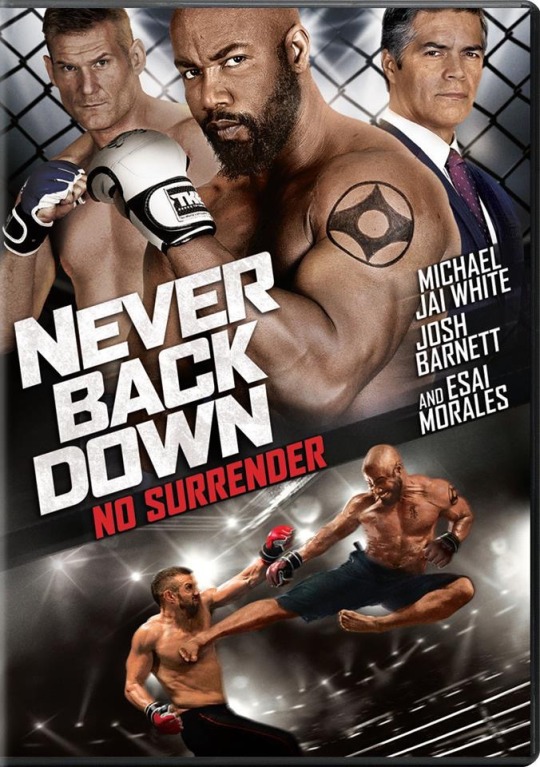
image

Photo source

For reasons I can’t
explain, I hadn’t thought to look into the Never Back Down
series before now
and thereby completely
overlooked
that Michael Jai White had
expanded from martial arts star to
filmmaker. This
movie
actually gives me some hope for the future, as it’s virtually the
only one I’ve seen
show an interest in actually
carrying on the legacy of
martial arts videos’ glory days. Don’t give me another boring
Dolph Lundgren production if White’s making films. Of course, Never
Back Down: No Surrender
’s
not perfect – it’s
actually one of the few
movies of this sort where the problematic screenplay bothers me more
than any technical shortcomings. As
is, this one works best as a blueprint to improve on, but in
the meantime, it’s a very
watchable blueprint.

The story: Legendary
fighter Case Walker (Michael Jai White) travels to Thailand to train
his comrade Brody James (Josh Barnett) for a high-stakes title match,
but soon realizes that the promoter (Esai Morales) has shady
intentions.

NBD3
has so many real-life
influences that it’s practically
meta. There are numerous
connections
between Josh Barnett’s character and the actor’s
real-life competitive career,
many of them unflattering. Additionally,
the movie tackles the
ever-relevant issue of steroids in sports with
surprising zeal. Ironically,
this approach makes the
film’s frequent idealistic stances feel haphazard and naive, as
it presents
simplistic solutions to complex problems. Also, I didn’t like that
the story is full of unresolved issues: aside from the loose
thread of Casey taking on a couple of young proteges, it’s
uncomfortable that
the feature
allows
things like Brody’s blatant infidelity and the racism of some
supporting characters to
fade into the background. I also
didn’t like how a side-story regarding sexism towards a character
played by Jeeja Yanin is “resolved”
via sexism. Despite
all of this, the screenplay isn’t
weak: Case
Walker is likable enough,
and the story eschews
typical life-and-death setups in
favor of a political approach
that feels more suitable to
modern sports promotion. Not
every idea it has
pans out, but I can
appreciate a film for showing
me that it at least had thought behind
it.

How
much you enjoy the action content depends
on your tolerance of
unnecessary slow motion. Fight
choreographer Larnel Stovall delivers good stuff, but the fact that
only a couple of the eight fights
aren’t mucked about with
this editing technique
is disappointing.
Nevertheless, Michael Jai White remains one of the best performers in
modern martial arts films,
and this is apparent throughout the feature. Though he achieves
Hector Echavarria levels of self-glorification by including a scene
that puts him over a genuine MMA star
like Josh Barnett, he looks fantastic in whatever he does and
whoever he fights. He’s got
a great cast of supporting
kickers,
including Nathan Jones as the rival champion and genre
staples Brahim Achabbakhe,
Eoin
O’Brien, and Ron Smoorenburg as
various brawlers.
More impressive on paper but less so onscreen are the Thai stars: the
aforementioned Jeeja Yanin has a
single
fight and is barely a character, while Tony Jaa only shows up to make
a fool of himself in a comedy cameo. Seriously,
if
the poor quality and
infrequency of
Jaa’s most recent output
hasn’t
caused you to lose esteem for him, his buffoonish
scenes
here will do the trick.

Despite these disappointments, NBD3
is an enjoyable watch. Again, I’m pleased that MJW
chose
to be
a filmmaker: it’s good
knowing that the legacy of U.S. martial arts videos has a competent
torchbearer, and it’s important that the subgenre contains
perspectives other than those of white men.
The main problem remains
the movie’s screenplay, but
I’m hopeful that White will improve in that regard in
time. Even so, this one is
worth a look.

image

Photo source

Never Back
Down: No Surrender
(2016)

Directed
by

Michael Jai White

Written
by

Chris Hauty (Never
Back Down
1
& 2), Michael Jai White

Starring
Michael Jai White, Josh Barnett (Absolution),
Gillian White (Bamboozled),
Esai Morales (NYPD
Blue
)

Cool
costars:

Stephen Quadros (Sworn
to Justice
),
Nathan Jones (Tom
Yum Goong
),
Jeeja Yanin (Raging
Phoenix
),
Brahim Achabbakhe (Dragonwolf),
Ron Smoorenburg (Who
Am I
),
Damian Mavis (Kung
Fu Yoga
),
Amarin Cholvibul (Hard
Target 2
),
Eoin O’Brien (Kill
‘Em All
),
and Creighton Mark Johnson (Risk
for Honor
)
all appear in martial roles. Pro fighter Quinton Jackson cameos in a
little scene. Tony Jaa also cameos, but…I just can’t.

Content
warning:

Sexist
and racist dialogue, racially-motivated violence,
police brutality. There’s
also a scene where a transsexual prostitute is “humorously” outed
against her will.

Copyright
Sony Pictures Home Entertainment

A Timeline of Low-Budget & Direct-to-Video Filmmaking [Martial Arts Subgenre]

Since
no such thing seems to exist yet,
I decided to lay a foundation. This chronology is undoubtedly
incomplete, but I’ve tried to mention all events that stand out to
me and ones that would probably stand out to others. To the best of
my knowledge, all information is accurate.

March
23, 1987 – The film production &
distribution
company Imperial Entertainment Corp. is founded. One of the first
studios to focus primarily
on
low-budget action features, its releases include Cynthia
Rothrock’s Lady
Dragon
,
Jerry
Trimble’s Breathing
Fire
,
and Don
Wilson’s Red
Sun Rising
.

August
18, 1988 – The
taekwondo-themed action feature
Miami
Connection

receives a limited theatrical release and subsequently bombs, almost
bankrupting star/producer Y.K. Kim. Over 24 years later, mounting
cult
fame inspires
a re-release
for the film on DVD.

1989
– Joseph
Merhi and Richard Pepin found PM Entertainment Group, Inc. – the most
prolific producer of direct-to-video action and martial arts fare of
the 1990s.

February
24, 1989
American
Ninja 3: Blood Hunt

receives a limited theatrical release before being sent to video.
It’s the first time an installment to
a major martial arts franchise receives anything less than a wide
debut.

February
1990 – Martial
arts legend Cynthia
Rothrock makes her solo debut in the U.S. with China
O’Brien
.
Rothrock would subsequently become one of the most prolific
low-budget action heroes and the single
most
successful female martial arts star of the American film market.

February
23, 1990 – Kickboxer
Olivier
Gruner debuts in Angel
Town
,
a movie about warring gangs. Ironically, a gang brawl breaks out at a
California drive-in during a screening.

April
12, 1990
– Film
production company Cine Excel Entertainment is founded by director
David Huey. Its first U.S. release, American
Streetfighter
,
premieres about two years later on video and is one of the first
starring vehicles of kickboxer
Gary
Daniels.

March
4, 1991
– The
Hong
Kong-based Seasonal
Film Corporation’s No
Retreat, No Surrender

series goes DTV with
its third installment, Blood
Brothers
.
Keith W. Strandberg returns as writer, but director Corey Yuen is
replaced by Lucas Lowe. Karate star Keith Vitali makes his debut as a
leading man.

December
18, 1991 – Pro kickboxer Don “The Dragon” Wilson,
America’s most prolific DTV action hero, makes his video debut with
Ring
of Fire
.

1992
– The film production
company
Nu Image, Inc. is founded by Avi and Danny Lerner, Trevor Short, and
Danny Dimport. Four years later, a subsidiary called Millennium Films
is launched. Producing both theatrical and DTV fare, their output
over the years has included the Undisputed
and
Ninja
series.

February
7, 1992 – Michael Worth makes his action film debut in Final
Impact
,
becoming the first martial arts action hero created by PM
Entertainment. Worth is also the first martial arts star to debut on
the video circuit, without any prior work in theatrical or
international markets.

July
16, 1992
– The release of Tiger
Claws
,
one of the first films of the subgenre to feature Chinese martial
arts over karate and kickboxing. Star Jalal Merhi had attempted the
same with his previous vehicle, Fearless
Tiger
,
but this wouldn’t receive a U.S. release until 1994.

August
20, 1992
– U.S.
video premiere of Martial
Law II: Undercover
,
the first martial arts vehicle of star Jeff Wincott.

October
14, 1992
– Director
Isaac Florentine releases his first U.S. production, Desert
Kickboxer
.

November
6, 1992 – Billy Blanks makes his starring debut in Talons
of the Eagle
,
which enjoys
a limited release before going to video.

March
3, 1993
American
Samurai

premieres in
the U.S. on video.
Mark Dacascos co-stars in his first substantial martial
arts-themed role.

May
5, 1993
Shootfighter:
Fight to the Death
is
released, becoming
the
first U.S.
starring
vehicle of Hong
Kong
action
staple
Bolo Yeung.

July,
1993 – At age 13, Ted Jan Roberts makes his video debut in Magic
Kid
.
To date, he is the youngest martial arts action hero of
the western hemisphere to
have a substantial solo career.

March
1, 1996 – Almost eight years after the release of the cult hit
Bloodsport,
its sequel The
Last Kumite

premieres via a limited theatrical release. With the exception of one
supporting cast member, no one who worked on the original had a hand
in the sequel.

December
8, 1998
– The
release of Champions,
the first U.S. action
film
based on mixed martial arts competition.

February
9, 1999
– Jean-Claude
Van Damme’s Legionnaire
unexpectedly becomes the star’s first DTV release. With a $35 million
budget (adjusted: $52.5 million), it’s officially one of the most
expensive releases of the subgenre.

2002
– PM
Entertainment folds. Its catalog of over 150 features and two TV
shows is acquired for
distribution by
Echo Bridge Home Entertainment.

November
23, 2004 – Unstoppable
becomes the first Wesley Snipes action vehicle to go DTV, following a
limited theatrical release.

2005
– Nicholas Chartier and Dean Devlin found Voltage Pictures, whose
output includes the
DTV rleases
Puncture
Wounds
,
Lady
Bloodfight
,
and Eliminators.
In a Variety
interview
four years later, Chartier describes
his business strategy of marketing DTV action flicks as a means to
pay for higher-budgeted theatrical productions.

May
31, 2005 – The
DTV action-thriller Submerged is released, and the Uruguayan
national government subsequently threatens legal action against the producers for
its embarrassing
portrayal of the
country.

December
27, 2005 – Multinational conglomerate Sony first becomes a major
player in the DTV action
scene when its subsidiary, Sony Pictures Home Entertainment, releases
Black
Dawn
.

2008
– The low-budgeted Money
Fight

(aka The
Red Canvas
,
aka Art
of Submission
)
becomes the first film to receive an “off-planet” premiere
aboard the International Space Station.

April
28, 2009
– Hector
Echavarria releases his MMA-themed
passion
project, Never
Surrender.

For
the next several years, Echavarria
is
the primary producer of movies capitalizing on the MMA craze by
heavily incorporating cage fighting into his plots
and featuring pro fighters in supporting roles.

February
2, 2010 – The Michael Jai White vehicle Black
Dynamite

is released on DVD, following a limited theatrical release. An
instant cult hit, it
wins widespread acclaim and the “Best Film” award at the
Seattle International Film Festival.

February
2, 2010
Universal
Soldier: Regeneration

is released on DVD in the U.S. Widely regarded as superior to its
predecessor, its
star

Jean-Claude
Van Damme –
reportedly
turned down the opportunity to appear in Sylvester Stallone’s
blockbuster The
Expendables

in favor of focusing on the
smaller production.

June
1, 2010
Undisputed
III
is
released to cult acclaim. The vehicle catapults star Scott Adkins to
martial arts superstardom, and the movie is quickly
regarded as a benchmark of martial arts filmmaking.

August
2011 – DTV movie veteran and pro fighter Joe Son is convicted of
torture and sentenced to life in prison. Two
months later,
he receives
another 27 years for the voluntary manslaughter of a
cellmate.

May
6, 2015
– The
Dolph Lundgren/Tony Jaa collaboration Skin
Trade

is released in the U.S. via the internet. In addition to being Jaa’s
first American production to not be released theatrically, it’s the
first U.S. martial arts film to have an online premiere.

April
14, 2016 – The
Martial Arts Kid

becomes the first full-length martial arts movie produced via crowd
funding.