
*SPOILERS
AHEAD*
I often read the opinion “[90s martial
arts star X] should have been bigger,” which I take to mean that the
performer the writer refers to should have had a mainstream career. While
I can usually point out why this wasn’t the case (martial arts action has
always been a niche genre and Hollywood already had Seagal and Van
Damme) and typically voice opposition to the notion (I prefer the creative
freedom that comes with the low-budget realm), the one person I make an
exception for is Jeff Wincott. Already an acclaimed actor by the time he
started doing karate films, Wincott was a better dramatic performer than his
more famous peers and at least as good of an onscreen fighter. His knack for
landing nice-looking productions allowed him to simulate what a big-budget feature
for him might look like, and Martial Law
II: Undercover is arguably the best example of this. It’s the kind of movie that could only have been made when it
was, when the home video market was ravenous for action and indie studios still
had the means of making movies that looked as good as their mainstream
counterparts. It’s a personal favorite and I’m excited to promote it.
The first of several stylistic differences
between the original Martial Law and
its sequel is apparent in the opening shots: whereas the original took place at night with shadowy lighting, Undercover
opens on a bright, sunny day. It’s a park scene, and two gangs have chosen the
adjoining street to carry out an arms deal. This is a police bust
waiting to happen, given that Officer Billie Blake (Cynthia Rothrock)
is selling hotdogs from a nearby wagon… but who’s the drunken vagrant stumbling
upon the van where the gang leaders (John Vidor and Nicholas Hill) are
conducting business? This is actually the returning Officer Sean Thompson, with
Jeff Wincott replacing Chad McQueen, and we get our first hint of his identity when
he grabs one of the baddies and throws him bodily from the vehicle. Other
policemen are on hand, but as Billie enters to fracas, the captain (Max Thayer) orders the rest to let the two supercops
take care of the attackers. Not only are they equal to the task, but they make
a pretty fun fight scene out of it.
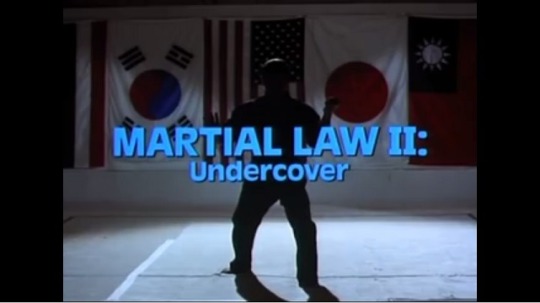
Following some curious opening titles that I’ll talk about later, the story
commences with Sean being promoted and transferring to the
Northwest Division to begin a martial arts program. He’s disappointed that Billie
won’t be accompanying him, but personally, I think splitting the team is
part of a positive revamp of Sean and Billie’s relationship. You see, they
were an item in the previous film, but the romance ended up marginalizing
Billie as a character and limiting Cynthia Rothrock’s utilization. Here, they
don’t seem to be romantic anymore, and in addition to Billie having more
opportunity to shine, the lack of deference on her part makes for a more equal partnership. She’s still willing to do big favors for Sean, but the respect
between them is a lot more apparent.
At his new workplace, Sean meets Captain
Krantz (Billy Drago), his new superior, and also his old academy buddy Danny
Borelli (uncredited). Danny’s happy to have his pal around but becomes
noticeably depressed when the instantly-suspicious Detective Dobbs (Charles Taylor)
walks onto the scene. Danny’s subsequently so preoccupied that he breaks off Sean’s tour
of the premises and goes off to pursuits unknown. Unknown, that is, until we
see him tailing Dobbs in his car after hours. It turns out that the guy is off to an illicit meeting with
business prodigy / gangster Spencer Hamilton (Paul Johansson). Hamilton
presents a legitimate image to the public – earlier, a news team was filming a report detailing his accomplishments – but he turns out to have his hands in prostitution
and illegal gambling. To make things easier for himself, he buys off police
officers.

For bodyguards, Spencer has surrounded himself with martial
artists – a fact which Danny must learn the hard way when he’s caught taking
photographs of the meeting. Held at gunpoint, Danny tries to fight his way free
but is thoroughly beaten by Spencer’s lieutenants: Tanner (Evan Lurie), Bree
(Sherrie Rose), Han (Leo Lee), and two unnamed characters; one is played by
Koichi Sakamoto, the other I have no idea. Drugged with liquor before having his
neck broken, Danny is sent down a hill in his car to make his death look like a
DUI accident.
We’ve now seen the depths to which the
villains are willing to sink. While Dobbs comes across as a greedy jerk willing
to screw over his comrades for money, Spencer is more of a study. On one hand,
it’d seem as though a prodigy like him would have no need for illegal action,
but on the other, it’s possible that his success is entirely built on crime. Whatever
the case, Spencer is a psychopath who enjoys exerting force and penetrating secure
institutions. The title sequence I mentioned before features a shadowy man in a
gi throwing kicks and punches in Sean’s dojo, and while I can’t be certain who
this silhouetted figure is, the ponytail makes me think it’s Spencer. His
mysterious presence here may symbolize that not only is he a physical match for
our heroes, but he’s already infiltrated Sean’s domain long before Sean even arrived. He’s a bad guy, for certain, but I’d go so far as to call Spencer a
Satanic archetype: he’s a manipulator, a seducer, a deceiver, someone who loves
making deals, and he commands a legion of minions from the underworld. In
short, he’s just plain evil.
TRIVIA:
The dojo in the film is actually the Jun Chong Tae Kwon Do Center of Los
Angeles, California. At least four members of the film’s cast have trained in
tae kwon do: Jeff Wincott, Cynthia Rothrock, Evan Lurie, and James Lew.
Sean arrives at the scene of the
“accident” and doesn’t accept the police verdict. Even though Danny had a
history of alcoholism and an autopsy reveals his intoxication, Danny had
mentioned that he’d been sober for months. What’s more, Sean finds a
matchbook in the vehicle from Syntax – the nightclub owned by Spencer. He
visits, but his conspicuous questions to the bartender (Pat Asanti) arouse the suspicion
of Tanner. A fight ensues, and Sean is effectively barred from pursuing the
matter: not only do the people at the club now know his face, but Captain Krantz
is irate and demands he stop. I like to think that Sean isn’t usually this
ham-fisted in his detective work, but perhaps the loss of his friend has affected his tactfulness. Whatever the case, he at least has the
wherewithal to come up with an alternative plan: have Billie investigate the
place in his stead. It proves to be a good idea, and a nice opportunity for
Cynthia Rothrock to do some genuine acting. There’s a fun scene where she applies for a job at the bar under a pseudonym, and the bartender quizzes her
on cocktails. (Billie’s recipe for the Cookie Monster: “Crème de cacao, crème
de menthe, vodka, lit on fire, run like hell.”)

We find out that Danny had been investigating
Dobbs for his interference in a solicitation arrest. The arrestee was Tiffany Michaels
(Deborah Driggs), one of Spencer’s employees whose primary job is to intimately
uncover secrets from his associates and business partners. She and Billie
develop a friendship after Billie beats up some aggressive men who
follow them from the bar, and it ends up being one of my favorite aspects of
the movie. While Martial Law II
doesn’t pass the Bechdel test, the scenes of Billie and Tiffany building a
rapport are rare instances female characters having scenes to themselves in
this subgenre, and they lend a more nuanced tone to an otherwise male-centric
action film. Also, Tiffany is arguably the most interesting character of the
movie, personifying the full gambit of Spencer’s nefariousness. Spencer’s
molded her into a femme fatale while keeping her dependent on his financial
assistance. Their relationship seems to be the result of a long history of
seduction and deceit, indicated in a scene where Tiffany coldly remarks on
Spencer drawing a college student (Kimber Sissons) into his service; she’s probably reminded of her own beginnings with the crime lord. Deborah Driggs
is a fine actress – equal parts Maria Ford and Jillian McWhirter – and
perfectly portrays Tiffany as a world-weary individual holding out for one
final possibility of changing her life.
Tiffany’s services are in demand: Spencer
uses her connection to a drug dealer (Matthew Powers) to facilitate a drug
bust so he can steal $10 million in drug money and purchase the business of a
wealthy sports promoter (Conroy Gedeon). To carry this out, he’ll need the
cooperation of someone more highly-placed than Dobbs, and it’s a surprise to
find out that Spencer even has his claws in Chief Krantz. Spencer tips off
Krantz about the upcoming drug deal and demands that he receive the spoils, but
the police chief is reluctant. He says that he “won’t cross the line,” but such
a declaration means nothing to Spencer. See, Krantz is involved with Tiffany,
and while it’s mostly mutual and Tiffany actually hopes that the chief will be
her ticket to a better life, she’s still indebted to Spencer and agrees to drug
Krantz during their next date. When Spencer and Tanner show up and take the unconscious
captain’s gun, she frets that they plan to kill him…but then Spencer turns
the weapon on her. Krantz comes to, and finds his lover dead and Tanner taking
incriminating photos. Spencer now officially has the chief under his thumb.

Meanwhile, Sean’s been putting up with multiple
attempts on his life because Spencer considers him a threat. First, Dobbs pays
a biker gang to attack him, and when that fails, Spencer
sends Han, Koichi Sakamoto’s character, and a new enforcer (James Lew) to his
dojo. Sean beats the odds here, too, and Spencer decides to have both Sean and
the ineffectual Dobbs eliminated in the aftermath of the drug bust. The plan is
partially successful: following the raid, the partnered Sean and Dobbs are
accosted by a group of thugs led by Han, but while Dobbs is executed, Sean counterattacks
and succeeds in capturing Han.
Sean has Han lead him to a factory occupied
by Spencer’s forces, where his boss is awaiting the money. The climax is quick
to follow, but there’s a segment preceding it that intrigues me. Sean
holds a shotgun on Han, demanding that Spencer and his forces give themselves
up, but Spencer refuses and even encourages him to kill his henchman. Han gives Spencer
a look, then drops to one knee and pulls a knife from his sock; Sean promptly
blows his head off. This is such an odd, futile move on Han’s part that it
deserves examination. At first, we’re wont to think that Han is making a
last-ditch effort to attack Sean, or maybe even sacrificing himself so the
others can attack, but considering that his action comes right
after Spencer declares his life worthless to him, it’s possible that this is an
act of indignant defiance. Han likely considers himself a part of Spencer’s inner circle, higher-placed than the bought policemen, but it’s just hit him
that the devotion he feels towards his boss is entirely one-sided. In other
words, he realizes that he’s no different than Tiffany, who did everything
asked of her and was still killed. It would have been interesting to see who
Han turned his knife on – Sean or Spencer.
A quick shootout follows (with a clump of
Han’s hair still clinging to the barrel of Sean’s shotgun), but it turns into a
series of hand-to-hand showdowns. Billie, who had recently been promoted to
Spencer’s personal team, has a disappointing fight with Bree, but the
four brawls that follow are all very nice. Our heroes are victorious: Tanner
ends up hanging from his neck by a chain while Spencer’s remaining lieutenants
are thrown from a catwalk. While Spencer puts up a much better offense
than I expected from a slimy rich guy, he ends up impaled on a makeshift
sword.
Sean had found out after the bust that his
captain was complicit in Spencer’s schemes, and he and Billie immediately go to
Krantz’s residence. Krantz sees them approaching and puts a gun to his head.
Aggrieved by his involvement in organized crime, the selling out of his
officers, and the murder of his girlfriend, he shoots himself. The sound of his
gunshot ushers in the end credits.

It’s an abrupt and unfulfilling ending, but
that’s the worst thing I have to say about this movie. Martial Law II is one of my go-to examples of a low-budget action
film that looks exactly as good as its high-end counterparts. Strong
direction coupled with an intimate style of choreography makes this virtually as
powerful of a vehicle as Seagal’s and Van Damme’s offerings of the same year. (I suspect that competition from independent studios played a part in those guys
moving up to bigger-budgeted, effects-driven blockbusters.) The excellent
casting and great distribution of resources, along with the clear storytelling,
qualifies this as study material for any director looking to make a
contemporary martial arts vehicle.
A good deal of credit goes to Jeff Wincott.
While he benefits immensely from a cool collection of costars, the great
choreography of Jeff Pruitt, and having no less of a talent than Cynthia Rothrock
as his onscreen partner, the guy does not
look like this is his first time headlining a kick flick. Wincott easily slips
into the action hero persona and takes to the fight scenes like a duck to
water. He’s the complete package, and arguably better-rounded than most of his
low-budget contemporaries, so it’s lamentable that his action career began
petering out well before the turn of the century.
From a social standpoint, the film could definitely
be stronger. Every non-white performer plays a villain of some stripe, and few of their roles fall
outside of stereotypes. Also, despite the presence of strong female characters,
women in general don’t fare well here, whether it’s Bree falling to her death
or Tiffany being murdered in cold blood. Nevertheless, we do have a significant
bright spot in the form of Sean and Billie’s relationship, because I can’t
understate how rare it is in these movies to see a friendly coexistence between
a man and woman without any romance involved. Billie and Sean are virtually
equal characters, with comparable prominence in the storyline and almost the
same number of fights. More importantly, they treat each other as equals, and
show fondness and concern for each other without needing to justify it with sex
or smooches. The fact that Billie isn’t stripped of her femininity to accomplish
this makes it all the more significant, and in this regard, the movie stands
out.
One minor nitpick is that Billy Drago isn’t
utilized to his full potential. I don’t mind that he didn’t get in on the
actual action, but when the most that he can brings to the film is an abortive
love scene, something’s awry. Nothing against Paul Johansson, but I’d have
loved to see this same movie with Drago in his role. But this, along with the
other shortcomings, isn’t reason enough to avoid the picture. Martial Law II excels on so many levels
and is such a gem of its subgenre that martial arts fans do themselves a
disservice in not plugging in their old VCRs for a viewing. Check it out!

Martial Law II: Undercover (1991)
Directed by Kurt Anderson (Martial Outlaw)
Written by Pierre David (story),
Jiles Fitzgerald (screenplay), Richard Brandes (screenplay)
Starring Jeff Wincott (Mission of Justice), Cynthia Rothrock,
Paul Johansson (Highlander: The Raven),
Deborah Driggs (Total Exposure)
Cool costars: Evan Lurie (Hologram Man), Sherrie Rose (Me & Will), Billy Drago (Death Ring), Leo Lee (The Perfect Weapon), Koichi Sakamoto (Bounty Tracker), James Lew (Balance of Power), Oscar Dillon (Deadly Bet), Nicholas Hill (Death Match), Max Thayer (The Retrievers). Though only credited as
a “featured part,” world kickboxing icon Peter Cunningham appears as part of a
gang that attacks Billie.
Title refers to: Sean and Billie,
respectively. Sean’s nickname is “Martial Law,” but it’s Billie who infiltrates Spencer’s inner circle.
Potential triggers: Domestic abuse,
group violence, violence against women
Copyright M.L. II Partnership
 B-Movie Dragons