For reasons I can’t
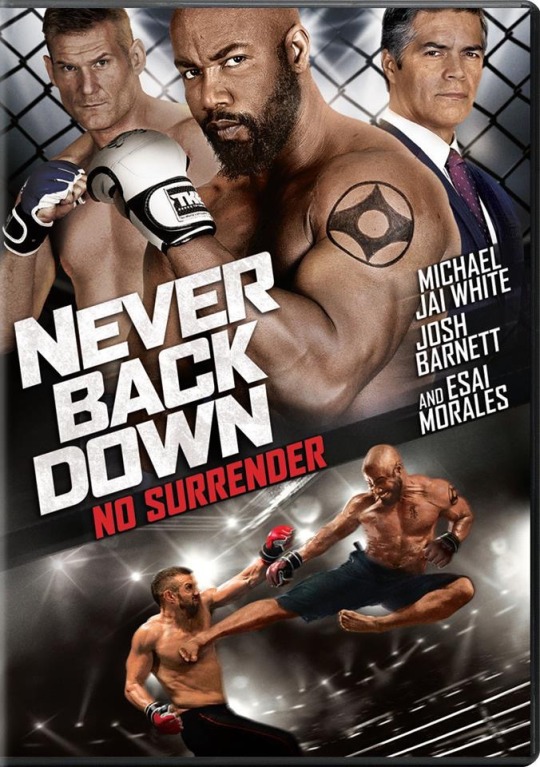
explain, I hadn’t thought to look into the Never Back Down
series before now
and thereby completely
overlooked
that Michael Jai White had
expanded from martial arts star to
filmmaker. This
movie
actually gives me some hope for the future, as it’s virtually the
only one I’ve seen
show an interest in actually
carrying on the legacy of
martial arts videos’ glory days. Don’t give me another boring
Dolph Lundgren production if White’s making films. Of course, Never
Back Down: No Surrender’s
not perfect – it’s
actually one of the few
movies of this sort where the problematic screenplay bothers me more
than any technical shortcomings. As
is, this one works best as a blueprint to improve on, but in
the meantime, it’s a very
watchable blueprint.
The story: Legendary
fighter Case Walker (Michael Jai White) travels to Thailand to train
his comrade Brody James (Josh Barnett) for a high-stakes title match,
but soon realizes that the promoter (Esai Morales) has shady
intentions.
NBD3
has so many real-life
influences that it’s practically
meta. There are numerous
connections
between Josh Barnett’s character and the actor’s
real-life competitive career,
many of them unflattering. Additionally,
the movie tackles the
ever-relevant issue of steroids in sports with
surprising zeal. Ironically,
this approach makes the
film’s frequent idealistic stances feel haphazard and naive, as
it presents
simplistic solutions to complex problems. Also, I didn’t like that
the story is full of unresolved issues: aside from the loose
thread of Casey taking on a couple of young proteges, it’s
uncomfortable that
the feature
allows
things like Brody’s blatant infidelity and the racism of some
supporting characters to
fade into the background. I also
didn’t like how a side-story regarding sexism towards a character
played by Jeeja Yanin is “resolved” via sexism. Despite
all of this, the screenplay isn’t
weak: Case
Walker is likable enough,
and the story eschews
typical life-and-death setups in
favor of a political approach
that feels more suitable to
modern sports promotion. Not
every idea it has
pans out, but I can
appreciate a film for showing
me that it at least had thought behind
it.
How
much you enjoy the action content depends
on your tolerance of
unnecessary slow motion. Fight
choreographer Larnel Stovall delivers good stuff, but the fact that
only a couple of the eight fights
aren’t mucked about with
this editing technique
is disappointing.
Nevertheless, Michael Jai White remains one of the best performers in
modern martial arts films,
and this is apparent throughout the feature. Though he achieves
Hector Echavarria levels of self-glorification by including a scene
that puts him over a genuine MMA star
like Josh Barnett, he looks fantastic in whatever he does and
whoever he fights. He’s got
a great cast of supporting
kickers,
including Nathan Jones as the rival champion and genre
staples Brahim Achabbakhe,
Eoin
O’Brien, and Ron Smoorenburg as
various brawlers.
More impressive on paper but less so onscreen are the Thai stars: the
aforementioned Jeeja Yanin has a
single
fight and is barely a character, while Tony Jaa only shows up to make
a fool of himself in a comedy cameo. Seriously,
if
the poor quality and
infrequency of
Jaa’s most recent output
hasn’t
caused you to lose esteem for him, his buffoonish
scenes
here will do the trick.
Despite these disappointments, NBD3
is an enjoyable watch. Again, I’m pleased that MJW
chose
to be
a filmmaker: it’s good
knowing that the legacy of U.S. martial arts videos has a competent
torchbearer, and it’s important that the subgenre contains
perspectives other than those of white men.
The main problem remains
the movie’s screenplay, but
I’m hopeful that White will improve in that regard in
time. Even so, this one is
worth a look.
Written
by
Chris Hauty (Never
Back Down 1
& 2), Michael Jai White
Starring
Michael Jai White, Josh Barnett (Absolution),
Gillian White (Bamboozled),
Esai Morales (NYPD
Blue)
Cool
costars:
Stephen Quadros (Sworn
to Justice),
Nathan Jones (Tom
Yum Goong),
Jeeja Yanin (Raging
Phoenix),
Brahim Achabbakhe (Dragonwolf),
Ron Smoorenburg (Who
Am I),
Damian Mavis (Kung
Fu Yoga),
Amarin Cholvibul (Hard
Target 2),
Eoin O’Brien (Kill
‘Em All),
and Creighton Mark Johnson (Risk
for Honor)
all appear in martial roles. Pro fighter Quinton Jackson cameos in a
little scene. Tony Jaa also cameos, but…I just can’t.
Content
warning:
Sexist
and racist dialogue, racially-motivated violence,
police brutality. There’s
also a scene where a transsexual prostitute is “humorously” outed
against her will.
While
every other martial arts fan was watching the long-awaited Boyka:
Undisputed IVa
couple weeks ago, I was
getting my hands on a
more low-profile release called Death Fighter. I
regret that decision, now.
While looking
up
lower-profile movies
has served me well in the past, it led
to a disappointment
this time. After having its
release pushed back repeatedly for
several
years, this film finally reveals that it has little more
going for it than
a
supergroup of karate stars and a few surprises. While
there are some things that I like and admire about this one,
I have
to admit that it’s just too plain to hang with its more substantial
competition.
The
story: A renegade FBI agent (Matt Mullins) teams up with an
ex-military mercenary (Don Wilson) to take down a dangerous kingpin
(Gigi Velicitat) in the Thai jungle.
Ensemble
casting is so common now that it’d almost be a bigger surprise to
feature less than four
prominent names in an action movie, but Death Fighter
certainly secured an iconic
draw. In addition to XMA
champ Mullins and kickboxing
hall-of-famer Wilson, the
cast packs two more legends
in Cynthia Rothrock as one of the evil lieutenants and the late Joe
Lewis as Mullins’ doomed partner. Throw in rising genre staple
Jawed El Berni and you can
see why I had such high hopes
for this. However, the utilization of its stars is the main
reason I’m unhappy with the film. Only the acrobatic El Berni
delivers approximate to his reputation; everyone else is in trouble.
Matt
Mullins: I’ve been waiting for this
guy to step up and become the
next Scott Adkins ever
since I first saw
him in Adventures
of Johnny Tao. With Death Fighter being
technically his first vehicle in 12 years, I thought it’d
be the stepping stone he
needed to get people at large
to notice him…but now, I
have doubts about his
potential. Matt shows off his
martial
skills just fine, but jeez, are
both he and his character
ever bland! Mullins comes off
as a Ken doll, and
is absolutely unremarkable beyond
his fight scenes.
Adkins is no master thespian
but at least he can create a memorable character, whereas Mullins
barely creates an impression. Were
it not for Matt’s
physicality, anybody could’ve
played this role.
Don
Wilson: The opposite of his younger costar, Wilson is charismatic but
totally unprepared for the movie’s style of action. Choreographer
Patrick Tang favors a flashy, acrobatic style of fight scene, but
Wilson isn’t about to change up his usual grounded game for
anybody. Though Don’s brawls feature significantly less slow motion
than his regular fare, they’re noticeably slower and less creative
than anybody else’s – giving the impression that everyone had to
go at half-speed with the old man.
Joe
Lewis: Speaking of old men, the late
karate god is in decisively poor shape. I know
Joe was in failing
health at this time in his life and thus excuse
much
about his utilization,
but he still seems
poorly-placed in an
action-packed film like
this. He briefly beats up a henchman
and engages in a shootout before being killed off only
a few minutes into the movie. Whereas
his previous role in Kill ‘Em All
seemed like an
appropriate sendoff to the
grandmaster’s film career,
this almost seems like an unwanted obligation.
Cynthia
Rothrock: Having previously
stated
that she’d like to do at
least one more Hong Kong film in her life, I’d hoped that the
similar
style of this picture might
be the opening Cynthia needed to remind the world that she’s an
action legend. Not so. Rothrock seems awkwardly cast in her
supporting role, playing second fiddle to a performer less
charismatic than she (Velicitat),
and like Wilson, her two fights leave a lot to be desired. Her
dream match against Don is
particularly disappointing, featuring some
cruddy
camerawork.
Nevertheless,
the picture has some noteworthy redeeming traits. Despite
my complaints about some of the fighters’ individual performances,
I’m still generally pleased by
the action
content. Though he doesn’t
properly
distinguish himself from other performers who utilize the tricking
style, Matt Mullins is well-matched against Jawed El Berni and the
various Thai stuntmen, making
for occasionally nice
showdowns. However, the film’s trump cards aren’t any of its
advertised performers, but rather two hitherto-unknown costars who
just about blow their cohorts out of the water. Chiranan
Manochaem is introduced as a dramatic performer and potential love
interest to Matt Mullins, but explodes onto
the adrenaline scenes
with
some impressive
fights,
making her arguably the best-utilized performer of the bunch. Less of
a character but definitely the best onscreen fighter is Prasit
Suanphaka, playing
Don Wilson’s near-stoic sidekick. I’ll
be really
disappointed
if
this guy gets lost among the masses of stunt
guys
in Thailand, because he’s one of the most versatile and unhinged
performers
I’ve lately seen leading
a fight scene. With
a brawling style that’s a fair mix of Tony Jaa and Jackie Chan,
he’s
one guy who should definitely been in more movies.
Other
positive things I noticed include the
refreshingly
layered participation
of women in
the action scenes.
I recently wrote an essay on the depiction
of women in martial arts films, and it
seems as though the filmmakers were thinking along similar lines
regarding exceptionalism.
Chiranan Manochaem soundly dismantles any demure expectations you
develop about her character
leading up to her first fight (demonstrating
that
women can be action participants and
supporting stars at the same time),
and Cynthia Rothrock’s otherwise disappointing casting as an
enforcer helps level the field between the sexes and makes the sight
of women fighting men less extraordinary than filmmakers often
perpetuate. A
subplot involving human trafficking isn’t handled with as much
gravitas as I’d hoped (it takes a backseat to the personal revenge
angle), but it isn’t played for titillation. Not
only that, but
– for the first time I’ve ever
seen
in a U.S. production – the kidnapped women are rescued by another
woman. These
are small
touches, but the effect they have on the presentation is
noteworthy.
If
there
were
only such
aspects
to
consider and
the handful of weird B-grade
moments (e.g. a kid thinks it’s funny when a murder victim’s
blood pours onto
his head), the film might
yet manage to shine a little.
Disappointingly, the
technical presentation keeps
viewers
from properly engaging with
the story.
While the movie can get its plot
from A to B, choppy editing frequently
gives a strained feel to conversations, fight scenes, and
montages.
The presence of some naturally pretty scenery merely
draws
attention to the lack of standout cinematography. Also, the movie’s
tone can shift so drastically at times that it can
be like watching
two different films: it
favors a refreshingly optimistic outlook wherein characters develop
genuine bonds and manage
overcome personal problems, but it can quickly turn around and become
quite grim, like the rather gratuitous throat-slitting scene.
This film wasn’t rated by the MPAA, but
I
can
see
it getting one of those ironic R ratings based
on
just a
couple
of
scenes.
(For
the record, it’s gotten
a 14^ rating in Canada.)
Outright lack of quality isn’t Death Fighter’s failing point so much as mediocrity. While a
movie like this would be a decent watch in most circumstances, the
amount of talent involved makes it all the more disappointing when
you see how little the filmmakers did with their resources. It makes
me fear for the career of Matt Mullins: Rothrock and Wilson
subsequently showed themselves prepared to shape up in The Martial
Arts Kid (produced after this one but released earlier), and the
sheer amount of movies coming out of Thailand assures me that I’ll
probably see Manochaem and Suanphaka again, but Mullins probably had
a lot riding on this for his prospective solo career. He’ll always
be able to find stuntwork and supporting roles, but if this is all he
can do when the spotlight’s on him, I have a feeling that it won’t
grace him many times more. However, responsibility for the picture’s
quality ultimately falls on the filmmakers: to the extent that
director Toby Russell wasn’t hampered by producers, he’s
demonstrated that he needs more practice in producing a standout
karate film and, for the time being, should stick to documentaries.
Death
Fighter (AKA White Tiger)
(2017) Directed
by Toby
Russell (Cinema of
Vengeance) Written
by
Lawrence Riggins (Replicant) Starring
Matt Mullins, Don Wilson, Chiranan
Manochaem,
Gigi Velicitat (The
Mark) Cool
costars: Prasit
Suanphaka,
Cynthia Rothrock, Jawed El Berni (Ninja
II: Shadow of a Tear),
Joe Lewis Title
refers to: The
official
title could refer to virtually any of the above-mentioned performers,
whereas the working title refers
to Matt Mullins.
(Don
Wilson: “Sometimes,
it takes a stubborn tiger like you to get a reluctant lion like me
to fight. And you’re white.”) Content warning:
Kidnapping, implied torture, violence against women, extreme
violence Copyright
Vision Films, Inc.
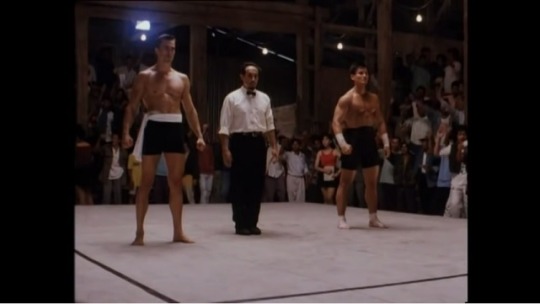
When it comes to cult movies, the original Bloodsport
has its own shelf in the annals of nostalgia. Though I’m not the biggest fan of
that one, I recognize its significance and respect it for helping to reignite interest
in martial arts cinema in the post-Bruce Lee world. Given such status, it’s
inevitable that unfavorable comparisons would dog its lesser-known sequel,
especially since Jean-Claude Van Damme is nowhere to be seen here. Personally, I give
the movie more credit than just being a follow-up. Bloodsport II: The Next Kumite isn’t a perfect film, but it is an absolute opus of onscreen karate. This is as good as it gets for martial arts tournament
flicks, and I’d match it against any picture of the same description.
The generic titles and the opening scene of kids in a dojo don’t
exactly imbue the movie with promise, but luckily,
here comes James Hong – one of my favorite actors – to play the role of Master
Sun. He calms the children by beginning a lengthy story about Alex Cardo
(Daniel Bernhardt), a professional thief whose tale begins with crashing the party of a wealthy businessman in Thailand (Pat Morita). Cardo
describes himself as a speaker of multiple languages, a specialist in Chinese
antiquities, and as being “quite good with [his] hands” – in other hands, he’s
as cocky as they come. Luckily, his arrogance doesn’t last long:
he’s come to steal an antique sword, and even though he
succeeds and beats up three guards in the process, his nefarious partner John (Philip Tan) double-crosses him and Alex is arrested. In
the words of Master Sun, “His greed had led him to a very dark place.”
The impression that Daniel Bernhardt makes on viewers during these opening
scenes is the impression of the film thus far, and I can empathize with
people who don’t take to it right away. The fact that Bernhardt uncannily looks,
sounds, and kicks like Van Damme almost makes me wonder why the filmmakers
didn’t just have him carry on the Frank Dux character from the original…but then again, even a good imitation is merely an imitation. Daniel
Bernhardt can’t help the way he looks, but perhaps the film would have been
better served with a more unique persona. The knockoff factor is high.
TRIVIA: The Bernhardt-Van Damme
connection encompasses more than just physical similarities. The two of them had
previously appeared together in a commercial for Versace Jeans, and
producer Mark DiSalle takes credit for having “discovered” both of them.
Alex is sent to prison. This seems to bring out his better side, as his
first act is to defend a fellow newbie being assaulted by the inmates. He subsequently makes the acquaintance of two other main characters: the sadistic prison guard Demon (Hans Ong) and the imprisoned Sun, who advises
Alex against fighting the guards. Sun is a lifer, imprisoned for the murder of
a rapist, and the bleakness of his situation is illustrated by that
his primary occupation seems to be sweeping a prison yard that’s
entirely made of sand. However, he has more interesting talents than that: Alex’s second
meeting with the bullying thugs doesn’t go well, and Sun demonstrates some
impressive tai chi to decimate the attackers. This sparks a mentor-pupil
relationship between the two, with Sun agreeing to teach Alex his secret – the
Iron Hand system.
Also called Iron Palm, Iron Hand is not actually a martial arts style but a system
of conditioning techniques meant to increase striking power and bolster the
durability of the fingers and palms. Sun’s variation includes
fancy kicks and extinguishing candles with a punch, and this makes for a reasonably
fun training montage. I set no store by Sun’s concept
of chi and I think his armchair diagnosis of Alex’s psychological state is
silly, but he does make mention of something we’ve been waiting for since the beginning: the Kumite tournament, which he claims to have competed in. Alex is intrigued,
but Sun informs him that he will first have to earn an invitation – foreshadowing the trial Alex will have to go through after their chat. An attempt is made on Alex’s life by
the same thugs as before, and when he successfully defends himself, the
complicit Demon has Alex placed in a sweatbox.
Alex survives his presumably lengthy punishment by maintaining a spiritual connection
with Sun, with both of them striking hard surfaces to simulate their synchronized heartbeat. Mythically, this is Alex’s belly of the whale, and he emerges
prepared to undergo a heroic metamorphosis. He begins to excel in his training
– now able to extinguish candles with both fists and feet – and demonstrates a
newfound ability to get along with fellow inmates by playing checkers with them. You get the impression that he’s learned all he can here, so it’s
fortunate when he’s mysteriously freed. On his way out,
Alex makes two promises to Sun: that he will free him as well, and that he will
“make the Kumite a spiritual event again” – in response to the
sadistic Demon having been invited to compete.
When Alex finds out that his
liberator is none other than the businessman whose sword he stole – David
Leung – he makes one more promise: to retrieve the sword from his villainous
ex-partner and return it to Leung. The sword, you see, is the grand prize of
the Kumite, and Leung needs Alex’s help to get it back.
TRIVIA: All inmates in the prison wear
conspicuous pink outfits. This costume design wasn’t planned, but was decided
on when director Alan Mehrez got a good deal on the fabric.
Alex arrives at the Kumite, and I think these initial scenes divide viewers
by how they deconstruct the tournament. For starters, the involvement of David Leung throws back the aura of secrecy from the first film. (How secret can a tournament be if a public businessman is supplying the prize?) Also, Alex is able to show up there
even though he hasn’t received an invitation, whereas the original film required the hero to pass through checkpoints. And perhaps more surprising than anything, we see that the
returning Ray “I ain’t your pal, dickface” Jackson (Donald Gibb) is now
involved in the tournie’s organization. It’s not explained how he went from being
a competitor to an associate, and given that he’s still the loudmouthed brawler he was in the past, you can’t help but wonder who the heck thought he was
supervisory material.
Much to Alex’s benefit, Ray has an odd way of doing his job. See, when
the head judge (Hee Il Cho) refuses Alex entry because he doesn’t have an invitation, Ray sets up an opportunity for Alex to win the invite of a fighter he’d just expelled (Jeff Wolfe). (It’s sort of a jerk move, given that Ray’s sole reason for tossing him out is that he
didn’t think he was good enough.) He does this for unexplained reasons, and after Alex wins a one-sided fight and the right to compete, the two of them become buddies. Weird.
We’re introduced to a handful of fighters with just enough screen time to count as characters. Cliff (Ron Hall) was the one who suggested
Alex consult Ray for help. Sergio (Nicholas Hill) is a self-proclaimed street
fighter and another of Alex’s impromptu friends. And Kim (Lisa McCullogh) is…well, not a
man. Admittedly, all of these characters have equally little substance, but how the film handles Kim is particularly irritating.
The screenplay *cannot* get over the fact that she’s a woman. She’s introduced
as the first female fighter to compete in the Kumite, and her reception in entering into an exclusively male domain is kinda harrowing. Her peers
hit on her, treat fights with her as a mockery, and go out of their way to try to
humiliate her. There are sexual jokes, and Ray feels compelled to protect her
more than he would any other fighter. At one point, she’s kissed against her
will. To be fair, the spotlight shines on her a little more than the other
fighters, but it’s disappointing what the filmmakers chose to
focus on.
Once the Kumite commences, I ascend to martial arts heaven. While it’s boring in the sense that the story all but stops, it’s
exciting in that I’ve rarely come across a collection of fight scenes that
consistently maintains such a high standard. While it lacks the original movie’s
theatrical touch, it nevertheless surpasses its predecessor in substance by presenting all
fights in their entirety. Nothing against montages, but give me any number of
consecutive brawls over a collection of snippets any day. There’s a lot of
back-and-forth action and long, uninterrupted shots – the foundations of any
great fight scene. The only real disappointment here is Demon, who – like Alex
– is very obviously modeled after his counterpart in the first film. Demon is arrogant,
plays to the crowd and flexes his muscles a lot, but the performance has a forced
look and can’t touch Bolo Yeung as Chong Li. A reenactment
of the judges turning their backs on the villain after he kills a competitor feels particularly desperate.
As he advances through the tournament, Alex also has to worry about retrieving
the sword. Despite having been offered David Leung’s vast resources, Alex is determined to carry out the recovery by himself.
It’s not clear why, but his plan bears fruit: he tricks
John into appearing for a faux transaction, then has the police show up to
arrest him – but not before a quick fight.
Ray and Sergio are searching for Alex at the same time, and in coming upon the
scene, Sergio is shot in the leg by John’s bodyguard. They don’t make a huge
deal about this, but I’m a little indignant. After all, Sergio had a real
shot of winning the tournament by now, and his injury could have been avoided if Alex hadn’t been all lone
wolf about this.
TRIVIA: Eight months after the film’s release, Nicholas Hill competed in the World Vale Tudo Championships under the ring name
Niccolaus. Though Hill was a legitimate martial artist who owned a dojo, he hadn’t competed before and lost to his opponent, future UFC star Pedro Rizzo. While the promoters viewed this as a one-off adventure and publicity stunt, Hill was in fact eager to compete and thus embarked on a six-year career as a pro MMA fighter.
With the sword retrieved, Alex has an excellent match against another
semifinalist (Chad Stahelski) en route to meeting Demon in the finals. Things start out bad for Alex: he goes down following a few hard strikes, exclaiming that “[Demon’s] arms are like
cement.” Demon nearly eliminates
Alex by targeting his leg, but the protagonist rallies upon receiving help
from an unexpected source. Unbeknownst to him, David has already freed Sun, who
is present at the match and is able to remind Alex of his training. By
channeling his inner strength, Alex is able to defeat Demon’s ‘cement arms’
with his Iron Palm. Upon victory, Alex is awarded the sword, but later presents
it to Sun in gratitude.
The film ends with a thoroughly unearned kiss between Alex and Janine (Lori
Lynn Dickerson). She’s technically been his love interest throughout the movie,
but has been so underutilized that I haven’t bothered mentioning her.
I have to admit, the storyline seems a little less sound than when I first saw
the movie. The narrative hops around a
little and, with the exception of Alex and Sun, it doesn’t do a great job of
building character relationships. Nevertheless, the film
largely succeeds in recapturing the first film’s ambience. No mention is made of the
original’s protagonist, Frank Dux, but it feels like this is the same world he
inhabits. My favorite aspect of this is the extensive assortment of fighters,
which measures up well to the first movie’s. It’s the same kind of cattle call
for martial artists, and the varied personalities that show up are impressive.
Nicholas Hill, Philip Tan, and grappler Gokor Chivichyan are (or would be) champions in
their respective disciplines; judge Hee Il Cho and fighter Jerry Piddington
give the roster some clout as legitimate masters; Ron Hall is hands-down one of
the most exciting performers in America. It’s a great ensemble,
unmatched in size and skill in all but a few movies.
On the surface, Bloodsport II seems
like a pretty straightforward film with an unambitious story. However, given that
the script supposedly underwent considerable rewrites, it’s worth looking at a
little more closely for signs of intrigue. Sure enough, there seem to
be traces of a deeper story here. The mention of Alex’s past as the unhappy son
of missionaries, Sun’s backstory as an immigrant in Thailand, and the
hints of a more established relationship between Alex, Cliff, and Sergio
provide some fodder for headcanon. However, the part that got me thinking more than
anything is an almost overlookable snippet in the film’s first half. When Alex is
thrown into the sweatbox, he experiences a series of
hallucinations; many of these are just replayed footage of past events, but
there’s also a momentary shot of him placing a damp cloth on a prone Sun’s
head. This scene never occurs elsewhere in the movie, and it’s actually the reverse
of what happens when Sun nurses Alex back to health. This may simply be
salvaged footage from a deleted scene, but I interpret it as Alex’s realization
of his transformation. The relationship between him and Sun had almost
exclusively been to his benefit until then, but soon after, Alex makes his commitment
to free his teacher. Alex seems to have been endowed with a sense of purpose during the
sweatbox torture and comes to see himself as Sun’s savior. Such extraordinary conviction
may explain his confidence in handling a life & death situation later (i.e.
the bust on John), and it even justifies the seemingly empty spiritual talk
throughout the movie. Basically, I think Alex received a supernatural
premonition in the hotbox. After all, heat exhaustion is often used as a
catalyst in trances.
In an interview on The Voice Versus
TV show, the real-life Frank Dux claimed that the reason Bloodsport II “never went anywhere” was because he wasn’t involved
in its production and it lacked his style of fight choreography. It seems more likely that the film’s obscurity is
due to that it was a low-budgeted limited release produced by
filmmakers who specialized in DTV work and didn’t star Van Damme. Daniel
Bernhardt has since played supporting villains in major pictures, but I don’t
think there are too many casual viewers looking up his past work. As such, Bloodsport II doesn’t stand on accolades
or cult fame; it stands solely on its merits, and in that regard, I’d argue
that it definitely does go places. It has a good cast, excellent fight scenes, and it’s colorful and fun to look at. It’s
a smooth, exhilarating adventure whose faults don’t come close to dragging it
down. I’d even say that as far as pure DTV martial arts flicks go, this is one
of the very best. Check it out!
TRIVIA: The movie features 28 full-length
fight scenes – seven more than its predecessor. This officially makes it one of the
most fight-crammed U.S. productions ever released.
Bloodsport
II: The Next Kumite (1996) Directed by Alan Mehrez (Bloodsport III) Written by Jeff Schechter (creator
of the TV show Stitchers) Starring Daniel Bernhardt (True Vengeance), James Hong (Big Trouble in Little China), Donald
Gibb, Pat Morita (The Karate Kid series) Cool costars: Hans Ong (Dragon: The Bruce Lee Story), Philip Tan
(Martial Law), Ron Hall (Triple Impact), Nicholas Hill (Fists of Iron), Hee Il Cho (Best of the Best), Jeff Wolfe (Once Upon a Time in China and America),
Nils Allen Stewart (Mercenary), Earl
White (Heatseeker), Gokor Chivichyan
(Streets of Rage). Lisa McCullogh was
one of Uma Thurman’s stunt doubles in Kill
Bill Vol. 1. Chad Stahelski has since become one of the top Hollywood fight
choreographers. Fighters Jerry Piddington and Ken Harte don’t have many other
credits but are respected as masters in the martial arts community. The
credits claim that good ol’ Eric Lee is in here, playing a character called
Seng, but I haven’t been able to identify him. Title refers to: The tournament. Whether it’s actually the next Kumite – i.e. the one following the original film’s – isn’t clear. Content warning: Prison violence and abuse, group violence, torture, sexual harassment and assault Copyright FM Entertainment
International N.V.
Steven Seagal’s residence in direct-to-video
fare is something of an economic coincidence. Seagal’s bankability was
always tied to what his movies earned on video, but eventually,
three events over a short period of time facilitated his slide into relative obscurity. These were: (1) the crash of the home video
market and his subsequent reduced profitability, (2) the Hong Kong revolution
in Hollywood which outdated his personal style of action, and (3) the events of
9/11 which temporarily made Hollywood sensitive to violence in the media and lowered the demand for action features. By
late 2002, Seagal was no longer a top-tier actor, but having been one of the
two biggest martial arts stars of the western hemisphere allowed him to settle comfortably
into the B-movie realm. Many fans lament Seagal’s state as DTV lord, but I’m pleased
with it. Working outside the mainstream has allowed him to interact with more
interesting and eclectic filmmakers than ever before, and of all his films,
none is more interesting, eclectic, or weirder than Belly of the Beast.
The movie opens in “Thailand, 1994,” where CIA agent Jake Hopper (Seagal) and
his partner Sunti (Byron Mann) are discussing business with two underworld
figures. Things aren’t going well: the gangsters’ armed thugs are closing
in on the meeting, and when Jake sees one of the villains go for a weapon, Sunti
and he have to shoot their way to freedom. They get separated, and in the heat of
things, Sunti mistakenly shoots a woman holding a child. A horrified Sunti is then
hit by one of the gunmen, but before the shooter can finish him off, Jake comes
to his rescue. As the opening credits leave Sunti lying on the ground, little does the audience realize that his journey will end up being more relevant than Jake’s.
Ten years later, Jake’s retired from the CIA and makes his living as a
professional thief. We’re treated to a pretty unique heist wherein he breaks
into a wealthy residence, cracks a safe’s security code, casually steals a bottle
of water from the fridge, and partakes in some gratuitous sliding across
the floor. The sliding is our first glance of the film’s stylistic flair,
courtesy of Hong Kong director Siu-Tung Ching (AKA Tony Ching) making his debut
in American features. Later, when Jake gives the stolen data disc to his old
Agency friend and buyer (Martin McDougall), he’s told that his daughter Jessica
(Sara Malakul Lane) has been kidnapped while vacationing in Thailand.
She and her friend Sarah (Elidh MacQueen) – the daughter of a U.S. senator – are
apparently being held by the Abu Karaf militant group, who demand the release
of prisoners in U.S. custody. Not trusting the government to save his daughter,
Hopper heads to Thailand himself.
He isn’t in Thailand for but a few minutes before an attempt is made on his
life. We don’t know how the villains anticipated his arrival, but we see that
they’re no match for him, as he demolishes his attackers in the middle of a
market. We also don’t know the identity of the creepy old man who
watches Hopper from a distance, but the sight of him terrifies the one
remaining assailant so much that he flees and accidentally fillets himself on a
meat cleaver. As the stranger disappears, Jake probably realizes how vulnerable
he is on his own, and will soon move to change that.
The market brawl is another demonstration of director Ching’s influence. Simply, it’s a grand departure from Seagal’s typical fight scenes.
Whereas Seagal’s characters usually dispatch opponents with throws and
bone-breaking maneuvers, Jake Hopper employs kung fu of the showiest variety,
complete with pose-striking and spin kicks. However, it’s clearly not
actually Seagal performing the more athletic moves, but a double (Dian Hristov). Seagal’s
reliance on a stunt double in this and many other DTV movies has led to
criticism from viewers who call his ability and commitment into question.
While the doubling can be jarring, I’m personally impressed by the presentation and how it spices up Seagal’s repertoire. Hong Kong choreographers
have worked on his movies before, but Belly
of the Beast is the only one of his films to feature full-blown Hong
Kong-style fight scenes.
TRIVA: Siu-Tung Ching opted to shoot as
much of the action as possible without Seagal’s involvement, bringing his star
onto the set only to film specific shots. Trouble arose when Seagal wanted to
shoot his performance in ways that wouldn’t correspond with the existing
footage, and eventually Ching and his stunt crew left the set until
producers assured them that Seagal would cooperate.
After checking into a hotel, Jake visits a go-go club to meet up with his
friend Fitch McQuoid (Vincent Riotta), who he hopes will be able to give him
information. In the process, he rescues one of the club’s
employees – Lulu (Monica Lo) – from a group of men out to rape
her. Jake doesn’t acquire any useful information, but he gains Lulu as a
shadow. Their relationship ends up being…interesting at best and disconcerting
at worst. I’ll get into it later, but for now, Jake is too preoccupied to accept
the woman’s offer for dinner. After a sleepless night, he takes a boat ride to
a Buddhist monastery where he finds his old partner Sunti living the life of a
monk. Jake’s there to receive the blessing of the abbot, but tells Sunti why
he’s in Thailand. He says that he wants Sunti to stay where he is
and continue tending to his psychological wounds, but doesn’t seem particularly
surprised when Sunti shows up at his hotel soon after, back in civilian clothes
and pledging to help him rescue Jessica.
In the book Seagalogy: A Study of the
Ass-Kicking Films of Steven Seagal, the film critic Vern notes Jake’s
manipulative behavior: regardless what he says, it’s unlikely that Jake didn’t
foresee his faithful ex-partner dropping everything to come to his aide. This
is one of a few actions on the character’s behalf that unintentionally make him
unlikable. In a world where mysticism and spirituality are more than concepts, Sunti risks both physical and spiritual well-being for a partner
who’s not even upfront about recruiting him. Make no mistake, Sunti is an
extremely useful partner – finding Jake important information and holding his
own in fights – but the level of devotion between the characters is rather
one-sided.
Following some intrigue wherein Fitch is revealed to have been giving Jake
false information, Jake and Sunti follow a lead to an abandoned train yard
where a shady deal is taking place between the Abu Karaf and some unknown forces
represented by a mysterious woman. When Jake spots a sniper preparing to take
out Mongkol (Pongpat Wachirabunjong) – the Abu Karaf leader, who he needs alive
for information – he initiates an enormous shootout, but not before a quick
exchange with Sunti. This is probably Jake’s best character moment: he warns
Sunti of the maelstrom they’re about to unleash, but also indicates that
this is his last chance to back out. Sunti doesn’t, but it’s a rare acknowledgement
by Jake of the sacrifice that Sunti is making.
The police arrive and Jake is arrested, but even though he’s sprung from jail, his
time away allows a mysterious figure to enter his hotel room and steal one of
his shirts. What’s more, Lulu returns to her home to find her roommate murdered
– presumably by the same mysterious forces at the train yard, which Jake is
growing more convinced are the actual kidnappers. Lulu
takes refuge with Jake, and they have sex. It’s an awkward scene, with Jake coming across as cold and distant. The relationship between
these two seems fairly unhealthy, with Lulu repeatedly trying to appease a man
who seems annoyed by her presence. Lulu herself seems obsessive – trying to
follow Jake on outings and entering his hotel room while he’s away to bring him
food he didn’t ask for. (How did she get in, with the door locked and the window on the second story??) While others have accused Seagal of vanity for
frequently having onscreen girlfriends much younger than him (i.e. there’s a 25-year
age difference between the performers), I’m merely troubled by the film’s
portrayal of Jake as a man worth pursuing.
Eventually, Jake is granted a meeting with the man whose life he saved earlier and is vindicated in his belief that the Abu Karaf are innocent of
kidnapping. Mongkol reveals to him the identity of the mysterious woman – Lena –
and her connection to the deceitful McQuoid. Jake and Sunti return to Fitch’s
club, where Lena is lying in wait. Armed with a whip and razor-sharp nails,
Lena – revealed as a transwoman – fights and loses to Jake, who subsequently puts
together the masterplan before killing McQuoid in self-defense. It essentially
amounts to a rebel military faction having kidnapped the senator’s daughter and
framing the Abu Karaf – encouraging the U.S. to attack them and thereby
eliminating the rebels’ competition in drug distribution. Our heroes now know
where to go: to rescue the girls, they will need to storm the home of the rebel
leader – General Jantapan (Tom Wu).
At this point, this becomes a supernatural story. While Jake and Sunti return to
the monastery for a final blessing, Jantapan facilitates dark magic. He’s the
one who stole Jake’s shirt from the hotel, and has delivered it to the
mysterious old man from the market. This fellow is not only a demon-worshipping
mystic, but an actual wizard who creates an effigy of Jake from the shirt. As the heroes infiltrate Jantapan’s domain, Jake meets the general in combat
but is increasingly disabled by the wizard abusing the doll. Things seem
bleak until the effigy explodes in his hand, and as the camera zooms out
of the arachnid-infested temple, we see the entire Buddhist monastery praying and
chanting like mad. The wizard tries to rally, but eventually he’s overpowered by the supernatural forces and collapses. At the
same time, Jake overcomes Jantapan – defeating him with a blow that sends him
flying across the room. It’s been an exhilarating fight entirely in director
Ching’s style, featuring an absurdly cool instance wherein Jake bisects a flying arrow with a sword.
TRIVIA: Tom Wu is award-winning martial
artist, having medaled in international wushu tournaments.
Though Steven Seagal and Byron Mann are also martial artists, Wu is the only
one among the starring cast to have been active in competition.
During all of this, Sunti has been protecting the girls and
singlehandedly taking on an entire platoon of Jantapan’s men in a firefight.
Though both Jake and he are victorious, Sunti
collapses in Jake’s arms, his body riddled with bullet holes. As the movie
draws to a close, its final scene is of Sunti’s funeral, wherein Jake wades
into the river to distribute his ashes.
While it’s tempting to think of Sunti’s rescuing the girls as his redemption,
it’s his manner of death that symbolizes atonement.
Buddhism – the religion of Sunti and the real-life Steven Seagal – does not
seem to include the concept of divine forgiveness seen in Abrahamic systems,
and Sunti’s decision to help Jake is an attempt at personally compensating for his
misdeeds. Sunti kills several people prior to the finale –
something he’s visibly distressed by – so I think that being struck
by so many bullets is his form of penitence. An act of
masochism, if you will, to assuage the guilt that he’s carried for so long.
Every bullet that he’s used to kill people, he tries to take back. It’s a
depressing thought, and as the film concludes, one can’t help but hope that
Sunti has better luck finding enlightenment in his next life.
Belly of the Beast is one of Seagal’s
most colorful and exciting movies. Disappointingly,
it’s also one of the most convoluted. I have tried to relate the story coherently,
but I’ve needed to gloss over and omit several characters, events, and details
to do so. According to Joe Halpin – a regular writer of Seagal’s post-theatrical
films – the stories of these films remain in an amorphous state throughout
production, with bits and pieces being added and removed and significant sections being lost in editing. Belly of the Beast isn’t hopelessly bad in this regard, as you can
still make general sense of events, but I’ve watched it many times and still don’t understand all of it. I’m also at a loss why the credits don’t list
at least three of the most important characters: the abbot, the evil wizard,
and Lena.
Speaking of Lena, her inclusion is surprising. It’s unheard of to
find a female character in Seagal’s films who can legitimately fight, and trans
characters have been absent altogether. Thailand is known for its transgender community, and with trans characters frequently appearing in Thai films, this
may just be a unique way of representing them as part of the environment. Disappointingly, Lena
isn’t that great of a character: while she does have a pretty good fight, she’s
a one-dimensional villain who is amused by violence and tortures a man to death
– in other words, she’s not a very flattering representative of her demographic.
Jake’s daughter Jessica is less exotic, though I’m pleased that she’s not strictly treated as a damsel: she remains reasonably calm throughout her
incarceration, mounts an escape attempt, and kills a guard with his own knife
when he attempts to rape her friend.
It’s also worth noting the story’s political twist. The Abu Karaf is an
Islamic militant group, but they’re innocent of the crime General Jantapan tries
to pin on them. Jantapan successfully diverts attention from his own activities by playing to America’s post-9/11 suspicions…and it’s not terribly unrealistic. It’s not
sufficiently explained how Jake figures out the truth, but having
this as part of the story feels like a warning against political tunnel vision
and the tendency to blame all terrorism on Islamic influences.
Despite the production’s shortcomings, Belly
of the Beast was a breath of fresh air for Seagal’s career when it was
released and can still be regarded as such. In the midst of many gloomy
vehicles shot in Eastern Europe, this one is more colorful and bombastic
than anything else Seagal’s starred in. Siu-Tung Ching is one of the most acclaimed
directors the star has ever worked under, and his lavishes exalt the film and
make me wish he’d helmed more American pictures. While I’m usually not a fan
of fight scenes incorporating a lot of wirework, I like seeing action stars
stepping out of their comfort zone, and in this regard, the fights are
exciting. I can’t see myself recommending the movie to people who don’t like
Seagal to begin with or viewers who hold Tony Ching to a higher standard, but
as far as exotic B-movies go, this is worth seeing.
TRIVIA: Production designer Trevor
Murray was found dead in his Bangkok apartment while the film was being shot, having
died of natural causes. Murray was a veteran of filmmaking and a jack of all
artistic trades, with previous credits in art direction, model-making, set
decoration, and puppetry. Belly of the
Beast is dedicated to his memory.
Belly of the Beast (2003) Directed by Siu-Tung Ching (The Sorcerer and the White Snake) Written by James Townsend (Undisputed 2: Last Man Standing), Thomas
Fenton (uncredited), Steven Seagal (uncredited) Starring Steven Seagal (Above the Law), Byron Mann (The Man with the Iron Fists), Monica Lo
(Legacy), Tom Wu (Marco Polo) Cool costars: Sara Malakul Lane has
since become a B-movie star and appears in the cult classic Sharktopus. Kevork Malikyan – best known as Kazim from the third Indiana Jones movie – plays a doomed businessman killed by Lena. Don Ferguson and Erik Markus
Schuetz, who regularly appear in Thai movies as combatants, play uncredited bodyguards. Title refers to: Possibly the dangerous mission undertaken by Jake and Sunti. Potential triggers: Kidnapping, attempted rape, violence towards women, sexist dialogue Copyright GFT Beast Films Inc.,
Studio Eight Beast Limited, Century Time (H.K.) Ltd.





 B-Movie Dragons